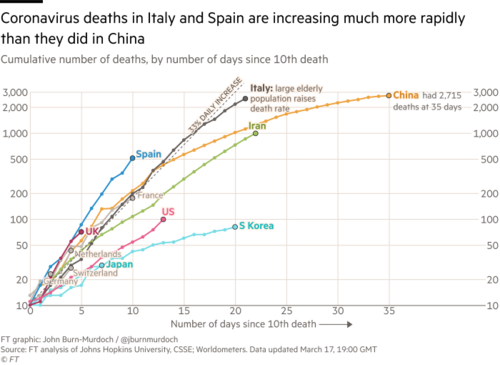
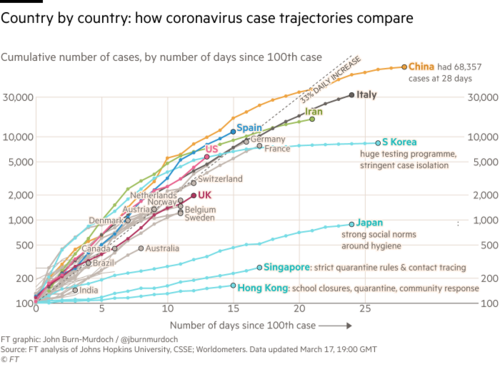
I repeatedly see people making the comparison between average ages and CFR between Italy, China, US, and trying to make the argument that it can’t really be that bad because of how it spread in X country. It’s more complicated than that. First, you are failing to take into account population demographics. The average age of the population is much higher in Italy, so yes you would expect there to be more mortalities there and the average age of mortalities to be higher. You can not simply extrapolate that to all populations where the demographics are different. There are different health factors, lifestyle differences, genetic differences that can manifest in differential mortality in populations.
When looking at disease curves, you also have to consider cultural differences. In many other countries, including Italy, it is extremely common to have three or even four generations living together in close quarters under one roof. That is going to result in a much different transmission pattern than in places where that is not a common living situation. Conversely, having a population of people who are resistant to social distancing practices will also alter the transmission curve, and not in a good way. It is not as simple as comparing X country to Y country and saying “See? They are different (or the same).”
As for why this virus is different than past viruses that have been in the news... it takes a special combination of a susceptible naive population, infectivity and transmissibility. Those depend on the specific little bits of genetic material unique to each virus. There is some evidence that a virus very similar to the H1N1 virus had circulated decades earlier, so there was some level of immunity present in the segments of the population that were alive and exposed to that earlier event. The others (SARS for example) just didn’t transmit super efficiently through the population, which made it relatively easy to stop. This one happens to have the right combination of characteristics to make it bad...highly transmissible, has not previously circulated in humans so the human “herd” in general has no immunity, and it happens to cause relatively significant respiratory disease in a higher than usual proportion of the population. So why is this virus different from those others? Because it has different mutations that give it different characteristics than those other viruses had. This is normal...more dramatic but no different than having different flu strains every year. Some are worse than others...depends on the mutations each virus possesses and whether the population has previous exposure or not.











 ) make the call.