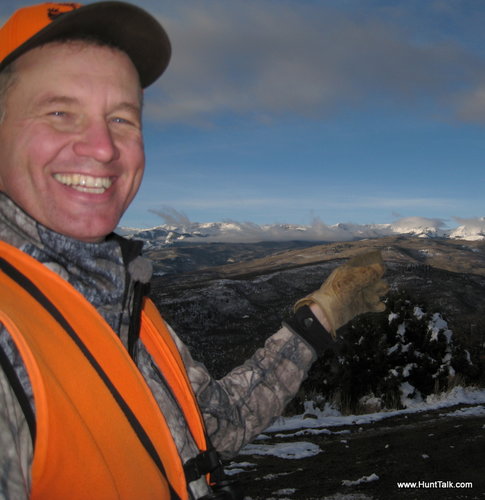
This is me pointing to the spot where the Colorado bulls were bedded. Picture cropped heavily from the right, to remove a very recognizable spot. Don't want Dinkshooter sending his mafia boys to remove my pearly whites.
I'm laughing to the camera guys that nobody would drive off this ridge and climb up the opposing ridges to shoot one of those bulls bedded on the closest faces. At the time of this photo I had dialed the scope back to low power and all the bulls were in the FOV. The crew of four Michiganders had just left and remarked how someone would be out of his mind to shoot anything in that location, let alone something as big as an elk.
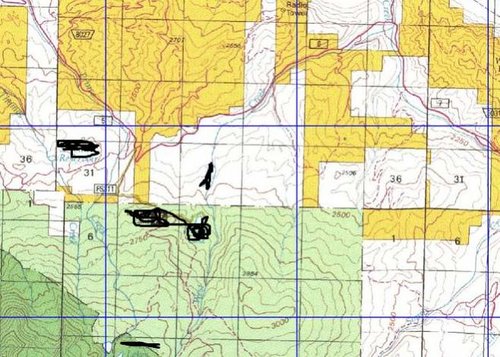
In those five days of deer hunting, I spotted eight legal bulls scattered across the public lands shown in this screen shot. One was a very nice 6-point that I would be very happy to shoot on any OTC unit. The others were 5-points or raghorns. I look for places like this map shows.
I spent years making elk hunting a very complicated endeavor. Doing the TV show has forced me to simplify and not over-think it. I have five days to sort it out, figure it out, and hopefully pack one out. Now that I've simplified, I see a lot more elk in late rifle hunts.
I go by this "Golden Rule of Elk Hunting," at least the way I elk hunt elk -
Where hunters are, elk aren't.
Elk avoid hunters. It's really that simple. They survive by learning to avoid hunters. Those elk that don't learn the skill get taken out of the gene pool rather quickly. They avoid hunters by heading to places with low hunting pressure. In the west, you find low hunting pressure on public land in two ways.
First is terrain that makes most people contemplate the effort required and they then decide they don't want an elk quite that bad. Elk know small spots where they can make a living and get through season. They use these same spots year after year. It might be a small bench that interrupts a bunch of contour lines. It is most likely going to be two miles from the nearest motors. And it is probably going to have a nasty chunk of terrain or timber nearby so they can make a quick exit.
Second, elk go to places with a lot of private that is hard to navigate. Show me a place with a public-private complication, and that is where I am going to look first. I will look there even before I look in places where terrain might concentrate bulls. These elk are usually less disturbed, most often an older age class because of the protection private lands provide them each hunting seasons and quite often is much easier terrain, even if the distance required is double or triple.
This map has some of both. The places I find elk on public land look a lot like this map. Most people don't want to screw with the access complications or make big loops to get around the private pieces to where the elk are hanging out on public.
Bulls are way different than cows this time of year. Finding cows is pretty easy. But, if you are hunting bulls, cows don't do you much good, unless one straggler raghorn is still running with the crew. Bulls will be higher up the ridges. Bulls will be in areas that don't require a lot of food or water. They want to stay alive, even if it means being hungry. If I am finding cows in a late season hunt (Nov-Dec), I look higher up the mountain for bulls.
A lot of times I am glassing for tracks in the snow. I don't want a big herd of tracks. Those are cows and calves. I'm looking for a string of 2-5 sets of tracks. And I'm not looking for tracks that are lined out like they are headed to Mexico for winter. I look for those couple sets of tracks that are milling around and looking for feed. Those elk are somewhere nearby. I might not see them that day. If I come back for two or three days and I am on the glass at the low light hours, odds are I will find the bulls that made those tracks.
Whether it is terrain or distance, it really comes down to the fact that most hunters don't want to spend a day or two retrieving an elk. If you think about it, what else did you plan to do for the next day or two? Seems the end goal is to get the chance to spend a couple days packing out an elk.
I copied and pasted the above text from a couple paragraphs in the book we are writing. The publisher thinks it will be ready in Jan/Feb. In addition to the normal stuff you read on Hunt Talk, there are going to be five small sidebar segments. They might be short chapters. They are titled, "The best public land elk hunters you've never heard of."
Right now, three Hunt Talkers have agreed to be interviewed. I am taking recommendations for a couple more guys who are public land elk killers; people who fly under the big publicity radar and probably forget more about public land elk hunting each morning over coffee than I will ever know in my life.
If you have names of some great "under the public radar" elk hunters I should interview, or questions you want me to ask them, let me know.






 Or maybe it's the prickers and cactus sticking me through my flip flops :hump: