Under mattresses too.
But to Eric's point, that money spent on outfitters does circulate in the local & regional economy. Trucks, food, etc all come into play as do wages & increased traffic. I think we need to be honest about that and recognize the value that outfitters have to MT's overall economy through diversification of revenue rather than placing the majority of your eggs in one basket like some states. We also need to be honest about what that impact actually is, what the hunting outfitters contribute versus fishing outfitters, and what DIY NR's bring to the table as well (Likely as much per person, but spread out differently among small businesses in key areas).
I posted this link to the study on another thread, but it might be useful here.
https://scholarworks.umt.edu/cgi/viewcontent.cgi?article=1376&context=itrr_pubs
My main problem with the study is that the data was collected through a dual survey- one sent to outfitters and one to NR visitors. The outfitter data probably
should be more accurate because they have books for tax reasons. But the study sites some answers that seem way off, like an outfitter who answered # of clients at 9,999 (max allowed). Even a rafting operator running 10 boats each day would have trouble getting to that number, so questionable answer. A survey sent to a visitor is just going to contain guesses. We know surveys are inaccurate for a lot of reasons.
The table below is a summary at the front.
As expected, the Outfitter, Guide category is the main driver of the difference (about 60%). Point of question, are "tips" included in the numbers. I would guess for visitor responses it does, but for outfitter responses, probably not. Don't take offense if you are an outfitter, I just assume everyone cheats on their taxes. The average expenditure in the outfitter number is probably low by 50% of the "tip", or lets call it $40-50.
Some numbers in the table make sense, some don't. I think it comes back to those numbers for visitors that hire an outfitter are skewed by fishing and hunting as the purpose. Keep in mind the data is for all NR visitors to Montana, not just hunters. It includes rafters, fishers, and just general vacationers. Glacier and Yellowstone visitors are 40% of all visitors who hired an outfitter. One table says 2% of Outfitter visitors (17,400) were for hunting while table on page 18 says 4% of visitors hired an outfitter for hunting while 3% of all visitors. (again, I question the survey responses when data starts to deviate and not tie back to other numbers).
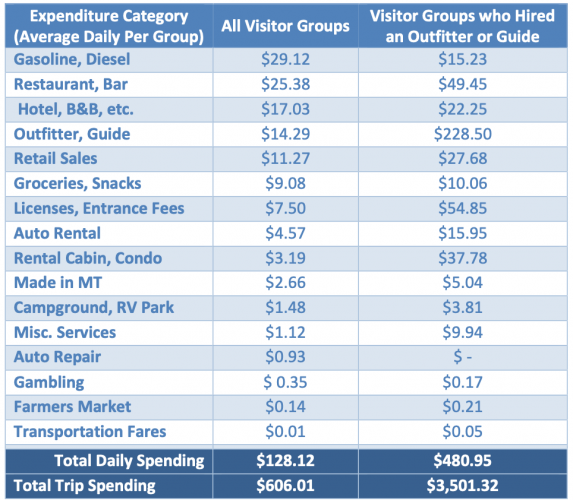
The only answer I have for that is economics, outfitted clients bring far more "bang for the buck", literally, than do unguided NR hunters. It is an indisputable fact. Even were I not involved with outfitting I would much rather see a NR have to leave maximum dollar. As a resident sportsman I see the NR as a "taker", you come to Montana and take something of "ours" home with you. If you are not making a large economic impact, why should we have you? I will not disparage that NR's who are not guided make an impact economically, but at 5-7 unguided, vs.1 guided, no comparison to the benefit for Montana.
As you can see above, everything in economics can be disputed. In this case, I don't dispute those that those hiring an outfitter spend more, but it mostly goes to the outfitter and shouldn't be used to drive legislative actions. That does not negate the conclusion of the importance of outfitting, but speaking in broad terms about positive economic impact is questionable at best in terms of the bill being discussed. We don't have data to compare NR hunters.
The paragraph below (page 5) is in the study about HB 161. Not sure how they concluded this but it was interesting in terms of this discussion.
Perhaps the first example of regulating guided activities was the I-161 initiative passed by the voters of Montana, 53.8 percent to 46.2 percent in 2010. I-161 was a citizen-initiated state statute to increase nonresident big game license fees and abolish outfitter-sponsored licenses. Until then, hunting outfitters were guaranteed a certain number of licenses for their clients. Clients paid almost double the price of a nonresident fee for that guarantee. Ultimately, Montana FWP lost revenue from nonresident licenses until 2017. The intent by many backers of I-161 was to open private lands to hunting by residents but it appears the opposite affect happened.