


Floating an idea, don't kill the messenger

Show me the numbers that verify your statements about revenue being less than administration please.
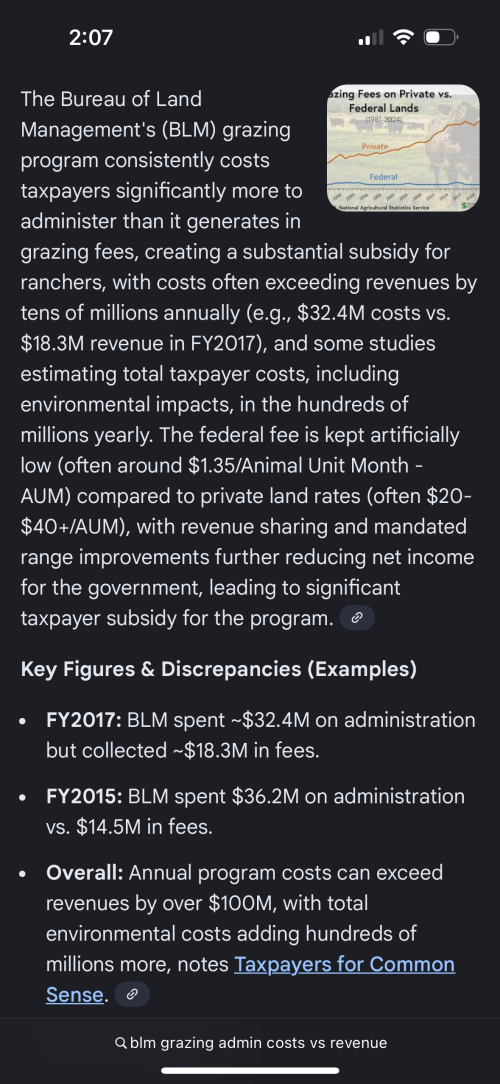
Seriously? Very, very well established and documented fact. Here’s a brief synopsis from Google, you can do further research yourself if you actually care to learn something. Might be a good idea before you start spouting off without knowing what you’re talking about.

IMG_7709.png
Aldo, I also am not a rancher or grazer and have zero cares about people “paying less than me”. Not sure where you got that idea. You aren’t making any sense.
 
1.35 per AUM is absurd
Thinking the federal gazing fee should be the same as private land is wrong, as it does not take into account the big differences.
Many public land ranchers need to take a long hard look and realize that while locally their contribution to the economy is big nationally they are a drop in the bucket
 
1.35 per AUM is absurd
Thinking the federal gazing fee should be the same as private land is wrong, as it does not take into account the big differences.
Many public land ranchers need to take a long hard look and realize that while locally their contribution to the economy is big nationally they are a drop in the bucket
Exactly. Like I said above, there is a ton of wiggle room between the 1934 rate of $1.35 or whatever, and 2026 market rate.
 
Seriously? Very, very well established and documented fact. Here’s a brief synopsis from Google, you can do further research yourself if you actually care to learn something. Might be a good idea before you start spouting off without knowing what you’re talking about.

View attachment 399109
Aldo, I also am not a rancher or grazer and have zero cares about people “paying less than me”. Not sure where you got that idea. You aren’t making any sense.
I did just google it and you are correct! Im certainly not too proud to say i was very wrong on this subject. It seems that lease fees should about double to end up at net zero. I cant imagine ANY cattleman anywhere having an issue with that. I know i sure wouldn't and i will be one of them paying. Something that most dont realize is that our entire food supply is kept artificially low due to govt subsidies. Therefore, anyone wanting to raise these grazing fees should also be onboard with cutting other subsidies which could have a drastic impact on food prices across the board. People complain so much about what food costs now that i cant imagine what would be said if this were to happen. You would pay “premium organic” prices for the garbage coming out of the grocery store and organic prices would be out of reach for many. Truly, thank you for enlightening me to this fact about it costing tax payers money to lease these lands! I had no idea. I did speak to my daughter in law who comes from a farming family in montana (and why we are heading that direction). She said the main source of contention on the western side is big corporate money coming in and buying these plces to develope that have BLM leases attached to them. I dont know what that means exactly and she couldnt explain how that effected anything other than the prices they are willing to pay driving up lnd costs that actual producers cant compete with. Again, my apologies for not fully understanding the subject matter at hand!
 
1.35 per AUM is absurd
Thinking the federal gazing fee should be the same as private land is wrong, as it does not take into account the big differences.
Many public land ranchers need to take a long hard look and realize that while locally their contribution to the economy is big nationally they are a drop in the bucket
Can you give us some examples of the "big differences?" Not disagreeing with you, but I want to hear what you think those are.
 
Can you give us some examples of the "big differences?" Not disagreeing with you, but I want to hear what you think those are.
Of course it is very site specific but in most places the better land with a higher capacity for forage was homesteaded and the least desirable eventually became public.
If I graze on private and the landowner and I decide that additional infrastructure (water, fence) is needed we can just go do it with no analysis, archeological reviews etc to be completed.
My main point was just because the private grazing in Montana or wherever is x amount of dollars than that is what the federal should be. In most cases it is an apple to oranges comparison
 
Of course it is very site specific but in most places the better land with a higher capacity for forage was homesteaded and the least desirable eventually became public.
If I graze on private and the landowner and I decide that additional infrastructure (water, fence) is needed we can just go do it with no analysis, archeological reviews etc to be completed.
My main point was just because the private grazing in Montana or wherever is x amount of dollars than that is what the federal should be. In most cases it is an apple to oranges comparison
There is a whole rabbit hole regarding forage production as it relates to soil types, plant species composition, etc on any given unit. It isn’t unusual for this to factor into rental rate calculations, and seems like a reasonable way to do it.
 
Hunting Wife do you have any prediction about what grazing leases might do going forward esp. with the current cattle prices?
 
Hunting Wife do you have any prediction about what grazing leases might do going forward esp. with the current cattle prices?
I’m not super in tune with markets and rates, other than what’s required to do my job. But the average rates published by National Ag Statistics Service, which are kind of an index of private land rates, have increased every year for the past few years. If prices keep going up, I would expect private rental rates to keep tracking. Obviously the public lands subject to Taylor Grazing Act rates won’t change much, if at all. I’ve only seen private rates decrease once or twice, when markets were really tanked. Someone whose bread and butter is ag probably could give you a better answer.

For simplicity, here’s what they look like for Montana. You can get data nationwide from NASS (USDA) but it’s harder to digest.


Edit: These rates do somewhat factor in the differences in land values and forage production you were getting at earlier. If you look at the national data, you’ll see variations by state, and then again at the county level.
 
I’m not super in tune with markets and rates, other than what’s required to do my job. But the average rates published by National Ag Statistics Service, which are kind of an index of private land rates, have increased every year for the past few years. If prices keep going up, I would expect private rental rates to keep tracking. Obviously the public lands subject to Taylor Grazing Act rates won’t change much, if at all. I’ve only seen private rates decrease once or twice, when markets were really tanked. Someone whose bread and butter is ag probably could give you a better answer.

For simplicity, here’s what they look like for Montana. You can get data nationwide from NASS (USDA) but it’s harder to digest.


Edit: These rates do somewhat factor in the differences in land values and forage production you were getting at earlier. If you look at the national data, you’ll see variations by state, and then again at the county level.
Thanks, just starting to hear about guys keeping heifers much higher than the recent drought years, Grass had been a premium before but herd numbers had decreased. So it had somewhat balanced out.
 
It has long been a concern (at least to me) that "non-consumptive" users to not pay their way in terms of the use of the Federal public lands. Many states too.
Whereas P-R and D-J funds from hunters, shooters, boaters, and fisherman fund a lot; hikers, bikers, snowmobilers, et. al. do not contribute.

Efforts to create a "backpack" excise tax have been killed by the industry lobby time and again. How do we get everyone contributing? Why should we pay the rent for the freeloaders?

I have heard of some non-consumptives who do buy a duck stamp, but it is not required.

Since all entrants to National Park and USFWS managed lands pay access fees, I wonder about the idea that USFS and BLM institute a permit or stamp based system for access to their lands. Would hunters pay $10-$25 per year for a USFS or BLM access stamp? Could PR and DJ payer somehow be exempted. (In Idaho, hunting license holders are free to access IDL managed lands.)

Many if us pay for access to State or Corporate lands. Would there be social acceptance of a permit system for Federal lands access?

I understand this is in some ways a double impact on those who are already paying excise taxes. I realize that compliance would be as bad or worse than Duck Stamp purchase for USFWS land.

Both P-R and D-J were started first within the sporting community before the became law. Is there enough grass to get the attention of Federal Land Managers or Congress for this.

There earmarked revenue potential from this could be quite high.
Id definitely pay as long as the revenue went to the right place
 
I am not on board for ANYONE paying any more than what we already do. I feel that we are ALL being taken to the cleaners by the government as it currently stands.

More permits and taxes and more fee's is just more government tyranny that NONE of us need (or should want) in our lives and it does nothing but create division and animosity amongst groups of people. Besides, your kidding yourself if you think they will use the money for what it was intended for instead of just pi$$ing that money away with pet projects/secret backdoor programs.

Now, if you want to fight for LESS Permits and LESS government involvement in our lives, most of us can get on board with that. Give the government an inch and they take a mile and they wont give $hit back to you.
I agree 100%
 

Latest posts

Forum statistics

Threads
118,357
Messages
2,190,538
Members
38,524
Latest member
Hall's Armory
Back
Top