The original post focuses on elk. And, the original post focuses only on opportunity, which many feel is measured by tags sold.
Should we focus on the number of "hunters/tags issued, per elk" on the public lands or "number of hunters per million acres of accessible lands" rather than just total tags sold (opportunity)? I would argue most Hunt Talkers would equate one of those criteria to the quality of their experience and most on this site would focus on animals available on accessible public lands, not animals on private lands.
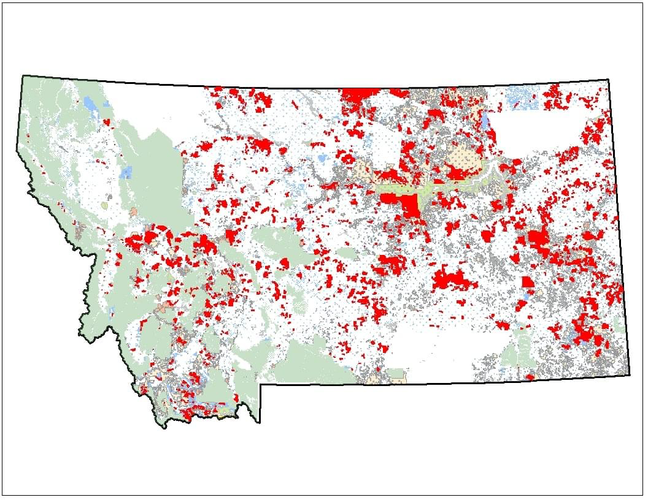
For the states with no limits on residents, the numbers below show it is more crowded each decade, if we can assume the new arrivals hunt in the similar proportions as the residents did in 1990, the base line year. I feel it in Montana. Since we cap non-residents (mostly), the added pressure I sense on public land is mostly from resident growth. And, likely combined with displacement of people who previously hunted private land who lost that access and are now hunting public land.
For states with limits on residents (AZ, NM, NV, somewhat CO) these numbers below show how much more resident competition there is for tags. Which, adds to the opportunity problem an individual hunter feels, as a tag every ten years is less opportunity than a tag every four years.
Do we think that animals numbers have kept up with the population growth (and likely resident hunter growth) shown in the charts below? Surely not for mule deer and antelope. Not for public land elk, though possibly private land elk has kept pace. Sheep, in states I apply to have went the other direction, as have moose.
Given the pressures population growth places on habitat I suspect animal numbers have peaked and are likely to go down, if they haven't declined already. We have seen studies that show how much general recreation impacts wildlife, so even if these new residents don't hunt and only bike or hike the impacts on wildlife are still there.
Given how changing land ownership trends closes more lands previously open to hunting, I suspect more lands will be closed to hunting, putting higher hunter densities on public lands.
Add fewer animals on public land, with more resident hunters and more competition for limited entry tags, and I suspect many would feel that the quality of their opportunity has decreased. Even if the actually quantity of the public land tags sold (opportunity) is higher than it was 20 years ago. In some instances, it is a loss of both quantity and quality of the opportunity, and that happens way more than increased quantity and quality of opportunity.
I know that sounds like "Back in my day" and to some degree it is. Hopefully with the population chart below, it is supported by something other than just my gut feeling or another old gray hair wanting something to complain about.
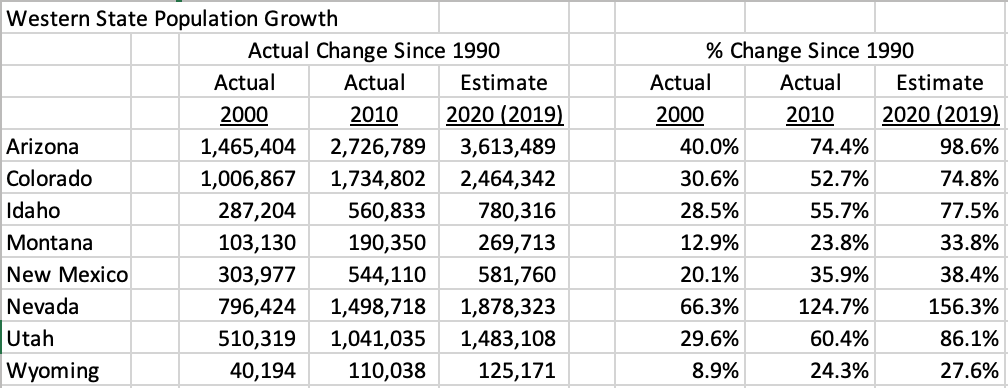
In the last 30 years we've added over 11 million residents in these inter-mountain states, or 82%. Given what I've seen since the 2019 census estimates projected in June 2019, I suspect those numbers are even higher today (November 2020).
The rate of growth in these inter-mountain states is some of the highest in the country. That seems to add even more pressure to the points mentioned herein.
Questions arise in my mind:
- How do we increase numbers of accessible elk (and other game) on public lands?
- Is it possible to find ways to get access to elk or other animals on private lands when trends are to closing more lands?
- When will the OTC states for residents be required to consider ways that reduce resident crowding or hunting pressure; or will they ever consider such?
My focus has been to focus my energy on helping put more elk, sheep, deer in the hills. Or in some cases, to slow rate of decline among the wild things. Given our country can't have discussions about population growth (from all sources), I join with many on this forum who feel conservation efforts are the best remaining option to improve/sustain hunting opportunity.