BigHornRam
Well-known member
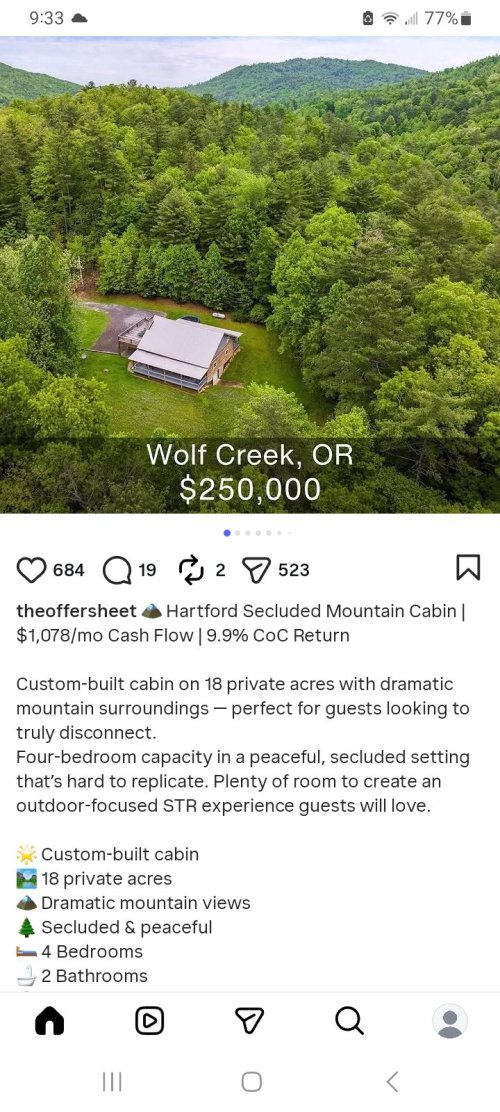
The interior looks as nice as the exterior. Curious what the property taxes are on it?



Follow along with the video below to see how to install our site as a web app on your home screen.
Note: This feature may not be available in some browsers.

Is it still full of smoke after the burning of thousands of acres of crops at times? Some fungal issue I believe was the reason. Back in the 80's is my reference point though.After your post, I watched a few YouTube videos about the Willamette Valley. It does look beautiful.

Based on what they wrote, I’d steer them toward the Willamette Valley and its foothills first, rather than trying to scout all of Oregon and Washington in one Christmas trip. It matches a lot of their wish list: small towns, rural property, green country, comparatively mild winters, proximity to Portland without actually living in Portland, and much less of the Gulf Coast combination of oppressive humidity, mosquitoes, and hurricanes. The tradeoff is a long gray/wet season—the Willamette Valley officially has mild, wet winters and warm, dry summers.


For a Christmas scouting trip, I'd give them this short list:
I would also spend one scouting day in southwest Washington—probably Battle Ground → Yacolt → Amboy → Woodland. That gives them an Oregon-versus-Washington comparison without going far from Portland. Rural Clark County gets surprisingly country once you're north/northeast of Vancouver.
- Yamhill / Carlton / rural McMinnville area — Probably my #1 starting point for what they're describing. Get outside McMinnville and it turns rural quickly. Yamhill and Carlton are genuinely small, and there are farms, wooded foothill properties and acreage all around them. You're roughly in the Portland orbit without feeling like you're living in suburbia. I'd especially drive the back roads west and northwest of Yamhill/Carlton and toward the Coast Range rather than just looking at houses in town. Carlton itself is small enough that places such as Carlton Corners have that diner/gas-station/local-hangout combination that's useful for getting a feel for the community.
- Sheridan / Willamina — I'd definitely add these if they're looking for more land for the money and don't care about having a polished wine-country town outside the door. They're farther west, toward the Coast Range. The country around them is beautiful, wooded and considerably more rural. The warning is that services and medical care become less convenient. That's something I'd investigate seriously for retirement rather than treating it as an afterthought.
- Dallas / Falls City / west of Monmouth — This would be my sleeper pick. Dallas is large enough for everyday necessities but still nothing remotely like Houston, and the country west toward Falls City gets rural very quickly. It's also a reasonable jumping-off point for Salem when they need something a small town doesn't have.
- Silverton / Scotts Mills — I'd put this very high on the list. Silverton is an unusually nice small town with actual restaurants, shops and services, while the surrounding countryside toward Scotts Mills and the Cascade foothills can feel very rural. Spend an afternoon walking Silverton rather than just driving through; something like Fin+Fowl Kitchen makes a good lunch stop. Then drive northeast into the countryside. Scotts Mills is particularly worth scouting if their mental picture is "house with some land, trees, quiet, but civilization isn't an expedition."
- Stayton / Sublimity / Lyons — Another good compromise between rural life and services. Stayton/Sublimity are more practical and less touristy than wine country. Head east and it gets prettier and more wooded as you approach the Cascades. Stop in downtown Stayton—Canyon Coffee would be an easy place to sit for a while and observe normal small-town life.
- Estacada / Molalla / Colton — These are worth investigating specifically because the son lives near Portland. They're southeast of Portland, with plenty of genuinely rural country nearby. Colton might particularly appeal to someone who thinks being 60 miles from Houston is still too close. The important question becomes exactly where the son lives around Portland, because crossing the metro area can turn "only 40 miles away" into something considerably less convenient.
There's a potentially meaningful retirement tax difference too. Oregon taxes pension and most other retirement income, although it doesn't tax Social Security. (Oregon) Washington currently has no general individual income tax; under legislation taking effect in 2028, a 9.9% state income tax applies above $1 million of annual AGI. (Washington Department of Revenue) Washington also has property-tax relief programs for qualifying seniors, with county-specific income thresholds. (Washington Department of Revenue) For a retired couple with substantial pension/IRA income, I'd actually run the numbers before deciding which side of the Columbia to buy on.
One thing I'd tell them to do differently on this trip: don't spend all their time touring houses. Christmas is almost the perfect time to discover whether they can tolerate western Oregon/Washington. Drive the prospective area at 4:30 PM in drizzle. Go to the grocery store. Find the hospital. Check cell reception at rural listings. Ask how long the power was out during the last ice/wind storm. Look at wells, septic systems, generators, road maintenance, wildfire exposure and whether a steep driveway becomes a problem in ice. And ask themselves, "Would we still like this place in February?" If the answer is yes, they'll probably love the summer.
If I were plotting their first serious reconnaissance loop, I'd do McMinnville → Carlton → Yamhill → Sheridan → Dallas → Silverton → Scotts Mills → Stayton, with little detours down county roads whenever the country looks appealing. That's a very good cross-section of the northern/central Willamette Valley without wasting the trip bouncing hundreds of miles around the Northwest.
One other thought: don't automatically reject a town of 10–20,000 people. For retirement, being 10 minutes from groceries, doctors and an emergency room while having five acres 5–10 miles outside town can be a much better arrangement than being truly remote. They can still have chickens, a shop, garden, tractor, woods and no neighbor in sight without making every medical appointment a 90-minute expedition.
Willamette is Kalapuya for "Valley of the sick" It's the grass seed capital of the world. If you have hay fever, you'll hate life May through August. Other than that, it's beautiful. Banana belt temps with only 30 more days of rain a year than San Francisco. And you forgot the Umpqua River. 2nd largest by volume after the Columbia. Smallmouth abound.Man, the Willamette valley isn't getting enough love. It's beautiful. The rivers that flow from the westside of the cascades are incredible from the Molalla to all the Santiams, the Sandy and Clackamas, the McKenzie and Willamette. And the rolling oak topped hills with snowy peaks in the background, and the coast only an hour over the hill.

My grandmother spent her last decade of life in Salem. I remember a couple of MISERABLE trips in June because of hay fever.If you have hay fever, you'll hate life May through August.
From burning the grass stubble after harvest. Used to happen all the time on the Palouse as well.I remember smoke covering the valley for days, from fires i was told were intentionally set every year.


Weird stuff happens in Wolf Creek... Beautiful area though.The interior looks as nice as the exterior. Curious what the property taxes are on it?
View attachment 416315

I think with the mild winters in that area, my wife and I will be good. The cool, wet weather I am familiar with, visiting my son near Portland.Weird stuff happens in Wolf Creek... Beautiful area though.
@Greybeard what kind of winters are you ready to endure? The Willamette Valley and SW Oregon will be fairly mild. Have to cross to the east of the cascades for real winter. The Willamette valley is way nicer than people give it credit for. There are almost twice as many people in the greater Houston area than in all of Oregon. Portland isn't nearly as bad as it's portrayed. Food scene is really good there. There are a ton of cute little towns with a population center nearby offering amenities/ services.
Spend some time around McMinnville, Dundee, Yamhill county, south of Portland west of I5, North of Salem. Bet you like it.