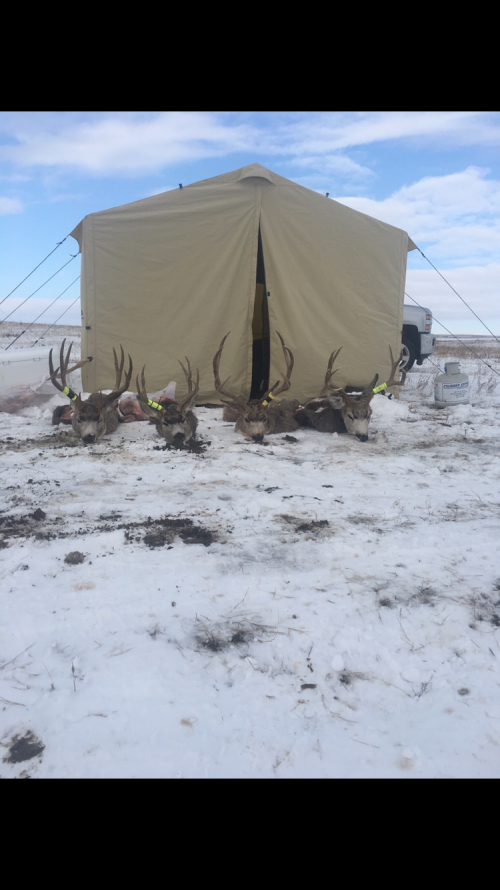
Mule deer are delicious. This is an atrocity.
Instead of guessing or speculating what well managed herd looks like. I just sent an email off to Dr. Monteith to get his take on age structure within a mule deer herd. He's more qualified than anyone on this thread in terms of credentials.
"Thank you for the response, Kevin. I have another question regarding Mule deer that is a hot topic on the hunttalk.com forum. Many Montana residents are critical of the MT FWP's management of mule deer and their liberal season and tag structure. Concerns raised are anything from shooting too many does. Shooting too many small bucks, not letting bucks mature, not seeing enough big bucks, etc.
What is the biological preference? Based on things I've heard you say, my assumption is that there is a benefit to having mature mule deer does on the landscape. They pass on the knowledge to offspring; I would assume that holds true even in populations that don't migrate in the more popular sense that we hear about (Wyoming's Migrations). But is there also a benefit to having mature bucks in a population? What is that ratio? What is that benefit? Is there an optimal management style (tag and season structure) to succeed if that is one's goal?"
Dr. Monteith got back to me today. His response to my question (above) is below.
"Hi Brock,
All solid questions, and to be honest, most comes down to societal desires perhaps.
Female harvest, as controversial as it may be in some places, can do good things for populations by reducing density and reducing competition for forage. Sure, as you note, having females be present to teach their offspring potentially how and where to migrate etc., can be important. So, how harvest occurs or is executed probably should play into that biology.
As to adult males, it really all depends. Reality is, it takes few males to maintain pregnancy rates in populations. So, from that biological aspect, it doesn’t matter too much. Having adult males present may reduce some of the rut-related costs in young males and females because adult males may harass less (note, jury still out on how much that matters), and adult males may serve some role in priming estrus of females. Often, desires to maintain mature age structure of males is driven by stakeholder desires, and yes, there can be some benefits to populations perhaps but generally at the same time, even few and mostly young males can serve their primary biological role. Point is, there really isn’t a magical number, if that makes sense?
Hope that helps just a little?
Best,
Kevin"