If you want to know what our AI overlords suggest:
Addressing shortages in the
Colorado River requires structural reform across hydrology, law, infrastructure, and agricultural economics. The system is chronically overallocated under the 1922
Colorado River Compact, and climate-driven aridification has reduced mean flows by ~20% over the last two decades. This is not a cyclical drought problem; it is a structural supply–demand imbalance.
Below is a disciplined framework organized by leverage and impact.
1. Fix the Allocation Framework (Law + Governance)
A. Renegotiate the Compact Allocations
- The Compact assumed ~16.4 MAF/year average flow; modern estimates are closer to 12–13 MAF.
- Basin states (Upper: CO, UT, WY, NM; Lower: CA, AZ, NV) must rebase allocations to hydrologic reality.
- Replace fixed volumetric entitlements with percentage-of-available-supply allocations to reduce litigation risk during low-flow years.
B. Prioritize Seniority Reform in the Lower Basin
- California’s senior rights dominate Lower Basin allocations.
- Develop compensated curtailment mechanisms rather than uncompensated priority enforcement, which destabilizes interstate politics.
2. Aggressively Target Agricultural Demand (Biggest Lever)
~70–80% of Colorado River water goes to agriculture, including high-water crops in arid regions (alfalfa, hay).
A. Expand Voluntary, Compensated Fallowing
- Pay irrigators for rotational fallowing (short-term, compensated).
- Scale successful models from the Metropolitan Water District of Southern California and Arizona water banking programs.
B. Reform Crop Incentives
- Discourage export-oriented alfalfa production in desert basins.
- Incentivize deficit irrigation and higher-value, lower-water crops.
C. Modernize Conveyance Infrastructure
- Line leaky canals (e.g., All-American Canal precedent).
- Upgrade flood irrigation to drip or micro-sprinkler where agronomically feasible.
Note: Efficiency gains alone do not “create” water if conserved water is reallocated; accounting rules must ensure true consumptive-use reduction.
3. Urban Conservation and Reuse (Second-Tier but Necessary)
Urban use is ~15–20%, but politically visible.
A. Permanent Turf Removal
- Eliminate non-functional turf in desert cities (Las Vegas model).
- Las Vegas has demonstrated aggressive per-capita reductions through turf buybacks and return-flow capture.
B. Wastewater Recycling (Indirect & Direct Potable Reuse)
- Expand advanced treated wastewater reuse in:
- Orange County’s groundwater replenishment system is a proof-of-concept model.
C. Tiered Water Pricing
- Steep marginal pricing for high-volume residential users.
- Protect essential indoor use; penalize ornamental outdoor consumption.
4. Stabilize Reservoir Operations (Lake Mead & Lake Powell)
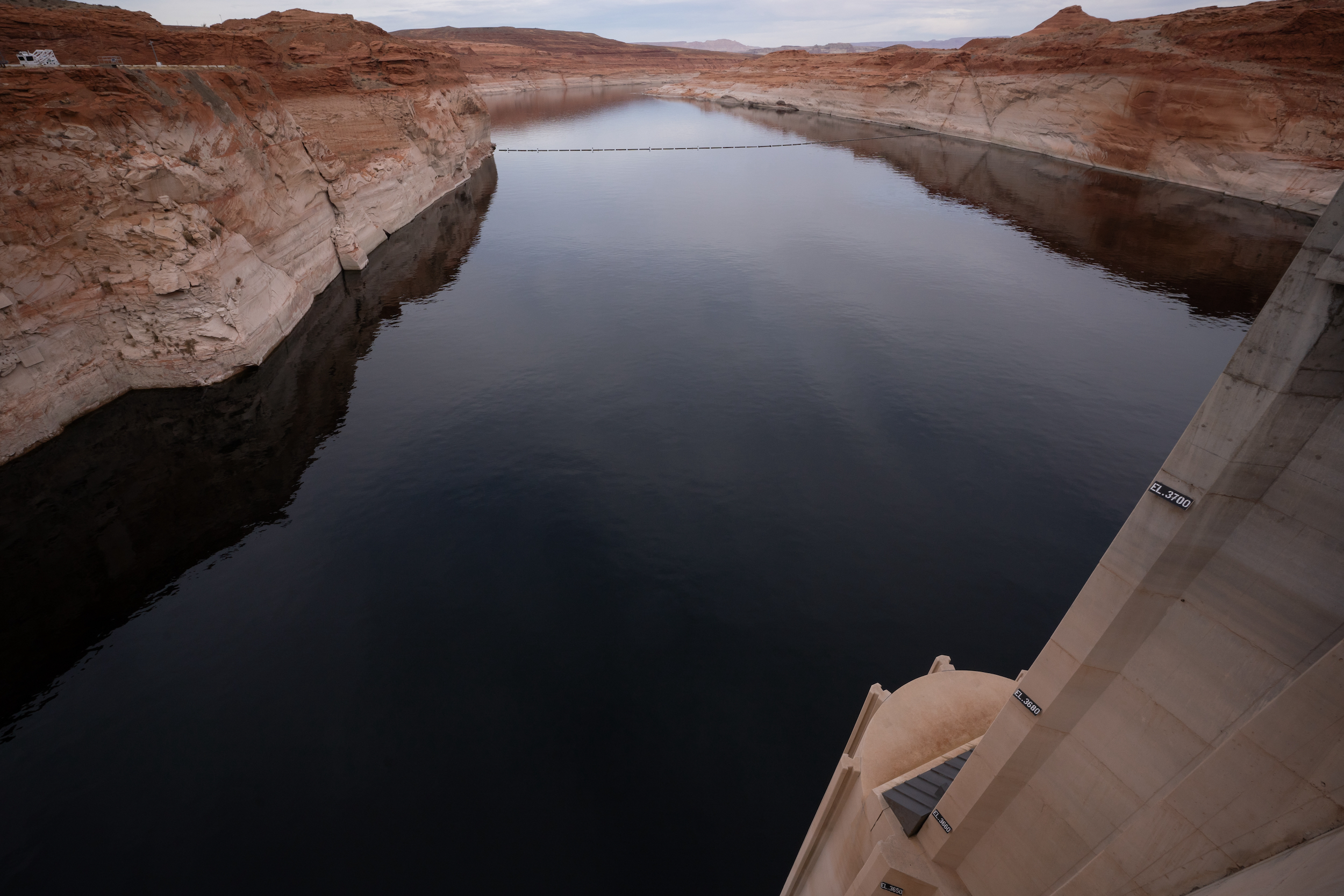
The crisis manifests at:
A. Protect Minimum Power Pool Levels
- Maintain elevations that preserve hydropower generation at Hoover and Glen Canyon dams.
- Coordinate Upper–Lower Basin releases to prevent dead pool risk.
B. Reevaluate Two-Reservoir Strategy
- Consider concentrating storage in one reservoir (hydrologic and evaporation analysis required).
- Reduce evaporative losses (≈1.5 MAF/year basin-wide).
5. Develop Supply Augmentation (Limited but Strategic)
These are expensive and energy-intensive, but part of a portfolio.
A. Desalination Partnerships
- Explore binational desalination with Mexico near the Gulf of California.
- Exchange desalinated water for reduced Colorado River withdrawals.
B. Brackish Groundwater Treatment
- Expand inland brackish desalination in Arizona and Texas-adjacent basins.
C. Stormwater Capture
- Urban aquifer recharge during episodic atmospheric river events.
6. Demand Realism: Accept Permanent Aridification
Paleoclimate records show the 20th century was anomalously wet. Policy must assume:
- Lower mean flows
- Higher evapotranspiration
- Greater interannual volatility
Planning targets should be based on the 10th–20th percentile hydrologic scenarios, not historical averages.
What Would Actually Move the Needle?
Ranked by real impact:
- Agricultural compensated reductions
- Compact reform tied to actual flow
- Permanent structural urban conservation
- Reservoir re-optimization
- Supplemental desalination (last resort)
What Would Worry Me Most
- Interstate litigation replacing negotiated reform.
- Collapse of hydropower at Glen Canyon → revenue loss for basin environmental programs.
- Rapid Upper Basin development increasing consumptive use just as supply declines.
If you want, I can:
- Quantify approximate MAF savings from each lever.
- Break this down by state (e.g., Arizona vs. California vs. Upper Basin impacts).
- Focus specifically on implications for Washington State agriculture and West-wide water markets.