Glen Canyon

The pact doesn’t expire, just the 2007 interim guidelines and subsequent agreements. Which would just push management back to 1970s rules which still favors the upper basin, IMO. The BOR wouldn’t allow management under those 70s rules, which is what’s going to drive it to court. Somebody like Togie might know more and correct me.
Yes, I might have been a little too flippant. There was an agreement in 2023 that created some deadline for end of 2026. That seems like just a kick-the-can kind of thing. If this winter continues as it has, they will be fighting over nothing. It just seems crazy that as a society we still choose to use water on golf courses rather than on farm fields and classify requirements for low-flow utilities as being "woke".
 
The pact doesn’t expire, just the 2007 interim guidelines and subsequent agreements. Which would just push management back to 1970s rules which still favors the upper basin, IMO. The BOR wouldn’t allow management under those 70s rules, which is what’s going to drive it to court. Somebody like Togie might know more and correct me.

Yeah the Compact doesn't expire.

And I'm not the steeped expert like several of my co workers. It is the 2007 Interim Guidelines expiring this year and BOR just released the Draft EIS for Post 2026 Operating Guidelines. It's these guidelines that outline how the Basins/states will agree to operate in shortages. My cursory research shows the Post 2026 Draft proposing much steeper cuts and on a system wide basis, not just based on Lake Mead and the Lower Basin. They're kinda getting this ball rolling on their own with no agreement having been reached, so there won't be any falling back on the 1970's rules.

The current deadline for Upper/Lower negotiations is the 14th. And, who knows, they may be given another deadline after that as the Interim Guidelines expire at the end of the year.

If negotiations fail the BOR will go ahead and ram through the new Post 2026 Guidelines and then the states will most certainly start suing each other on the merits of the compact to get what they want instead.

At least that's my best understanding.
 
I mean, you and SAJ are alluding to the same thing.

However, the Compact is a congressionally ratified interstate treaty; it's not just some "agreement" and I would expect SCOTUS to treat it as such. The faulty hydrology used in the Compact and whether or not the expected production of the Colorado River was a wise estimate isn't the question that will be before SCOTUS.

Certainly, an agreement on cuts could be reached to prevent a legal battle on the merits of the Compact, but we're more or less past that point now. We'll see.

As far as water use being predominantly Ag in the upper basin? That's basically true anywhere you pull up water use statistics. And, we can all spend a minute or two googling the Imperial Valley if we want...
My current perception of SCOTUS is far less optimistic.
 
Yes, I might have been a little too flippant. There was an agreement in 2023 that created some deadline for end of 2026. That seems like just a kick-the-can kind of thing. If this winter continues as it has, they will be fighting over nothing. It just seems crazy that as a society we still choose to use water on golf courses rather than on farm fields and classify requirements for low-flow utilities as being "woke".
Water rights in the west are more akin to home ownership than county zoning. "We" don't have much say in how you exercise your water rights, as long as you follow the law. I, as an active water right practitioner, both professionally and personally, support the existing system as is. It's a vestigate of freedom that I'm not willing to give up. I see no reason why anyone would want a WY farmer to give up his livelihood so that Black Rock can pave over more desert around Vegas.
 
Water rights in the west are more akin to home ownership than county zoning. "We" don't have much say in how you exercise your water rights, as long as you follow the law. I, as an active water right practitioner, both professionally and personally, support the existing system as is. It's a vestigate of freedom that I'm not willing to give up. I see no reason why anyone would want a WY farmer to give up his livelihood so that Black Rock can pave over more desert around Vegas.

The only point of disagreement is that something has to change because we are getting to the point where the demand for water exceeds the supply.
There are hard choices ahead.
 
The only point of disagreement is that something has to change because we are getting to the point where the demand for water exceeds the supply.
There are hard choices ahead.

We're long past that point.

And pain will no doubt be felt.

I do like to think the states will come to some agreement. I think everyone benefits from Compact ambiguity. SCOTUS has never had to insert itself into the Colorado River Compact and getting components of the Compact permanently adjudicated/clarified could sting more than negotiated cuts. Who knows 🤷‍♂️

The ironic blessing is this horrific winter we're having - if we had a booner snow year it would likely just result in more can kicking.
 
My lower basin buddy sent me that article last night and I got a little flippant with him too lol. I told him 'if anyone is looking for Lake Mead it's buried in the deserts of Arizona AMA's'. He said 'that was our allocation, and we operated within the law'. And he's right, they did do that. But I did remind him that New Mexico has never once received our full allocation, so what a luxury that must be.

Physical reality lives relentlessly in the real world. We will hit the wall. But if the fact that the lower basin can't sustain itself on the lofty numbers ascribed to it in the 1922 compact while the upper basin uses like half that, and still the upper needs to contribute, is some logic I don't understand.
 
Physical reality lives relentlessly in the real world. We will hit the wall. But if the fact that the lower basin can't sustain itself on the lofty numbers exceeding the value ascribed to it in the 1922 compact while the upper basin uses like half that, and still the upper needs to contribute, is some logic I don't understand.

lemme fix that
 
The only point of disagreement is that something has to change because we are getting to the point where the demand for water exceeds the supply.
There are hard choices ahead.
We need houses too. Are you going to take mine and give it to someone else?

Water is a public resource. The use of water is not.
 

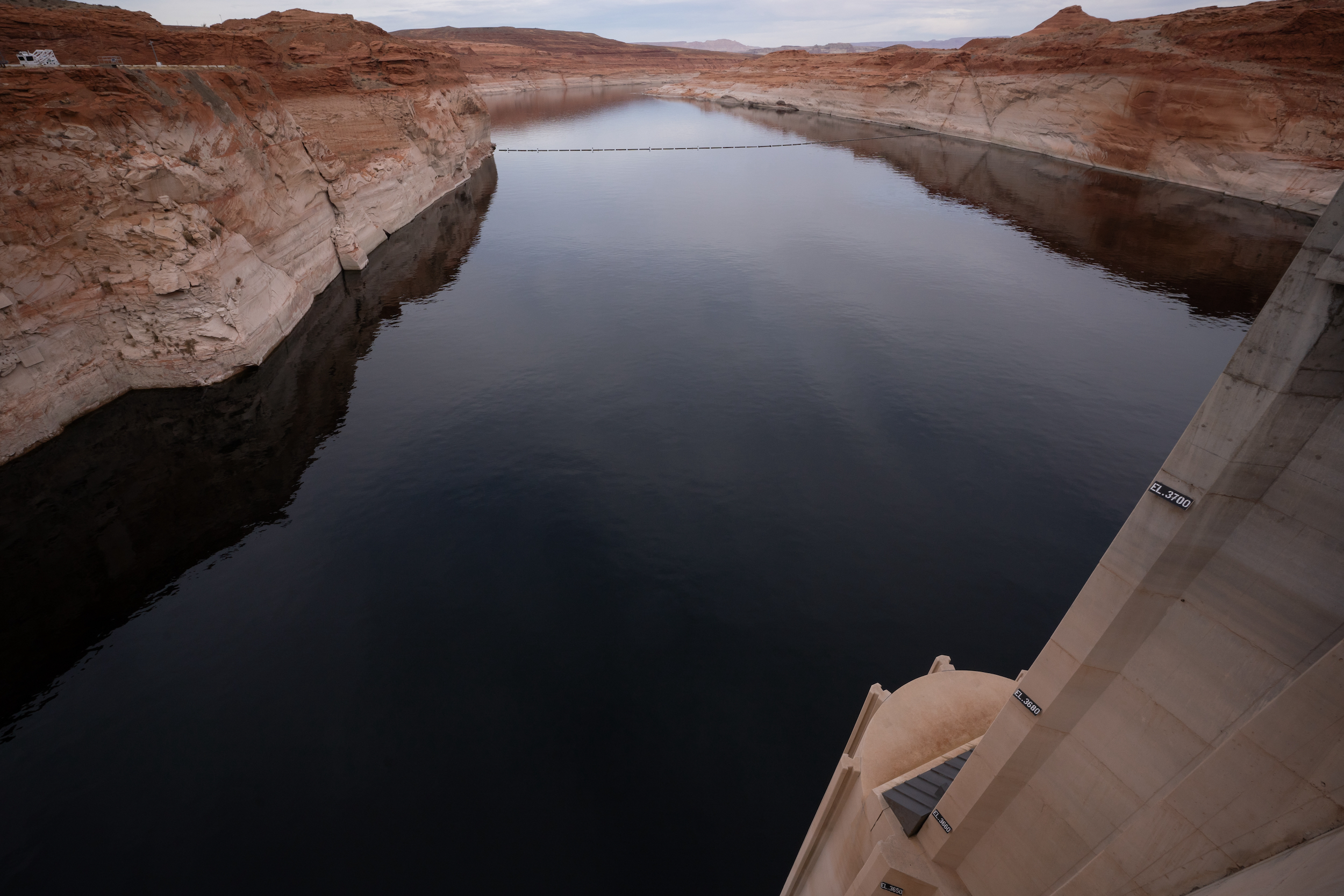
Lots of talk about Glen Canyon losing the ability to generate power. There is no way the BOR loses that power head. They will go to run of the river before that happens, regardless of how low that means outflow gets. IMHO
 

Lots of talk about Glen Canyon losing the ability to generate power. There is no way the BOR loses that power head. They will go to run of the river before that happens, regardless of how low that means outflow gets. IMHO
What do you mean by run of the river?
 
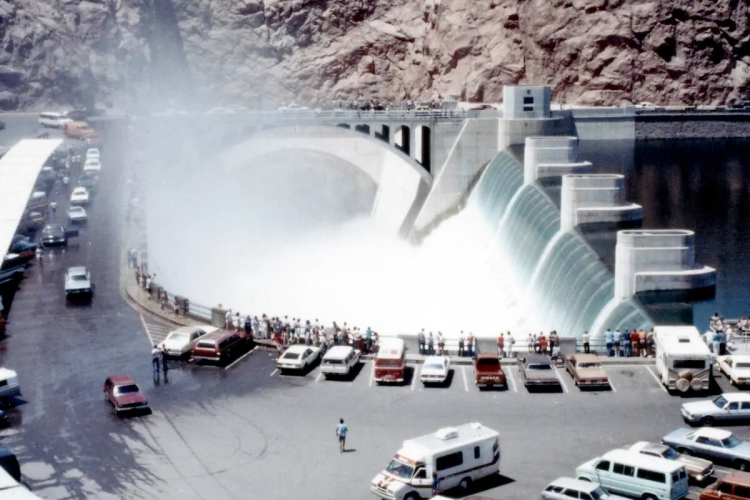
I wonder if I'll live long enough to see this again. We went to look at the overflowing spillways at Hoover dam in 1983, it was amazing.

View attachment 400656
I personally don’t believe that will ever happen again. I’ve seen the water level behind that spillway a few times in recent years and it would take an act of God to refill the reservoir.
 
I personally don’t believe that will ever happen again. I’ve seen the water level behind that spillway a few times in recent years and it would take an act of God to refill the reservoir.
Administratively hard, but not overly technically hard to fill it. It would need to be prioritized over other rights/desires/management
 
If you want to know what our AI overlords suggest:

Addressing shortages in the Colorado River requires structural reform across hydrology, law, infrastructure, and agricultural economics. The system is chronically overallocated under the 1922 Colorado River Compact, and climate-driven aridification has reduced mean flows by ~20% over the last two decades. This is not a cyclical drought problem; it is a structural supply–demand imbalance.

Below is a disciplined framework organized by leverage and impact.


1. Fix the Allocation Framework (Law + Governance)​

A. Renegotiate the Compact Allocations​

  • The Compact assumed ~16.4 MAF/year average flow; modern estimates are closer to 12–13 MAF.
  • Basin states (Upper: CO, UT, WY, NM; Lower: CA, AZ, NV) must rebase allocations to hydrologic reality.
  • Replace fixed volumetric entitlements with percentage-of-available-supply allocations to reduce litigation risk during low-flow years.

B. Prioritize Seniority Reform in the Lower Basin​

  • California’s senior rights dominate Lower Basin allocations.
  • Develop compensated curtailment mechanisms rather than uncompensated priority enforcement, which destabilizes interstate politics.

2. Aggressively Target Agricultural Demand (Biggest Lever)​

~70–80% of Colorado River water goes to agriculture, including high-water crops in arid regions (alfalfa, hay).

A. Expand Voluntary, Compensated Fallowing​

  • Pay irrigators for rotational fallowing (short-term, compensated).
  • Scale successful models from the Metropolitan Water District of Southern California and Arizona water banking programs.

B. Reform Crop Incentives​

  • Discourage export-oriented alfalfa production in desert basins.
  • Incentivize deficit irrigation and higher-value, lower-water crops.

C. Modernize Conveyance Infrastructure​

  • Line leaky canals (e.g., All-American Canal precedent).
  • Upgrade flood irrigation to drip or micro-sprinkler where agronomically feasible.
Note: Efficiency gains alone do not “create” water if conserved water is reallocated; accounting rules must ensure true consumptive-use reduction.


3. Urban Conservation and Reuse (Second-Tier but Necessary)​

Urban use is ~15–20%, but politically visible.

A. Permanent Turf Removal​

  • Eliminate non-functional turf in desert cities (Las Vegas model).
  • Las Vegas has demonstrated aggressive per-capita reductions through turf buybacks and return-flow capture.

B. Wastewater Recycling (Indirect & Direct Potable Reuse)​

  • Expand advanced treated wastewater reuse in:
    • Phoenix
    • Los Angeles
  • Orange County’s groundwater replenishment system is a proof-of-concept model.

C. Tiered Water Pricing​

  • Steep marginal pricing for high-volume residential users.
  • Protect essential indoor use; penalize ornamental outdoor consumption.

4. Stabilize Reservoir Operations (Lake Mead & Lake Powell)​

The crisis manifests at:

  • Lake Mead
  • Lake Powell

A. Protect Minimum Power Pool Levels​

  • Maintain elevations that preserve hydropower generation at Hoover and Glen Canyon dams.
  • Coordinate Upper–Lower Basin releases to prevent dead pool risk.

B. Reevaluate Two-Reservoir Strategy​

  • Consider concentrating storage in one reservoir (hydrologic and evaporation analysis required).
  • Reduce evaporative losses (≈1.5 MAF/year basin-wide).

5. Develop Supply Augmentation (Limited but Strategic)​

These are expensive and energy-intensive, but part of a portfolio.

A. Desalination Partnerships​

  • Explore binational desalination with Mexico near the Gulf of California.
  • Exchange desalinated water for reduced Colorado River withdrawals.

B. Brackish Groundwater Treatment​

  • Expand inland brackish desalination in Arizona and Texas-adjacent basins.

C. Stormwater Capture​

  • Urban aquifer recharge during episodic atmospheric river events.

6. Demand Realism: Accept Permanent Aridification​

Paleoclimate records show the 20th century was anomalously wet. Policy must assume:

  • Lower mean flows
  • Higher evapotranspiration
  • Greater interannual volatility
Planning targets should be based on the 10th–20th percentile hydrologic scenarios, not historical averages.


What Would Actually Move the Needle?​

Ranked by real impact:

  1. Agricultural compensated reductions
  2. Compact reform tied to actual flow
  3. Permanent structural urban conservation
  4. Reservoir re-optimization
  5. Supplemental desalination (last resort)

What Would Worry Me Most​

  • Interstate litigation replacing negotiated reform.
  • Collapse of hydropower at Glen Canyon → revenue loss for basin environmental programs.
  • Rapid Upper Basin development increasing consumptive use just as supply declines.

If you want, I can:

  • Quantify approximate MAF savings from each lever.
  • Break this down by state (e.g., Arizona vs. California vs. Upper Basin impacts).
  • Focus specifically on implications for Washington State agriculture and West-wide water markets.

 

Forum statistics

Threads
118,419
Messages
2,193,117
Members
38,538
Latest member
GearHeadDiver
Back
Top