mtmuley,
Thanks for your private message and your responses here.
Did you read the sources I provided?
Predation is a much misunderstood ecological process. Most people confuse the act of predation with the effect, believing that the killing of an individual animal invariably results in a negative impact on the population. This view is frequently wrong, and ignores the complexity of predation at...

aces.nmsu.edu
"This leads to the most common misconception people have regarding predation, namely that the individual killed by the predator would still be alive if the predator was removed. This simplistic view is used, for example, to justify many predator control programs, and ignores the concepts of predisposition and compensatory mortality. Simply, if predisposition is present, the individual killed by the predator was likely to have died from some other cause anyway. To illustrate, research in New Mexico has shown that individual mule deer killed by pumas were in significantly poorer condition than the population as a whole (Bender and Rosas-Rosas, 2016). This illustrates predisposition; such individuals were increasingly likely to die from some other factor if not killed by a puma. Hence, mortality in these populations was primarily compensatory (Figure 4; Bender and Rosas-Rosas, 2016). Primarily compensatory predation was similarly seen with pronghorn (
Antilocapra americana), elk, and desert bighorn (
Ovis canadensis) across multiple populations in New Mexico (Figure 4)."
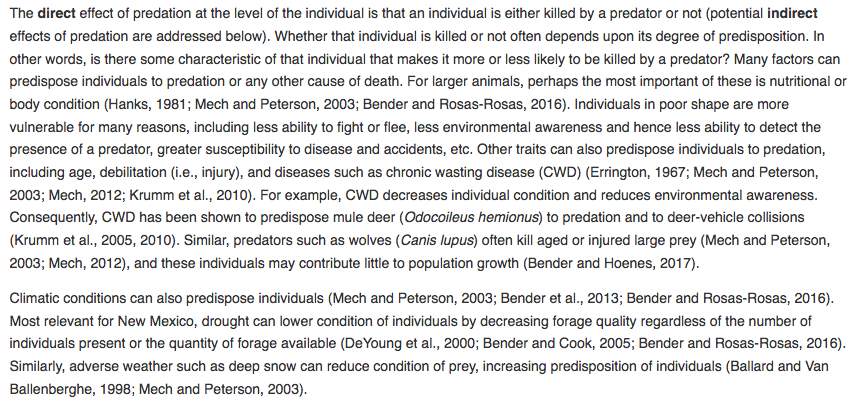
"The
direct effect of predation at the level of the individual is that an individual is either killed by a predator or not (potential
indirect effects of predation are addressed below). Whether that individual is killed or not often depends upon its degree of predisposition. In other words, is there some characteristic of that individual that makes it more or less likely to be killed by a predator? Many factors can predispose individuals to predation or any other cause of death. For larger animals, perhaps the most important of these is nutritional or body condition (Hanks, 1981; Mech and Peterson, 2003; Bender and Rosas-Rosas, 2016). Individuals in poor shape are more vulnerable for many reasons, including less ability to fight or flee, less environmental awareness and hence less ability to detect the presence of a predator, greater susceptibility to disease and accidents, etc. Other traits can also predispose individuals to predation, including age, debilitation (i.e., injury), and diseases such as chronic wasting disease (CWD) (Errington, 1967; Mech and Peterson, 2003; Mech, 2012; Krumm et al., 2010)."
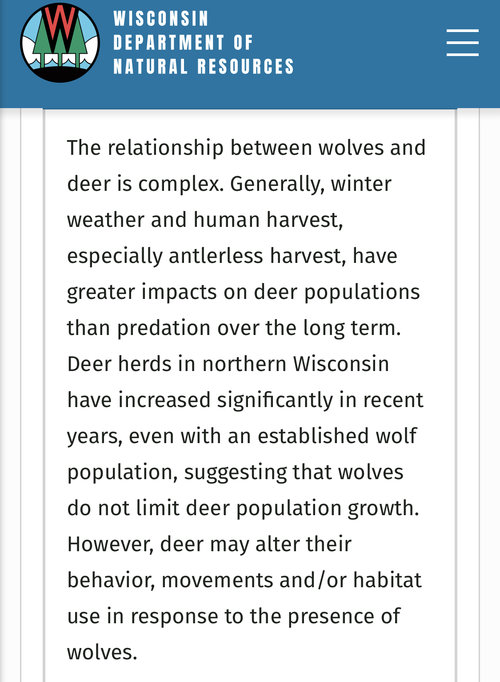
Wisconsin DNR
"Many deer hunters tend to believe that every deer killed by a predator results in one less deer available for a human hunter to harvest. Research has found the truth to be more complicated. Predators do not, in fact, always reduce the population growth rates of prey. Biologists use the terms “compensatory” and “additive” to describe the impact of predation on any given wildlife population. If predation is “compensatory,” it means the total number of prey to die in any given year does not change as a result of predation. It means the predators remove the number of animals that would have been lost anyway to other causes."