As much as it pains me to say this about the OP, it seems to me that (as Buzz stated), Wyoming would likely be able to recover the Non-resident lost revenue from Grizzly, Sheep, Goat, Moose and Bison through other revenue generating schemes.
However, any tampering with the current system may still have a negative impact on non-resident demand. I figure with about 400 employees; the Wyoming Game and fish should have just over $20MM in employment expenses. That’s over double what the resident tag revenue produces. While they (WG&F), seem to be well within a margin for error; it seems that they could technically reduce revenue while still maintaining the current employment structure, (assuming that they are well under 35% employment expense to revenue).
The impact of any potential reduced revenues would have to be reducing the amount of conservation projects that WG&F have control over. I figure that they have about $5MM dollars going to Grizzly and Wolf conservation which is likely impossible to change. BTY, don’t get sidetracked on Grizzly and Wolf – that’s a subject for another thread in a universe far, far, away.
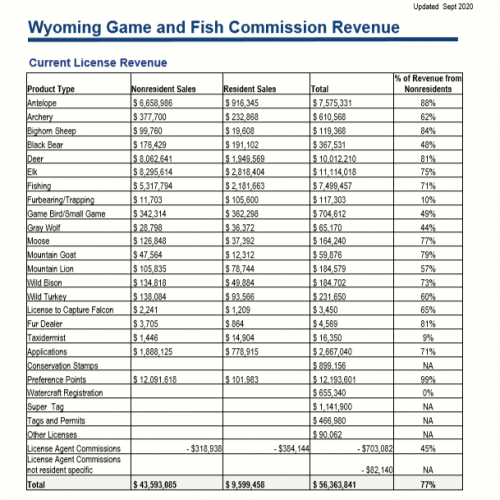
While the 90% resident, 10% non-resident tag allocation seems to be standard among most Western States; please understand that it does not sit well with those who have paid for 77% of the tag revenue (and no reasonable person would expect that to be so). Still, allthough it is a terrible disparity, many will tolerate it to get in at least one or two hunts.
I think that if residents recognize this fact (that non-residents have significant value to WY), and that non-residents recognize that residents should have first crack at the tag allocation, then both parties could come to agreement in good faith. As I see it the outstanding issues are (inorder of importance to me

):
- Residents want more opportunities for the best tags and consider the non-resident allocations are the reason for not being able to hunt those areas.
- Large Landowners want tag allocations as compensation for wildlife damages, wildlife conservation and taxes incurred.
- Non-residents do not currently have a seat at the table that they paid for; they want opportunities to hunt and honestly to want to hunt for trophy’s commiserate with the cost of the tag.
- Outfitter businesses seem to want tag allocations (or at least guided non-resident requirements) and exclusive access to public / private land where the highest number of best trophy potential animals are.
I figure that Wyoming Game and Fish is well aware of the issues with revenue disparity and will likely make decisions to balance the desires of the resident hunters, landowners, local business, their budgetary concerns and other stakeholders such as non-resident purchasers of licenses (the market).
This seems a bit dated, but I would expect it would be updated once a year. This was posed on Game and Fish:
Wyoming Game and Fish Commission Revenue
Updated Sept. 2020
License Revenue This includes hunting and fishing licenses sales, conservation stamps and fees, preference point sales, boat registration fees and the Super Tag program.
$56,363,841
Federal Aid (PR/DJ) Federal aid includes Pittman-Robertson (PR) and Dingell Johnson (DJ) funds from federal excise tax on sporting arms, ammunition and fishing and boating equipment. Funds are apportioned to state wildlife agencies for conservation work, hunter education programs, operation of archery and shooting ranges, and sport fisheries work.
The Commission must match funds derived from PR/DJ at a rate of 25% state and 75% federal.
$19,400,000
This amount may be reduced with potentialy reduced revenues, as it's based on WG&F's ability to pay 25% of any given project
Grants Grant funds awarded to the Department from conservation and other partners to achieve specific outcomes that benefit the Department’s mission.
$6,400,000
Interest generated from Commission accounts.
$2,700,000
This fregin number is the WG&F holding your application tag money
Other Revenue generated from Commission owned property, magazine publication sales, Access Yes donations and other miscellaneous items.
$3,700,000
Total
$88,563,841
The Wyoming Game and Fish Commission’s (Commission) revenue is generated from fish and wildlife constituents, associated federal funding sources, grants, donations, and from Commission owned property. The Commission receives no State General Funds. Revenue can be broken into five main categories and is reflective only of revenue that can be expended.
The Wyoming Game and Fish Commission’s yearly revenue is approximately $88.5 million. This includes hunting and fishing licenses, conservation stamps and fees, preference points, boat registration, Super Tag and Federal Aid. The majority of the revenue, $75.7 million or 85%, comes from hunters, anglers, recreational shooters, and boaters.
Of the $56.3 million that comes from license revenue, approximately 77% comes from nonresidents.
Prior to the current fiscal year, the Commission received approximately $800,000 annually from the State General Fund for license recoupment to offset the revenue lost from free and reduced-price licenses. This year General Fund support was eliminated to aid in the State’s current financial crisis.
The Commission’s budget is based on needs and identified priorities. When revenue exceeds the budget, the Commission places those funds in a reserve similar to a personal savings account. This reserve is for emergencies and allocating funding to significant projects, including capitol construction, wildlife crossings and wildlife research.
All funds tied to license revenue must be controlled by the Commission and spent on approved wildlife related activities to meet the requirements of Federal Aid.
Wyoming Game and Fish Commission Revenue
Updated Sept 2020