Wildfire management LTTE

Sorry you missed the point. The point you made about costs of prescribed burns vs. wildfire. There's no comparison in costs. Homes are destroyed, lived are changed forever. People die.
You missed my point. No one is arguing that Rx burns are beneficial and I'm not trying to say it wouldn't be cheaper in the long run. The issue is that the areas that need it are those that are near people and people complain about that smoke like they complain about everything else. That and insurance companies don't like the idea of lighting stuff on fire on purpose... so now they sell you insurance for that. Someday you will discover that things are never simple as they seem in your head. Go back to yelling at clouds.
 
You've completely missed the point
People keep writing that, but then don't explain what the point actually is.

Here's my take: You (and many, if not most, people) don't like smoke from forest fires (mostly because it's annoying and potentially dangerous, especially to people with existing respiratory health issues) and you want to blame someone. But it's not easy to figure out who to blame because we all share responsibility at some level (who we vote for, how involved we are in shaping public opinion, where we choose to live, etc, etc) and a fair amount of blame rests with our predecessors - forest (mis)management has been ongoing for more than a century. Forest fire mitigation, management, and suppression are complicated and expensive and we could be doing a lot better, but our short-sightedness makes us the worse enemies of our future.
 
What are the solutions? Everything seems to involve more $ and people are not in favor of higher taxes.
I have no new solutions. Most everything has been tried and argued about for decades. I agree it's all costly and people hate taxes and love to gripe.

I hope we can recognize there are a lot of resource professionals doing their best with what they have to address the situation they face.
 
Sorry you missed the point. The point you made about costs of prescribed burns vs. wildfire. There's no comparison in costs. Homes are destroyed, lived are changed forever. People die.
I Think his point was that costs to prevent fire are less expensive than the cost of fighting them.
 
I do think solutions are there.

I also know that they will be unpopular, and likely require a major change in the country's leadership.

The anti-science, climate change isn't real stance has to change. It indirectly leads to making the problem worse by preventing acknowledgement that we live in a new normal and change is needed. A big part of that need is acceptance that climate changes make it worse, and restoration of cuts followed by expansion of resources is needed to mitigate the increased frequency of fires that are the new normal.

The role timber harvesting plays in creating more fuel and improving access access to arsonists and careless people needs to be accepted and changes need to be made.

Development, building permits, and expansions all need to include compliance with fire mitigating/prevention measures before being allowed.

FIre prevention education programs need to be first restored after cuts were made, then expanded.

Incentives for compliance with standards need to be looked into and applied.

Just a start.
 
People keep writing that, but then don't explain what the point actually is.

Here's my take: You (and many, if not most, people) don't like smoke from forest fires (mostly because it's annoying and potentially dangerous, especially to people with existing respiratory health issues) and you want to blame someone. But it's not easy to figure out who to blame because we all share responsibility at some level (who we vote for, how involved we are in shaping public opinion, where we choose to live, etc, etc) and a fair amount of blame rests with our predecessors - forest (mis)management has been ongoing for more than a century. Forest fire mitigation, management, and suppression are complicated and expensive and we could be doing a lot better, but our short-sightedness makes us the worse enemies of our future.
People keep adding their own opinions when interpreting others. I've stated mine, what feels like 42 different ways, but because you don't agree with it, you don't "get it".
My points are:
1. That hazardous air quality is, in fact, actually hazardous to humans. Anything over an AQI of 150 is demonstrably bad for you. You can drop the potentially.
2. There are 100k's, if not millions, of people, from kids to the elderly, are forced to deal with hazardous wildfire-related smoke for considerable portions of their lives.
3. The FS is capable of putting out fires. As shown by decades, almost a century of wildfire suppression. And that there are options outside of fire to reduce forest fuels.
4. Putting out wildfires is costly, but increasingly so the larger they are.
5. Science has shown that there are a plethora of positive outcomes from a lack of wildfire. Observation and logic will also tell you there are a plethora of negative ones too.
6. That either A) far too much societal weight is currently placed on the benefits of "natural" wildfire; and/or B) no one is actually accounting for the societal health "costs" when saying full suppression is too costly.

If you've ever had to do a SEPA or NEPA for a waterline, powerline, low-incoming housing project, or some other project that is generally beneficial to the public, then you know that intent doesn't actually mean a goddamn thing, and you do have to actually account for all of your impacts. It's why data centers can sometimes be stopped. If we have a national, state, or forest specific "plan" for how we manage fires, I would like to see it, and the underlying data and decision making that goes into it.

 
The role timber harvesting plays in creating more fuel and improving access access to arsonists and careless people needs to be accepted and changes need to be made.

You really think this is an issue? Better access for arsonists and careless people? I know one thing about forest fires, once we can stop lightning, we'll have a huge leg up. mtmuley
 
You really think this is an issue? Better access for arsonists and careless people? I know one thing about forest fires, once we can stop lightning, we'll have a huge leg up. mtmuley
Its real. And about to get more real if Trump is successful in opening up Roadless areas. Which by the way are FAR less prone to fires...which in part loops around again to limited access.
 
Its real. And about to get more real if Trump is successful in opening up Roadless areas. Which by the way are FAR less prone to fires...which in part loops around again to limited access.
I don't reall buy in to that all the way.No way to find out but I bet the difference in human caused fires to natural causes is huge. mtmuley
 
I don't reall buy in to that all the way.No way to find out but I bet the difference in human caused fires to natural causes is huge. mtmuley
Yep. Over 80 % caused by people.

 
Yep. Over 80 % caused by people.

How accurate is that? I am standing here watching rolling thunderstorms. I bet there are dozens of fires later. Tomorrow or even later in the week. Ones that no one even knows about that get put out. I agree people start fires. But not 80 percent of them. mtmuley
 
People keep adding their own opinions when interpreting others. I've stated mine, what feels like 42 different ways, but because you don't agree with it, you don't "get it".
My points are:
1. That hazardous air quality is, in fact, actually hazardous to humans. Anything over an AQI of 150 is demonstrably bad for you. You can drop the potentially.
2. There are 100k's, if not millions, of people, from kids to the elderly, are forced to deal with hazardous wildfire-related smoke for considerable portions of their lives.
3. The FS is capable of putting out fires. As shown by decades, almost a century of wildfire suppression. And that there are options outside of fire to reduce forest fuels.
4. Putting out wildfires is costly, but increasingly so the larger they are.
5. Science has shown that there are a plethora of positive outcomes from a lack of wildfire. Observation and logic will also tell you there are a plethora of negative ones too.
6. That either A) far too much societal weight is currently placed on the benefits of "natural" wildfire; and/or B) no one is actually accounting for the societal health "costs" when saying full suppression is too costly.

If you've ever had to do a SEPA or NEPA for a waterline, powerline, low-incoming housing project, or some other project that is generally beneficial to the public, then you know that intent doesn't actually mean a goddamn thing, and you do have to actually account for all of your impacts. It's why data centers can sometimes be stopped. If we have a national, state, or forest specific "plan" for how we manage fires, I would like to see it, and the underlying data and decision making that goes into it.

As someone with asthma...albeit well controlled...who for the first time in decades had some problems after being out during a prolonged period of fire smoke/bad AQ, I cant argue with that concern.

But back to one of my points...the climate has changed and political decisions are amplifying that.

Even if things turn for the better, the increased fure frequency might be hard to overcome...if the goal is to revert to past levels.

Moving to areas less prone to fire caused bad AQ is something more people are doing, from what I have read. Same for folks tiring of weeks of 100 degree heat.
 
Yep. Over 80 % caused by people.

Interesting. I guess I can't argue with that article. I am going to try to find out if 90 percent of Montana's fires were human caused this year. Don't even know if the data exists. mtmuley
 
3. The FS is capable of putting out fires. As shown by decades, almost a century of wildfire suppression. And that there are options outside of fire to reduce forest fuels.
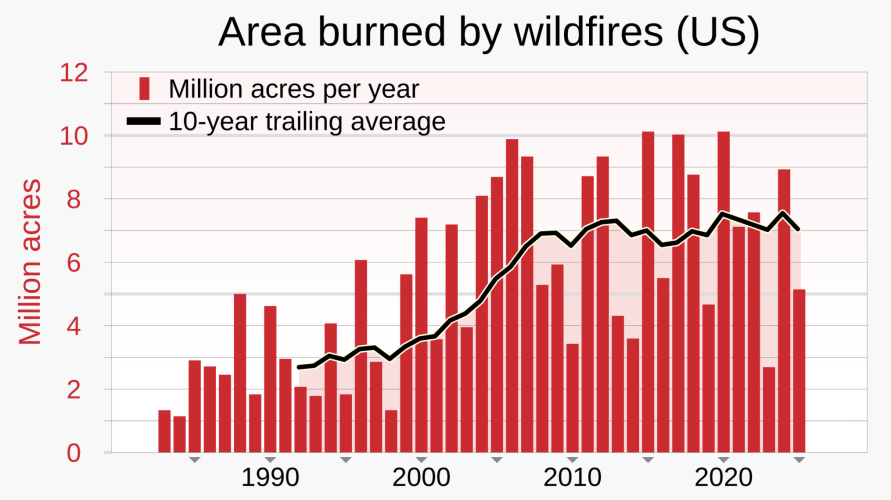
This ^ I would disagree with, and not just present day but in the past. The amount of wildfire each year is highly variable, probably due to moisture levels, not some grand proclamation on suppression. See chart below from Wikipedia. It looks like we have reached a new level for the 10-yr avg. The current Admin policy is full suppression. It's not working out very well.

Options to reduce fuels are what? Logging? Fine. Log away. Controlled burns? Most think those are good too, but I note your #1,2, and 6 as opposition. Might as well require every camper to bring a rake and a garbage bag.

The problem is scale. Averaging 3mil acres per year is not the same as 7mil acres per year. We couldn't do enough controlled burns to even scratch the surface. We need to find ways to find fires and scale up resources quicker. We see steps in that direction, like satellite thermal imagery. Do we consider drone aircraft? I'm not sure there even is an answer. At least not a good one. And why would politicians spend money on it when they can use "mismanagement of our national forest" as a talking point.

Screenshot 2026-09-01 at 5.21.40 PM.png
 
Options to reduce fuels are what? Logging? Fine. Log away. Controlled burns? Most think those are good too, but I note your #1,2, and 6 as opposition.
But we don't and we won't. The people who don't have to deal with smoke don't like logging.

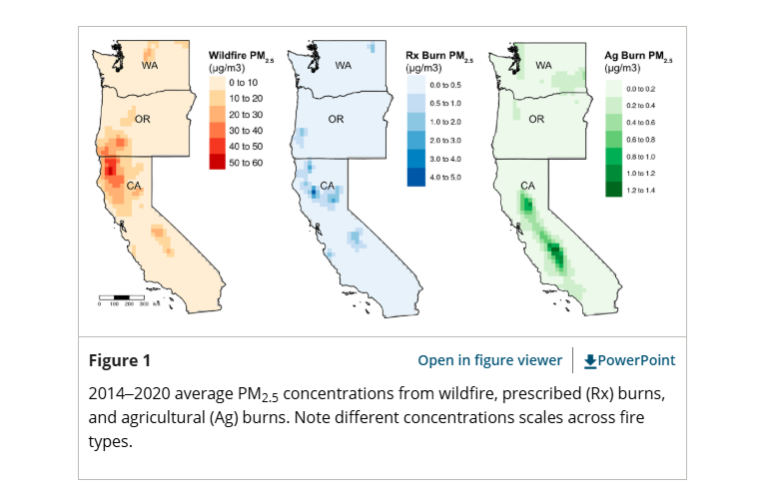
I hate to be this kind of dick, because I think on most topics we agree, but JFC, I've said about a million times that prescribed fires don't cause hazardous air quality. Noitce the order of magnitude difference.
1788310369065.png

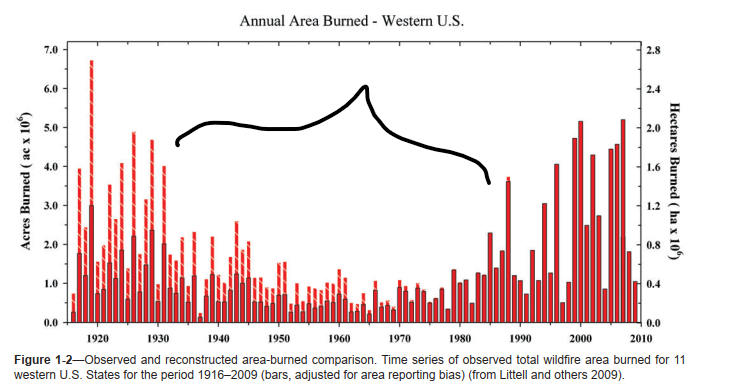
Also, your graph missed the mark. There are 50 years of successful wildfire suppression. WA's two biggest droughts occurred in that time frame.

1788310105340.png

We CAN do more than we are. We are choosing not to. Why we're choosing not to...
 
I've said about a million times that prescribed fires don't cause hazardous air quality.
Sure they do. Just on a smaller scale, localized, Shorter time etc. I volunteered for a controlled burn that was cancelled because the wind forecast shifted directions and it would have blown into the nearby town. I agree it is a legit complaint for some. But the reality that creates is controlled burns are limited in size and frequency and don’t do much good in those years or places where the stuff hits the fan.

It’s a good chart, but there are more variables to the equation than just a piece of paper from the USFS stating its suppression plan. I would be willing to bet it isn’t an issue of staffing either, but maybe $$$s?
 
View attachment 416037

We CAN do more than we are. We are choosing not to. Why we're choosing not to...

I’d say that chart is an N-of-1. Folks above have mentioned that we used to do a lot more fuels reduction by way of merchantable timber and that’s part of it, but that 40 year span of suppression also built a hell of a lot of fuel up on the landscape and became unsustainable. I don’t think the increases in acres-burned over the last 30 years are chiefly driven by a different management perspective on wildfire.

I believe we are better at firefighting now than ever before and we are catching fires much earlier than ever before with better technology than ever before all while spending more money than ever before.

If I were king for a day and solely with reducing the amount of smoke folks experience in the summer in mind, we would log a heck of a lot more. Litigants would have no options. We would engage in more prescribed burning, which really only touches very small acreages compared to what’s out there, has a ridiculously small window of efficacy seasonally, and I would remove the liability concerns associated with that activity.We would engage in far more fuels reduction efforts, which make no money whatsoever and quite the opposite. All of those efforts would have to be repeated at particular intervals. Fuels reduction isn’t something you do and walk away from- it’s a literal maintenance schedule. We would be far more aggressive in our stage restrictions - limiting the ability of the public to have campfires and such - and we would put a lot more heads on pikes. We would heavily restrict where people could build structures because those areas get a disproportionate focus to other areas that might produce more smoke. We would probably also restrict access to the woods far more aggressively when it’s dry out.

Pros and cons. None of it particularly feasible. And I suspect we’d still have big damn fires. Here in the Pyrocene.
 
Last edited:
Folks above have mentioned that we used to do a lot more fuels reduction by way of merchantable timber and that’s part of it, but that 40 year span of suppression also built a hell of a lot of fuel up on the landscape and became unsustainable.
You point out the ultimate irony. Fire suppression policies were driven by timber companies, but they couldn’t log it fast enough so fuels built up. Sounds a lot like our current policy of suppress and log but there aren’t enough loggers. Tariffs and all, it is still cheaper to buy Canadian boreal forest timber than to log some of these USFS lands.
 

Forum statistics

Threads
119,912
Messages
2,242,718
Members
39,054
Latest member
FarmerJoe13
Back
Top