Seth Bodnar - independent US Senate candidate

It's also clear that the Republican Congressman and Senators don't agree with everything in the platform. For this issue, they are on record with disagreeing. For example ...

So brave those two, making those statements after it was clear the OBBB wouldn't pass the House with Lee's amendment. Thank Zinke if you want.
 
I tried to get info on Bankhead's positions on her website. She has statements that rotate through the screen, but they don't linger long enough for you to read them. In other words, she can't even raise enough money for a decent website, yet people are adamant about voting for her over Seth. Messed up world.
 
I'm assuming you've been watching politicians reverse positions once elected over the years. Why would anyone think debates, positions, and ads are really what they intend to do? I think a better indicator is what they've done in life and who supports them.
 
I'm assuming you've been watching politicians reverse positions once elected over the years. Why would anyone think debates, positions, and ads are really what they intend to do? I think a better indicator is what they've done in life and who supports them.
Do you think Ryan Zinkes outspoken support for public lands, and important folllw throughs, represent nothing?

I completely get why MT politics is completely lost - with voters moving in that simply view voting/politics the way you do.
 
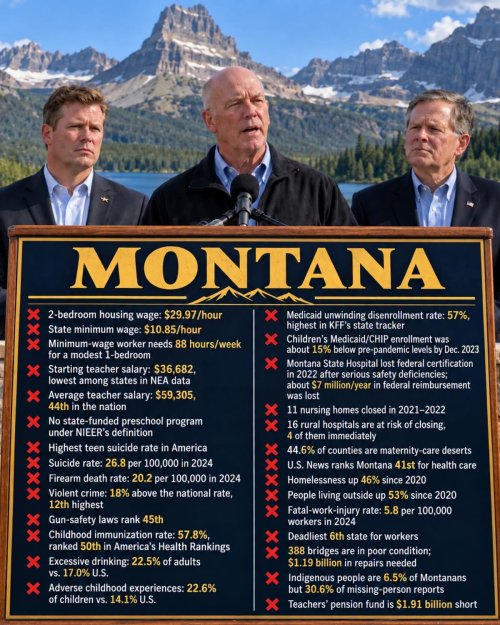
IMG_5479.jpeg

This was on a Democrat Facebook page.

I think half of these issues are what they are and are sort of just how Montana is being rural. Some of them like gun safety laws idk what they are trying to say, I personally don’t want any more gun laws in Montana and would actually like the pendulum to swing the other way with less regarding suppressors. Many of them I don’t see as something a politician can or should fix.

If Democrats are trying to convince Montanans that government is the solution to their problems/issues then I think they are not reading the room.

Not one mention of public lands or access (corner crossing).

Seth Bodnar has my vote.
 
View attachment 418385

This was on a Democrat Facebook page.

I think half of these issues are what they are and are sort of just how Montana is being rural. Some of them like gun safety laws idk what they are trying to say, I personally don’t want any more gun laws in Montana and would actually like the pendulum to swing the other way with less regarding suppressors. Many of them I don’t see as something a politician can or should fix.

If Democrats are trying to convince Montanans that government is the solution to their problems/issues then I think they are not reading the room.

Not one mention of public lands or access (corner crossing).

Seth Bodnar has my vote.
Yeah seems pretty tone deaf and not what the majority of middle Montanans want to hear.

Fits the fantasy narrative of Bankhead staying in the race though.
 
View attachment 418385

This was on a Democrat Facebook page.

I think half of these issues are what they are and are sort of just how Montana is being rural. Some of them like gun safety laws idk what they are trying to say, I personally don’t want any more gun laws in Montana and would actually like the pendulum to swing the other way with less regarding suppressors. Many of them I don’t see as something a politician can or should fix.

If Democrats are trying to convince Montanans that government is the solution to their problems/issues then I think they are not reading the room.

Not one mention of public lands or access (corner crossing).

Seth Bodnar has my vote.
Agree a lot of those are what they are, but they are also the things they criticize blue states for. Examples like violent crime rate or pay teachers a low salary and promise them high future retirement payments and then not charge enough in taxes to fund the pension. Same stuff regardless of zip code or what party is in charge. I guess you can’t scare voters with a pension funded ratio.
 
I went to another of his public events this week. Was interested to hear his responses to some of the claims against him. I saw some folks who were known supporters of the GOP there. We visited. It was interesting to hear how frustrated they are with the Montana GOP not representing Montana.

It's hard to think about a career where you have a 15% approval rating, but 95% of incumbents get re-elected if they run. It surely explains why the two parties don't want to have their game disrupted by an outsider. And it shows me how broken the current system is.
 
More polling demonstrating what everyone looking at this objectively already knew/expected to happen:

Accusations aside, the main question should be why is Bankhead still in the race? She is unemployed and the primary funding from the PAC that initially supported her was cut off. Someone should ask what she plans on doing after the realization comes that she won't be a Senator. It's like someone is paying her to stay in the race.
 
How did he respond?
To which ones? He mentioned quite a few attack ads directed against him and was asked some questions by the audience to clarify what they might have heard in the attack ads.

I think he summarized it very well when he said (a quote from @Straight Arrow that I had used on my podcast with Bodnar), "You know you're over a valuable target when the flack gets the heaviest." In other words, there's a reason both the R and D are focusing a lot of their negative ads on him - he's a true threat. Whether him or Dan Osborn (the Nebraska independent Senate Candidate with a great chance to win) were to gain a Senate seat, it would stand the status quo on its head.

I hope enough people are frustrated in MT and NE to vote against this crazy system that rewards incompetence and being a party lackey.

Either way, Montana is going to have another freshman Senator; Bodnar, Alme, or Bankhead. Sheehy is an example of a Freshman Republican Senator - does exactly what the party tells him. His voting record is virtually identical to Ted Cruz (R-TX) and Mike Lee (R-UT). When MT ranchers and farmers are getting hammered by beef import policy, wars that drive up fertilizer and diesel prices, and lack of market competition, we hear nothing from our freshman Senator Sheehy. If he can't speak up on those issues, what issues can he speak up on?

Like Sheehy, Alme as a freshman R in the US Senate is like giving Texas or Utah a third Senate seat. And Bankhead would be the lackey carrying water for Schumer, et al, giving California, Washington, and Maryland a third Senate seat.

"Freedom's just another word for nothin' left to lose..." Kris Kristofferson in Me and Bobbie McGee. Do Montana (and Nebraska) voters have anything left to lose?

The current system and it's corruption, a system that let's a senile old man hide in the White House basement for his four year Presidency, and a system of bootlickers (Daines/Sheehy as examples) who provide political cover for the Pedophile in Chief, have me completely vested in dismantling the current system and doing what I can that is to the detriment of the two parties and clowns who control the circus. Whether Bodnar or some future Independent, the remainder of my breathing days spent on politics will be directed towards changing the mess that has been created by the two parties, their hyper-partisans, and the billionaires funding the mess.

At this time Bodnar is the best option I see for changing this system, at best by winning, and at worst by running a close campaign that might not win, scaring the shit out of the two parties who think they have full control of the circus they benefit from.

 
Sheehy is an example of a Freshman Republican Senator - does exactly what the party tells him. His voting record is virtually identical to Ted Cruz (R-TX) and Mike Lee (R-UT). When MT ranchers and farmers are getting hammered by beef import policy, wars that drive up fertilizer and diesel prices, and lack of market competition, we hear nothing from our freshman Senator Sheehy. If he can't speak up on those issues, what issues can he speak up on?
Isn’t that mind boggling?
 
At this time Bodnar is the best option I see for changing this system, at best by winning, and at worst by running a close campaign that might not win, scaring the shit out of the two parties who think they have full control of the circus they benefit from.

I agree. Thanks for the clarification, I think the flack comment is quite astute.

As you well know, long before guys from New Jersey and CA moved to Montana and planted their unique, nationalist brand of conservatism, we had a strong independent streak. Presidential elections went to republicans and local elections could go either way. I was always quite proud of that, and would correct people who tried to compare us to our neighboring states.

I wrote off Montana republicans around 2016 for their lack of self-reflection and willingness to march lock-step with the national republican agenda, save a few of the old guard (Marc Racicot comes to mind). Until now, Montana Dems typically didn't share the same problem as national democrats (National dems have always been the exact opposite of republicans: spending too much time navel gazing and over analyzing focus groups) and always leaned more into moderate territory (save the dedicated few Missoulians).

The Bankhead campaign and her very obnoxious supporters, however, show just how far the MT Democratic party has fallen as well. You're right, her positions mostly mirror the national democratic agenda. Her supporters' vitriol has reached a fever pitch that has pushed all us moderates out of the way.

What is most concerning to me is this staunch unwillingness to compromise in order to advance a goal and both sides taking even more extreme positions to combat the other side. That doesn't leave room for compromise. It leaves room for nothing at all.

Many dems crow that the current presidential administration is an existential threat to democracy. If that were true, then wouldn't they want to vote for a candidate who can win and balance the scales? Yet when confronted with that question, I have only seen much hemming and hawing about how Bankhead won the primary and that it is the principle of thing that matters. Principle doesn't win elections. Losing elections doesn't get anyone anything.

So much for "The enemy of my enemy is my friend."
 
I don’t know how many people believe Bodnar is an Independent when the mail ads recently tout how many Democrats support him with most of his funding coming from Actblue. You can read his President messages at the UM website. He’s clearly agrees with other Democrats. There’s nothing wrong with that if you like those policies.

The choice is R who caucuses with the Rs, or D and “I” who caucuses with the Ds. Bodnar and those like Tester miscalculated. He should have just run as D. He’d still lose, but wouldn’t have the Bankhead issue.
 
I don’t know how many people believe Bodnar is an Independent when the mail ads recently tout how many Democrats support him with most of his funding coming from Actblue. You can read his President messages at the UM website. He’s clearly agrees with other Democrats. There’s nothing wrong with that if you like those policies.

The choice is R who caucuses with the Rs, or D and “I” who caucuses with the Ds. Bodnar and those like Tester miscalculated. He should have just run as D. He’d still lose, but wouldn’t have the Bankhead issue.
He was asked who he would caucus with. He said "neither side." He explained how in Senate rules you are not required to caucus with anyone. He explained that a truly independent Senator can hold a lot of sway in a Senate as closely divided as this will be, even when it comes to committee assignments for a "non-caucusing" Senator.

As for his endorsement by former Ds, you seem to have missed that he is also endorsed by former Republican Governor Marc Racicot - polled as the most popular governor that I am aware of; polling as high as 80% while in office and still over 70% when his second term expired. Also endorsed by former MT GOP Chair (Susan Geise), and former MT Senate President (Republican Bob Brown). Not sure if those names are familiar with you, but it is kind of curious how you would point out his Democratic endorsements (former Senators Baucus and Tester) yet omit the well-known popular Republicans who endorse him.

For those who don't give two shits about either party, as is the case for me, he comes across as the most Independent candidate we've had in a long time.

For those who don't like his positions, that's a perfectly fine reason to oppose him and vote R or D. Vote that way.

For those who are true Independents, this is the first opportunity to vote for a viable Independent candidate in the 36 years I've lived in Montana. Hopefully they will vote that way.
 
Since this is a summary from the internet ... it may or may not be complete.

A U.S. senator can sit as an independent without joining the Democratic Caucus or Republican Conference. That is rare in the modern Senate. The two current independents—Bernie Sanders and Angus King—both caucus with Democrats. The last short-term example of someone who stayed fully outside both conferences was Dean Barkley of Minnesota in 2002. Kyrsten Sinema later tried a hybrid: she kept Democratic seniority and committee seats but stayed out of caucus organizing and messaging.

Caucusing is not required by the Constitution. It is how the Senate actually organizes itself: committee slates, leadership votes, floor scheduling, and most day-to-day power.

Pros​

  • Clear independence. The senator is not bound by caucus votes, messaging, or party platforms. That can match how some voters see themselves and can make it easier to vote issue-by-issue.
  • Leverage in a razor-thin Senate. If the chamber is 50–49 or 50–50, refusing to organize with either side can decide who becomes majority leader, who chairs committees, and whose agenda moves. That is real power for a short window.
  • Freedom from party discipline. No whip counts, no pressure to fundraise for the party apparatus, no obligation to defend the party’s national brand.
  • Bipartisan branding. The senator can work with whoever will deal, without looking like a defector from a team they just joined.
  • State-first politics. In a split or moderate state, “I don’t belong to either machine” can be a durable electoral argument.

Cons​

  • Committee assignments suffer. Parties write the committee slates. A senator who joins neither conference has no guaranteed seats, no seniority track inside a conference, and little chance at a chair or ranking slot. Wayne Morse’s independent period showed how hard it is to force assignments from the floor. Barkley’s brief tenure never really tested committees because he was barely there.
  • Lost institutional power. Most Senate work happens in committee and through leadership-controlled floor time. Without a conference, the senator is last in line for information, amendments, and the calendar.
  • No path to leadership. Majority leader, whip, conference chair, and most other posts are elected inside the two conferences.
  • Weaker staff and resources. Conference operations, research shops, and coordinated press operations sit with the parties. A lone senator runs a smaller shop.
  • Isolation, not influence. In a 53–47 Senate (the current 119th Congress shape: 53 Republicans, 45 Democrats, 2 independents who caucus with Democrats), one unaligned senator does not swing organizing votes and can be ignored on most bills.
  • Fundraising and reelection cost. National parties, aligned PACs, and many donors route money through party infrastructure. A true unaffiliated senator has to build that machine alone.
  • Procedural risk. Unanimous-consent deals, hotlining, and the daily floor schedule run through the two leaders. An outsider can object, but that is a blunt tool and burns goodwill.
  • Precedent is thin. Almost every long-serving independent in the last 50 years chose a conference precisely because the costs of staying out are high.

How it works in practice​

Committee ratios and slates are negotiated by the two parties, then ratified by the full Senate. An independent who caucuses with one side is counted in that side’s numbers (Sanders and King are treated as part of the Democratic share). An independent who caucuses with neither is not automatically given a share. The Senate can invent a workaround, but it has almost never done so for a full-term member.

Sinema’s 2023–2025 arrangement is the closest recent model: keep committee seats and seniority through one party, skip the closed-door politics. That preserved some power while advertising independence. Fully walking away from both conferences is a larger gamble.

Bottom line: not caucusing is strongest as a short-term bargaining chip when control of the Senate is in doubt. Over a six-year term, it usually means less committee power, less information, and less ability to move legislation than joining a conference while still voting independently—which is what Sanders and King already do.
 
Back
Top