My youngest will be in college and potentially out of the house by the time I'm 50-52. We did that on purpose lol.I hate to break it to you homey but at 40 the last thing you have the energy for is chasing around a toddler.



Navigation
Install the app
How to install the app on iOS
Follow along with the video below to see how to install our site as a web app on your home screen.
Note: This feature may not be available in some browsers.
More options

You are using an out of date browser. It may not display this or other websites correctly.
You should upgrade or use an alternative browser.
You should upgrade or use an alternative browser.
Rinella article.. CUT AND PASTED
- Thread starter Point Creep
- Start date

Carl 9.3x62
Well-known member
46 for meMy youngest will be in college and potentially out of the house by the time I'm 50-52. We did that on purpose lol.

Gulf of America
Well-known member
Put product giveaways in the important videos where at some random point in the video you say what personal piece of information people have to put in the comment to win. Complete nightmare for you? Absolutely. But you beat the algorithm at its own game and force people to watch the stuff they need to watch. All the problems with hunting solved just like that. I'll see you at the annual Nobel awards, or however that works.I'm going to provide some information from the back end of our YouTube channel. Here are a handful of 2021 videos about advocacy, conservation, and videos that get to the core of some of the topics people are mentioning here. None of them mention a product or service. I could do the same with podcast episodes, but YouTube has a better analytics dashboard and illustrates this better.
Look at how few views these videos get, how few comments. When we do even a marginal elk hunt, we quickly get near 100K views and hundreds and hundreds of comments. Hell, me sitting down in my shop answering questions or telling stories of me shitting myself to death get 10X the number of views as these videos.
Why such low views? Because these topics are not what people are selecting to watch and the algorithm, in this case the YouTube algorithm, notices that behavior and selects other content to push to people. The algorithm, as much as I hate them, doesn't lie. The algorithm knows exactly what people watch, what they share, what the comment on, and just as precisely, what content people ignore and refuse to watch.
We still produce videos on conservation, proper behavior in the field, natural history, science, etc. Why do we do them, even though we know they won't get many views, or in the case of podcasts, many downloads? Because that is part of our "WHY." We lose thousands of dollars on this forum, by producing these types of videos, on podcasts that talk about these issues, and other content that falls in our content categories of education/information/advocacy. But if we are going to hold true to our effort to create more advocates, we have to produce this type of content along with the stuff that does attract them.
The fact that people don't consume those content topics is likely not changing. Whether in video, social media images, or podcasts, people select for what they are interested in. I wish I could force them to listen, watch, or have interest in this type of content, but that ain't going to happen. Best I can hope for is that when we produce content they like the algorithm with serve them some of this unpopular content because it comes from us.
So, is the problem that we aren't producing enough of that content or is it that people don't GAF about that type of content?
This trend holds true no matter what media platform we distribute content across. I suspect back in the "old days," the folks at Outdoor Life, Field & Stream, Petersen's, and other magazines quickly came to the same realization even without the analytics of today, and that is why we seldom, if ever, saw/see small critters on magazine covers.
Point being, the content is being produced by us, and a few others, that is not about big antlers rather focuses on other core topics essential to hunting and conservation. But, in today's world doing so is like publishing that content in a broom closet, given how little attention it gets.
View attachment 208722View attachment 208723View attachment 208724View attachment 208725View attachment 208726View attachment 208728View attachment 208729View attachment 208730

Irrelevant
Well-known member
Which is basically Buzz's point if I understood it correctly. The hunters we are recruiting, creating, retaining, etc., though our own actions, stories, and lifestyles, are simply not conservationists. They don't care about what's actually important. That is a problem.or is it that people don't GAF about that type of content?
However, I will say, that enough repetition of conservation content and ideas did cause me to change my stance away from killing and towards conserving wildlife and their habitat. And I'm seeing that same progression with my younger relatives. The bloodlust wanes and conservation and appreciation for wildlife in general replaces it.
BuzzH
Well-known member
Totally agree...I'm going to provide some information from the back end of our YouTube channel. Here are a handful of 2021 videos about advocacy, conservation, and videos that get to the core of some of the topics people are mentioning here. None of them mention a product or service. I could do the same with podcast episodes, but YouTube has a better analytics dashboard and illustrates this better.
Look at how few views these videos get, how few comments. When we do even a marginal elk hunt, we quickly get near 100K views and hundreds and hundreds of comments. Hell, me sitting down in my shop answering questions or telling stories of me shitting myself to death get 10X the number of views as these videos.
Why such low views? Because these topics are not what people are selecting to watch and the algorithm, in this case the YouTube algorithm, notices that behavior and selects other content to push to people. The algorithm, as much as I hate them, doesn't lie. The algorithm knows exactly what people watch, what they share, what the comment on, and just as precisely, what content people ignore and refuse to watch.
We still produce videos on conservation, proper behavior in the field, natural history, science, etc. Why do we do them, even though we know they won't get many views, or in the case of podcasts, many downloads? Because that is part of our "WHY." We lose thousands of dollars on this forum, by producing these types of videos, on podcasts that talk about these issues, and other content that falls in our content categories of education/information/advocacy. But if we are going to hold true to our effort to create more advocates, we have to produce this type of content along with the stuff that does attract them.
The fact that people don't consume those content topics is likely not changing. Whether in video, social media images, or podcasts, people select for what they are interested in. I wish I could force them to listen, watch, or have interest in this type of content, but that ain't going to happen. Best I can hope for is that when we produce content they like the algorithm with serve them some of this unpopular content because it comes from us.
So, is the problem that we aren't producing enough of that content or is it that people don't GAF about that type of content?
This trend holds true no matter what media platform we distribute content across. I suspect back in the "old days," the folks at Outdoor Life, Field & Stream, Petersen's, and other magazines quickly came to the same realization even without the analytics of today, and that is why we seldom, if ever, saw/see small critters on magazine covers.
Point being, the content is being produced by us, and a few others, that is not about big antlers rather focuses on other core topics essential to hunting and conservation. But, in today's world doing so is like publishing that content in a broom closet, given how little attention it gets.
View attachment 208722View attachment 208723View attachment 208724View attachment 208725View attachment 208726View attachment 208728View attachment 208729View attachment 208730
Fighting an uphill battle and why I don't know if its a good idea to make things easier for new hunters or not.
Maybe it makes more sense to create more and better advocates from what we already have.
I'd rather have 10 solid advocates that actually do some good over a bunch of new hunters that don't do anything but buy tags.
For the record I think you, and many on this board, have been pretty helpful at getting more of the right people involved. Don't know why, but lots of the guys that started posting a long time ago have really stepped up and into the fray. Many that I know aren't real comfortable doing so.
THAT'S what we need to capture...and I'm not sure how to do it.
Last edited:

Agree. We get a ton of emails and comments from people (who are the ones we hope to reach) that upon watching our content and starting to follow more of what we do that they have become more interested in conservation. That gives me the feeling that it is not a futile effort that is without result. In fact, most of them who write and become interested are a high proportion of adult onset hunters who have a concern for wild things and wild places. They are engaged and communicate well. Those are who we hope to reach.Which is basically Buzz's point if I understood it correctly. The hunters we are recruiting, creating, retaining, etc., though our own actions, stories, and lifestyles, are simply not conservationists. They don't care about what's actually important. That is a problem.
However, I will say, that enough repetition of conservation content and ideas did cause me to change my stance away from killing and towards conserving wildlife and their habitat. And I'm seeing that same progression with my younger relatives. The bloodlust wanes and conservation and appreciation for wildlife in general replaces it.
The feedback from those folks is surely drowned out by the other content that is out there and the comments on that other content. We script a story book for each hunt and it talks about the species, the landscape, and conservation issues. Sometimes is becomes the core of the episode, sometimes only ancillary. Yet, it is still a way to raise awareness of the topics through the content that gets more views.
I can't list the number of people who complain about not seeing a kill shot. "You owe me 20 minutes of my life back." or "I don't care to sit around and watch people glass if they're not going to shoot something." or like when our guest hunter decided to pass a quarter towards shot on a bull at 400+ yards in a video a couple weeks ago, "He shouldn't be hunting if that isn't a shot he can make." or "If you are elk hunting, out to 600 yards should be a slam dunk."
Point of that being, when you try to show lessons of good behavior, proper decisions by a new hunter, and other messaging that hopefully helps build the hunting ethos we expect, you better be ready for a "metric shit ton" of folks ragging on you. Many of those folks I just deleted from our YT channel. Those are not the kind of people I produce content for, so they can GFT as far as I'm concerned. And, I'm not going to let our channel comments be plugged up with folks who have that perspective on it.
Some refuse to delete or ban anyone, relying on the adage "Any publicity is good," or in the case of social media like YT, any viewer/subscriber/comment is good. Note to all, and one I hope is present on Hunt Talk (another form of social media), if you show up on one of my platforms to be a prick and let the world know how pissed off you are, expect to be shown the door.
A long ramble to explain how challenging it is to get these kind of messages out there. As grandma said, "The world's radio is mostly static, your job is to find the music among all that static."
Here's another one. This video is probably the best video we have ever produced trying to mix conservation, landscapes, and how hunting is a foundation to improving those issues.
This was a two year project, required outside talent for sound and color, and was a very expensive trip to Alaska to get it done. Hard costs and employee cost, this was over $30,000 to produce. I am worried about the future of Sitka Blacktail deer, so I again, I don't GAF about the fact that it has only generated $207 of revenue on YouTube. We have elk hunts without firing a shot or releasing an arrow that have double this number of views and 4x the amount of revenue from YT ads.
Point being, not many people want to watch this stuff. It has been available for three years, this May. it has resulted in 77 new subscribers. Some channels can get 4X that many subscribers by giving away a hat and a T-shirt. The CPM (revenue per thousand views) is $4.65. If this was a hunt with a big bull elk, the CPM would be $12.00+. That shows how advertisers money, which gets bid/placed by computer, doesn't follow this content either.
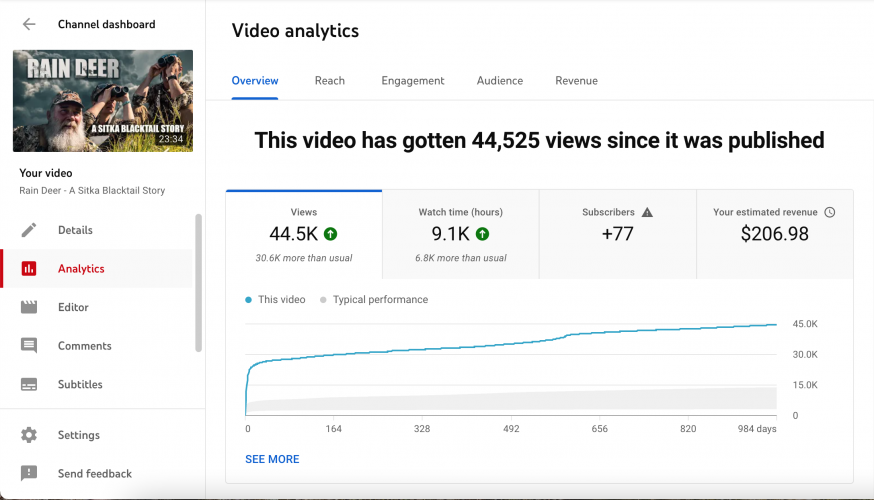
I'm still damn proud of that episode. If you want to watch it, here is the link -
This was a two year project, required outside talent for sound and color, and was a very expensive trip to Alaska to get it done. Hard costs and employee cost, this was over $30,000 to produce. I am worried about the future of Sitka Blacktail deer, so I again, I don't GAF about the fact that it has only generated $207 of revenue on YouTube. We have elk hunts without firing a shot or releasing an arrow that have double this number of views and 4x the amount of revenue from YT ads.
Point being, not many people want to watch this stuff. It has been available for three years, this May. it has resulted in 77 new subscribers. Some channels can get 4X that many subscribers by giving away a hat and a T-shirt. The CPM (revenue per thousand views) is $4.65. If this was a hunt with a big bull elk, the CPM would be $12.00+. That shows how advertisers money, which gets bid/placed by computer, doesn't follow this content either.
I'm still damn proud of that episode. If you want to watch it, here is the link -

LuketheDog
Well-known member
Here's another one. This video is probably the best video we have ever produced trying to mix conservation, landscapes, and how hunting is a foundation to improving those issues.
This was a two year project, required outside talent for sound and color, and was a very expensive trip to Alaska to get it done. Hard costs and employee cost, this was over $30,000 to produce. I am worried about the future of Sitka Blacktail deer, so I again, I don't GAF about the fact that it has only generated $207 of revenue on YouTube. We have elk hunts without firing a shot or releasing an arrow that have double this number of views and 4x the amount of revenue from YT ads.
Point being, not many people want to watch this stuff. It has been available for three years, this May. it has resulted in 77 new subscribers. Some channels can get 4X that many subscribers by giving away a hat and a T-shirt. The CPM (revenue per thousand views) is $4.65. If this was a hunt with a big bull elk, the CPM would be $12.00+. That shows how advertisers money, which gets bid/placed by computer, doesn't follow this content either.
View attachment 208734
I'm still damn proud of that episode. If you want to watch it, here is the link -
I liked that one...
LuketheDog
Well-known member
Totally agree...
Fighting an uphill battle and why I don't know if its a good idea to make things easier for new hunters or not.
Maybe it makes more sense to create more and better advocates from what we already have.
I'd rather have 10 solid advocates that actually do some good over a bunch of new hunters that don't do anything but buy tags.
For the record I think you, and many on this board, have been pretty helpful at getting more of the right people involved. Don't know why, but lots of the guys that started posting a long time ago have really stepped up and into the fray. Many that I know aren't real comfortable doing so.
THAT'S what we need to capture...and I'm not sure how to do it.
Do you consider someone like Matt Rinella a solid advocate though? I'm not sure I do. Regardless of his actual advocacy positions and the fact that he'd probably be fun to hunt and have a beer with, he surfaces too infrequently and comes across too harsh to be 'solid' in my book.
You're right, uphill battle for sure...
This is even a worse performing video that took three trips to Nevada to talk about volunteers that works so selflessly on behalf of wild sheep. These folks and their peers are the core of conservation in America. I think about @Oak and his fellows at RMBS who are the equivalent of what we showed in this video.
Quite simply, without these people, these volunteers, the folks over on the "Duke" thread don't have any ram tags to go buy at auctions. Yet, who does the collective audience of hunters seem to be most enamored with, not Oak, not his fellow volunteers, not Matt in this video, not Art in this video. Rather, they like watching the dudes who waive their big check books and shoot rams in the ass; rams none of us will likely ever get to hunt and rams that are on the mountain because of a lot of volunteers taking time from family and jobs to do something good for wildlife.
Here is the result of another $30,000 investment to tell a conservation story. A good way to lose your ass from a business perspective. But, fortunately for me, I have a livelihood outside this operation that allows me to do what I damn well please, no matter the financial ramifications. Most aren't in that situation.
All told, over the last 2.5 years, we got 11 new subscribers and $60 of revenue.
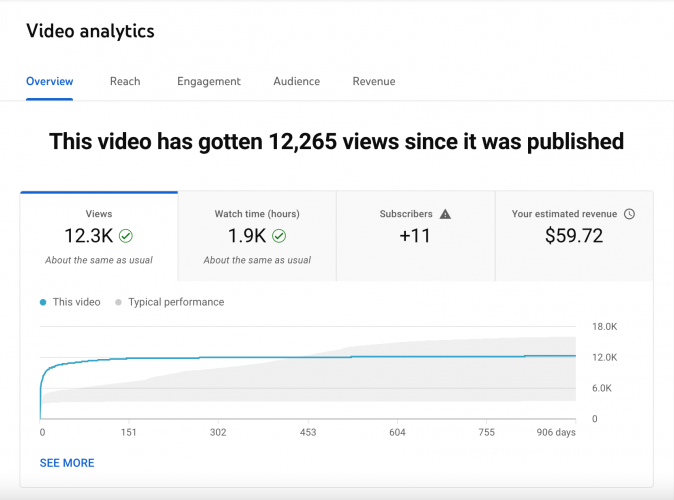
Another really good product I am very proud of, even if the audience doesn't find it that appealing. And I'll admit that I am disappointed that I have yet to solve the riddle of how to make content like this our most popular content.
If you want to watch, here is a link -
Quite simply, without these people, these volunteers, the folks over on the "Duke" thread don't have any ram tags to go buy at auctions. Yet, who does the collective audience of hunters seem to be most enamored with, not Oak, not his fellow volunteers, not Matt in this video, not Art in this video. Rather, they like watching the dudes who waive their big check books and shoot rams in the ass; rams none of us will likely ever get to hunt and rams that are on the mountain because of a lot of volunteers taking time from family and jobs to do something good for wildlife.
Here is the result of another $30,000 investment to tell a conservation story. A good way to lose your ass from a business perspective. But, fortunately for me, I have a livelihood outside this operation that allows me to do what I damn well please, no matter the financial ramifications. Most aren't in that situation.
All told, over the last 2.5 years, we got 11 new subscribers and $60 of revenue.
Another really good product I am very proud of, even if the audience doesn't find it that appealing. And I'll admit that I am disappointed that I have yet to solve the riddle of how to make content like this our most popular content.
If you want to watch, here is a link -

huntin24/7
Well-known member
Good question. I think the only way to make it more difficult while still providing a decent amount of opportunity is by making seasons more difficult either by timing or length of season and or more primitive weapons seasons. If people want to continue to have plenty of opportunity to hunt western big game at the rate the popularity of it is growing, then seasons will have to have lower success rates…in my lowly opinion anyways. Either that or more limited entry I guess. But I don’t think the resource can handle the increased pressure in most western states at the current growth rate of hunters.That could be it's own thread. How would you make it harder? Fixed power scopes? No scopes? No electronic devices on your person? No calling? Only straight walked cartridges? What are we talking here?
BuzzH
Well-known member
Me as well, I liked that video and the one on the Yellowstone River wayyyyyyy more than another blasting an elk episode or any other Randy has done. Sad that these episodes aren't the ones people gravitate more toward, truly is.I liked that one...
I don't watch many of the video's where its just shoot another elk type deal, boring. I've BTDT a lot...and there flat isn't much for me to learn about shooting elk anymore. Elk habitat, conservation, habits of elk, etc. yes, never stop learning and in 3 lifetimes you'd still not know it all about those things.
But, my final thoughts are, I can see where Matt Rinella is coming from. I think Matt focused a little too much on himself and his hunting though. It can't be just about him.
I don't mean to sound like someone who doesn't want to introduce people to hunting either. I do, I just hope its the right people. I also don't mind sharing the woods with the right people. People that are ethical, show some compassion to the animals they hunt, are willing to be courteous to other hunters, want to learn about the animals they hunt, habitat, etc.
That used to be the norm, now the norm is, "It's public land, I'll do what I want"...been a huge change in my lifetime, way too competitive, way too much emphasis on everything but the actual hunt...and I don't have to like it.

i do think buzz is correct - nobody needs to do the legwork, the level of commitment required to be good is going away, and with it, the level of commitment to the resource and the ethics.
but i must disagree on one point: that it is only the new hunters.
even with Big Fins analytics from youtube.....
let me make my hypothetical case with that information - i don't think Fin's youtube results would be any different if hunting hadn't recruited a SINGLE new hunter since before youtube, instagram, and facebook were invented.
let's just make up a number and say that 80% of the hutners we're recruiting are the types Buzz is talking about - kinda lazy, only care about big antlers, uninterested in getting involved, etc. is it so hard to suspect or believe that 80% of the hunters that have been at it for 20 or 25+ years are also that type? i have feeling the proportions are similar.
it even, might, JUST might, be that the newer hunters are more driven by ethics and food than the previous generation.
in other words, i think whether the hunter started last year, or 30 years ago, the odds that they are lazy; uninterested in involvement; have questionable ethics; uniterested in researching, learning, studying, etc, etc. is close to similar.
i'll go back to some of my first comments in this thread, wayyyyy back in the early pages. our problem here is people. not the new people, not the engrained long timers, just people, we're just contending with way more of them. we've recruited a lot of more hunters, and therefore, a lot more shitty hunters, but i can't see that they are only that way cause they are new.
but i must disagree on one point: that it is only the new hunters.
even with Big Fins analytics from youtube.....
let me make my hypothetical case with that information - i don't think Fin's youtube results would be any different if hunting hadn't recruited a SINGLE new hunter since before youtube, instagram, and facebook were invented.
let's just make up a number and say that 80% of the hutners we're recruiting are the types Buzz is talking about - kinda lazy, only care about big antlers, uninterested in getting involved, etc. is it so hard to suspect or believe that 80% of the hunters that have been at it for 20 or 25+ years are also that type? i have feeling the proportions are similar.
it even, might, JUST might, be that the newer hunters are more driven by ethics and food than the previous generation.
in other words, i think whether the hunter started last year, or 30 years ago, the odds that they are lazy; uninterested in involvement; have questionable ethics; uniterested in researching, learning, studying, etc, etc. is close to similar.
i'll go back to some of my first comments in this thread, wayyyyy back in the early pages. our problem here is people. not the new people, not the engrained long timers, just people, we're just contending with way more of them. we've recruited a lot of more hunters, and therefore, a lot more shitty hunters, but i can't see that they are only that way cause they are new.
Last edited:
BuzzH
Well-known member
Another that I liked, a lot. That was a great video and I really appreciated whoever it was that had done all the work for sheep and had never even drawn a tag.This is even a worse performing video that took three trips to Nevada to talk about volunteers that works so selflessly on behalf of wild sheep. These folks and their peers are the core of conservation in America. I think about @Oak and his fellows at RMBS who are the equivalent of what we showed in this video.
Quite simply, without these people, these volunteers, the folks over on the "Duke" thread don't have any ram tags to go buy at auctions. Yet, who does the collective audience of hunters seem to be most enamored with, not Oak, not his fellow volunteers, not Matt in this video, not Art in this video. Rather, they like watching the dudes who waive their big check books and shoot rams in the ass; rams none of us will likely ever get to hunt and rams that are on the mountain because of a lot of volunteers taking time from family and jobs to do something good for wildlife.
Here is the result of another $30,000 investment to tell a conservation story. A good way to lose your ass from a business perspective. But, fortunately for me, I have a livelihood outside this operation that allows me to do what I damn well please, no matter the financial ramifications. Most aren't in that situation.
All told, over the last 2.5 years, we got 11 new subscribers and $60 of revenue.
View attachment 208736
Another really good product I am very proud of, even if the audience doesn't find it that appealing. And I'll admit that I am disappointed that I have yet to solve the riddle of how to make content like this our most popular content.
If you want to watch, here is a link -
THAT GUY is who we should all strive to be and who we need to bring into the sport...dedicated, passionate, and he's certainly doing what he does for more than just himself.

Last Place
New member
In the Meateater podcast I think Steve made a really good point - what's the difference between social media postings and DU, Field & Stream, BHA, etc.
Media and entertainment is crucial in maintaining hunting for future generations. It is our responsibility to choose what we decide to be responsible entertainment and promote the image we wish to portray.
Media and entertainment is crucial in maintaining hunting for future generations. It is our responsibility to choose what we decide to be responsible entertainment and promote the image we wish to portray.
BuzzH
Well-known member
Wow, that's a tough question, but IMO, yes he is.Do you consider someone like Matt Rinella a solid advocate though? I'm not sure I do. Regardless of his actual advocacy positions and the fact that he'd probably be fun to hunt and have a beer with, he surfaces too infrequently and comes across too harsh to be 'solid' in my book.
You're right, uphill battle for sure...
His day job alone separates him pretty far from the rest of the field. Its pretty tough to say the Man isn't dedicated when he spends his life, and career, for wildlife and wildlife habitat. Conservation of some sort is probably on his mind 24-7.
If all he REALLY cared about, was whacking and stacking animals, doubtful he'd be a research ecologist in podunk Montana, making crap for wages. Let's just be brutally honest for a moment. A heart surgeon living in downtown Chicago can hunt the best of the best every year. I bet Matt could be doing a lot of things to make a lot more money that would afford him that same luxury. Make NO mistake, there's a higher level of connection to the wildlife and land from him than 99.9% of the people that hunt.
I can say its the same for me, its not like Laramie is some mecca for high wages, great weather and awesome culture. But its how I want to spend my life...close to the land, close to the wildlife, and hoping, that maybe, just maybe I get lucky and do some good for both.
As far as coming across as harsh, people tend to hear what they want. Its more important to listen to the message than the delivery.
I mean, come on...some people say I come across as "harsh".
LuketheDog
Well-known member
I mean, come on...some people say I come across as "harsh".
Only when you clearly need a Snickers...

BuzzH
Well-known member
I was laughing so hard it was tough for me to type that...Only when you clearly need a Snickers...
Irrelevant
Well-known member
Every hunter I grew up around fit that mold. It took a while to realize that was more to it.i think whether the hunter started last year, or 30 years ago, the odds that they are lazy; uninterested in involvement; have questionable ethics; uniterested in researching, learning, studying, etc, etc. is close to similar.
Similar threads

- Replies
- 192
- Views
- 5K
- Replies
- 26
- Views
- 2K

- Replies
- 159
- Views
- 8K


- Replies
- 7
- Views
- 220
- Replies
- 18
- Views
- 2K