This also gets to the point of needing good regulation and good regulators to enforce them. I am not for government waste, but paying the DEQ staff according to their worth would make the position much more appealing. We want very intelligent and capable people in those positions. That's not to say there are not great mine managers and environmental engineers in industry that care deeply for the environment, but they are hemmed in by investors and executives that eye profit. We also need elected legislatures that will staff DEQ accordingly and keep their eye on the long term impact which ultimately falls to each of us as voters to keep them accountable.



Navigation
Install the app
How to install the app on iOS
Follow along with the video below to see how to install our site as a web app on your home screen.
Note: This feature may not be available in some browsers.
More options

You are using an out of date browser. It may not display this or other websites correctly.
You should upgrade or use an alternative browser.
You should upgrade or use an alternative browser.
Ranchers Shouldering the Waste of Mining and Coal Bed Methane?
- Thread starter Big Fin
- Start date
WyoCoalMiner
Well-known member
- Joined
- Nov 14, 2024
- Messages
- 537
Most winters that is one deer killing stretch of highway. The crossings will be a great thing for those deer.Not sure if it’s related to the nuke plant or not, but they are also in the process of high fencing 189 from I-80 to Kemmerer with a game bridge and some tunnels for game crossing.

BigHornRam
Well-known member
The article briefly touch on this detail of the Tongue River and its tributaries, but then went on to basically dismiss it.
wsgs-2011-mp-90.pdf https://share.google/IiXIBa2dJ3NFbWWGF
Mentioned coalbed methane development has been replaced by fracking, but didn't elaborate. Used the opinions of a legacy rancher for most of the information presented in the article. Kind of reminded me of a 60 Minutes "news" segment.
wsgs-2011-mp-90.pdf https://share.google/IiXIBa2dJ3NFbWWGF
Mentioned coalbed methane development has been replaced by fracking, but didn't elaborate. Used the opinions of a legacy rancher for most of the information presented in the article. Kind of reminded me of a 60 Minutes "news" segment.

It’s definitely better, but problems still exist. Such as the zombie/ghost/orphan oil/gas wells in Texas.This is understandable and, as you state, justified. I would like to be able to say that those issues can't happen in today's environment but that wouldn't be true. Cleanup and mitigation are significantly better today than in the S. IL boom days but it's not perfect. The ability to rape and pillage today is much less but its not zero.
WyoCoalMiner
Well-known member
- Joined
- Nov 14, 2024
- Messages
- 537
Interesting research article.The article briefly touch on this detail of the Tongue River and its tributaries, but then went on to basically dismiss it.
wsgs-2011-mp-90.pdf https://share.google/IiXIBa2dJ3NFbWWGF
Mentioned coalbed methane development has been replaced by fracking, but didn't elaborate. Used the opinions of a legacy rancher for most of the information presented in the article. Kind of reminded me of a 60 Minutes "news" segment.

The article briefly touch on this detail of the Tongue River and its tributaries, but then went on to basically dismiss it.
wsgs-2011-mp-90.pdf https://share.google/IiXIBa2dJ3NFbWWGF
Mentioned coalbed methane development has been replaced by fracking, but didn't elaborate. Used the opinions of a legacy rancher for most of the information presented in the article. Kind of reminded me of a 60 Minutes "news" segment.
Interesting study. The CBM boom was mostly bust by 2010/2011 in terms of drilling and produced water. I'd be curious to see if this research was done at an earlier point, when discharge was much higher.

BigHornRam
Well-known member
Irrigation practices could have an effect on salinity levels in the arid west.I wonder what effect cattle being in close proximity (and in many cases actually standing in) these creeks may have in salinity levels?

Irrelevant
Well-known member
This is the figurative mission statement of one political party...The entirePowder Rivercountry got hammered for short term gains and left a long-term mess for everyone else to clean up.
Drill Baby Drill

elkduds
Well-known member
. . .and sell off public lands. Private property is the only property that matters.This is the figurative mission statement of one political party...
Drill Baby Drill
Last edited:
No, not really. As I told you privately, I do not support the sell-off of public lands to private owners or to the States that can then turn around and do the same thing such as what Mike Lee has tried to push through. It would appear your reading comprehension needs some work. I consider public lands a national treasure that should be maintained for all and have been very consistent on that position. But I do acknowledge and support private property rights 100%. That is two very distinct and different topics. It's a shame you don't support one of the foundational tenants that formed the US in the first place and is enshrined in the 5th Amendment (and supported by the 4th Amendment). Perhaps you should read the writings of James Madison and Alexander Hamilton. If you support the "No Kings" movement, then you (should) support the right of the individual to own private property and have that property protected from unreasonable seizure. Monarchies (Kings) claim ownership of all the lands in their kingdom and only graciously allow individuals the opportunity to own land in exchange for loyalty and service or lease that land at a (usually) steep price.. . .and sell off public lands. Private property is the only property that matters; did I get that right, @Alpine01?
Irrelevant
Well-known member
Man, there are some damning quotes:
Former Gov. Judy Martz, a Republican who famously said she didn’t mind being a “lapdog” for industry, was so eager to fan the flames of the CBM boom that in the early 2000s, she reportedly drank a glass of discharge water to ease locals’ water-quality fears.
Another background article from a decade ago.

 wyofile.com
Under the administration of Republican Gov. Jim Geringer, Wyoming was eager to swing the doors open wide for the promising new drilling boom, leading to a letter that became famous—known as the “Go Blue” letter. The letter, from Assistant Director of Wyoming’s Office of State Lands and Investments Harold Kemp, urged companies to drill on the state sections, which are shown in blue on land ownership maps.
Kemp wrote, “… if permitting costs on federal lands consistently exceed those same costs on State of Wyoming lands by as many as four-hundred times or more, (as little as $20 on State land and as much as $8,000 on federal land) there seems to be a compelling reason to evaluate placing that drilling venture on Wyoming State land. As such, we’re asking you to take another look at the blue squares on the Wyoming Land Status map and ‘fill them in’ with your well symbols.”
The letter took even a sharper turn into the realm of state-sanctioned boom-mentality propaganda, stating, “We stand ready here at the Office of State Lands, assisted by Wyoming’s Office of the Oil and Gas Supervisor, (Oil and Gas Conservation Commission) to provide all the assistance you need to ‘Go Blue.’ Try it!”
And try it they did. State sections, many of which are isolated islands in a sea of private surface, were developed, often without concern for the state surface or the surrounding private surface operations. Though the main duty of Kemp’s office was and is to maximize the financial return from state lands, many conservation groups and landowners found the “Go Blue” letter irresponsible. In their eyes it helped operators—many eager to begin making good on their investments—bypass the good-faith requirement to work out meaningful surface use agreements with landowners.
“Going blue” often led to operators discharging coal-bed methane water on the surface with little regard to the downstream surface owners. This exacerbated one of the most contentious issues of the play, pitting neighbors against one another for gas production that resulted in large volumes of briny groundwater flowing year-long over ephemeral draws. Historically, these draws had been dry most of the year and prime grazing grounds in the arid Powder River Basin.
The red highlight seems to be contradictory to @WyoCoalMiner's claims, but maybe it was a different time.
The MTFP article just reaffirms how little I trust industry, regulators, and politicians to protect my health and the environment.
Former Gov. Judy Martz, a Republican who famously said she didn’t mind being a “lapdog” for industry, was so eager to fan the flames of the CBM boom that in the early 2000s, she reportedly drank a glass of discharge water to ease locals’ water-quality fears.
Another background article from a decade ago.
Coal-bed Methane: Boom, bust and hard lessons - WyoFile
Wyoming’s coal-bed methane boom in the early 2000s stirred controversies over land rights, mineral rights, the disposal of water and—at every turn—politics.
wyofile.com
Under the administration of Republican Gov. Jim Geringer, Wyoming was eager to swing the doors open wide for the promising new drilling boom, leading to a letter that became famous—known as the “Go Blue” letter. The letter, from Assistant Director of Wyoming’s Office of State Lands and Investments Harold Kemp, urged companies to drill on the state sections, which are shown in blue on land ownership maps.
Kemp wrote, “… if permitting costs on federal lands consistently exceed those same costs on State of Wyoming lands by as many as four-hundred times or more, (as little as $20 on State land and as much as $8,000 on federal land) there seems to be a compelling reason to evaluate placing that drilling venture on Wyoming State land. As such, we’re asking you to take another look at the blue squares on the Wyoming Land Status map and ‘fill them in’ with your well symbols.”
The letter took even a sharper turn into the realm of state-sanctioned boom-mentality propaganda, stating, “We stand ready here at the Office of State Lands, assisted by Wyoming’s Office of the Oil and Gas Supervisor, (Oil and Gas Conservation Commission) to provide all the assistance you need to ‘Go Blue.’ Try it!”
And try it they did. State sections, many of which are isolated islands in a sea of private surface, were developed, often without concern for the state surface or the surrounding private surface operations. Though the main duty of Kemp’s office was and is to maximize the financial return from state lands, many conservation groups and landowners found the “Go Blue” letter irresponsible. In their eyes it helped operators—many eager to begin making good on their investments—bypass the good-faith requirement to work out meaningful surface use agreements with landowners.
“Going blue” often led to operators discharging coal-bed methane water on the surface with little regard to the downstream surface owners. This exacerbated one of the most contentious issues of the play, pitting neighbors against one another for gas production that resulted in large volumes of briny groundwater flowing year-long over ephemeral draws. Historically, these draws had been dry most of the year and prime grazing grounds in the arid Powder River Basin.
The red highlight seems to be contradictory to @WyoCoalMiner's claims, but maybe it was a different time.
The MTFP article just reaffirms how little I trust industry, regulators, and politicians to protect my health and the environment.
WyoCoalMiner
Well-known member
- Joined
- Nov 14, 2024
- Messages
- 537
I said nothing in regard to permitting costs. Cost to permit is not the same as reclamation bonding.Man, there are some damning quotes:
Former Gov. Judy Martz, a Republican who famously said she didn’t mind being a “lapdog” for industry, was so eager to fan the flames of the CBM boom that in the early 2000s, she reportedly drank a glass of discharge water to ease locals’ water-quality fears.
Another background article from a decade ago.
Coal-bed Methane: Boom, bust and hard lessons - WyoFile
Wyoming’s coal-bed methane boom in the early 2000s stirred controversies over land rights, mineral rights, the disposal of water and—at every turn—politics.
Under the administration of Republican Gov. Jim Geringer, Wyoming was eager to swing the doors open wide for the promising new drilling boom, leading to a letter that became famous—known as the “Go Blue” letter. The letter, from Assistant Director of Wyoming’s Office of State Lands and Investments Harold Kemp, urged companies to drill on the state sections, which are shown in blue on land ownership maps.
Kemp wrote, “… if permitting costs on federal lands consistently exceed those same costs on State of Wyoming lands by as many as four-hundred times or more, (as little as $20 on State land and as much as $8,000 on federal land) there seems to be a compelling reason to evaluate placing that drilling venture on Wyoming State land. As such, we’re asking you to take another look at the blue squares on the Wyoming Land Status map and ‘fill them in’ with your well symbols.”
The red highlight seems to be contradictory to @WyoCoalMiner's claims, but maybe it was a different time.
elkduds
Well-known member
Thanks for demonstrating for others the pervasive flaw in your private correspondence. "It's a shame you don't support. . ." People know what they said or wrote. Your tactic of inserting your bias into statements you wrongly attribute to others has likely ended more discussions than you realize. I said nothing above about opposition to private property rights. So everything you wrote above after "It's a shame" was you telling yourself what you already believe, moot to me. There's this principle in communication, checking for understanding, in which you seek input from whoever you are interfacing with to see if they understand you and you understand them. Perhaps you should readNo, not really. As I told you privately, I do not support the sell-off of public lands to private owners or to the States that can then turn around and do the same thing such as what Mike Lee has tried to push through. It would appear your reading comprehension needs some work. I consider public lands a national treasure that should be maintained for all and have been very consistent on that position. But I do acknowledge and support private property rights 100%. That is two very distinct and different topics. It's a shame you don't support one of the foundational tenants that formed the US in the first place and is enshrined in the 5th Amendment (and supported by the 4th Amendment). Perhaps you should read the writings of James Madison and Alexander Hamilton. If you support the "No Kings" movement, then you (should) support the right of the individual to own private property and have that property protected from unreasonable seizure. Monarchies (Kings) claim ownership of all the lands in their kingdom and only graciously allow individuals the opportunity to own land in exchange for loyalty and service or lease that land at a (usually) steep price.
Whether you do or don't, correcting your "you were wrong when you said that thing you never said" assertions is not the responsibility anyone except you. Boredom with and ignoring your tiresome, manipulative strategies of arguing do not connote agreement with you.
I thank you and everyone who advocates on behalf of our public lands legacy and treasures.
Irrelevant
Well-known member
Oh, I assumed they were included because you need a bond to be permitted.I said nothing in regard to permitting costs. Cost to permit is not the same as reclamation bonding.
This is not the thread to hash this discussion - but since you persist ....Thanks for demonstrating for others the pervasive flaw in your private correspondence. "It's a shame you don't support. . ." People know what they said or wrote. Your tactic of inserting your bias into statements you wrongly attribute to others has likely ended more discussions than you realize. I said nothing above about opposition to private property rights. So everything you wrote above after "It's a shame" was you telling yourself what you already believe, moot to me. There's this principle in communication, checking for understanding, in which you seek input from whoever you are interfacing with to see if they understand you and you understand them.
Post #42 on the thread "OR Ballot to end hunting, ....: elkduds: "Democrats like me value ..., fair distribution of wealth; ....". I asked you (privately) to clarify what that meant, to "check[ing] for understanding, in which you seek input from whoever you are interfacing with to see if they understand you and you understand them." You chose not to elaborate which is your prerogative even when I asked how this applies to private property. Private property in all its forms is "wealth"; land, buildings, collectibles, precious metals, stocks, etc. But you stated quite clearly that you believe in redistribution of that wealth, presumably by the government, and most assuredly against the wishes of the individual that owns that wealth. So given that, one can only surmise that you don't support private property rights. At least you refused to state that explicitly in our side discussion. So which is it, do you still advocate for taking someone else's wealth (i.e., property) and redistributing it or do you support private property rights? Please help me understand your position better. You can do it privately so as not to derail this thread or do it here. Makes no difference to me. And I will leave you the last word. As I said, this is not the place to hash this out so I am done with the topic on this thread.

antlerradar
Well-known member
Almost noneI wonder what effect cattle being in close proximity (and in many cases actually standing in) these creeks may have in salinity levels?
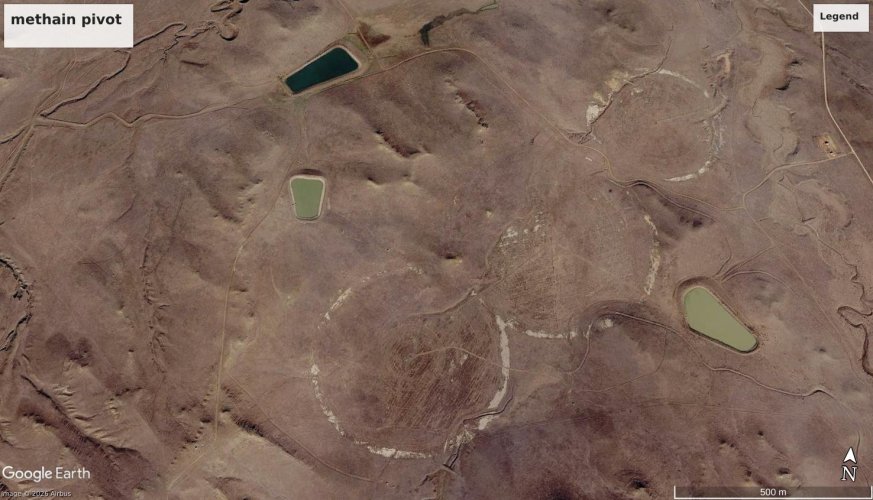
It is not hard to figure out where the salt is coming from. Here is a google earth shot of three coal bed methane pivots. You can still see the salt on the top of the ground close to 20 years later.
WyoCoalMiner
Well-known member
- Joined
- Nov 14, 2024
- Messages
- 537
When operating on State land you will have a state bond, similar to the Federal bond, which is really just to hold your right to mine that chunk of state land. You will also have a reclamation bond held by the state. This is the bond that gets huge, depending on disturbance. Same system as Federal but the right to operate bond rates for state and Fed are different. I am not certain what the State rate is but similar to the Federal rate its small, relative to the reclamation bond. The reclamation bond starts out very small but grows as you disturb ground. Both of these bonds are needed to get a permit but at the start amount to not much. I believe it is a similar system for O&G but it is possible there is a difference.Oh, I assumed they were included because you need a bond to be permitted.
BigHornRam
Well-known member
Based on the study around 2012, the salt flush in the spring into the Tongue, is coming from a different source.Almost none
It is not hard to figure out where the salt is coming from. Here is a google earth shot of three coal bed methane pivots. You can still see the salt on the top of the ground close to 20 years later.View attachment 411173
"CBNG produced water is being
ruled out as the source because it
has a distinct water chemistry and
isotopic signature. CBNG produced
waters have water compositions that
are strongly sodium bicarbonate
and have a unique carbon isotopic
signature. The isotopic compositions
of most CBNG water samples are
much higher than normal surface
water. This isotopic fingerprint is a
by-product of the microbes that have
generated the gas that resides within
the coal beds. The scientists tested
for CBNG produced water, the
composition that is high in sodium
bicarbonate with a unique carbon
isotopic signature; neither of which
was observed in the surface water
of the Tongue River. As a result, the
preliminary findings indicate that
the elevated TDS in the water in the
Tongue River was not caused from discharged CBNG
produced waters.
Conclusion
The preliminary results of this study show that CBNG
produced water is not the cause of the elevated salinity in
the Tongue River in early spring. The scientists indicate
that the elevated TDS measured at the Wyoming/Montana
border in February and March is a natural process, which
was likely caused by the underlying geology of the Powder
River Basin and watershed, and related to the earlier
snowmelt in the basin interior.
The Wyoming DEQ and Montana DEQ can use this
research as a basis for future inquiry on the water quality of
the Tongue River. Geologists can also apply this research
and water sampling methods to better characterize other
watersheds in the state and study whether rivers in other
basins are also affected by the underlying geology of the
region."
Now if land owners are using CBNG well water to feed their pivots for the past 20 years, a new study should be done to see if it can now be detected.
WyoCoalMiner
Well-known member
- Joined
- Nov 14, 2024
- Messages
- 537
Were they running those pivots to irrigate a crop or simply to increase evaporation of waste water?Almost none
It is not hard to figure out where the salt is coming from. Here is a google earth shot of three coal bed methane pivots. You can still see the salt on the top of the ground close to 20 years later.View attachment 411173
Similar threads
- Replies
- 3
- Views
- 621


- Replies
- 23
- Views
- 1K
- Replies
- 0
- Views
- 115