I’m guessing it’s a little what gambling feels like, but when I see unsuccessful my first reaction is to log back in and apply for the next thing immediately. Like “No good deer/elk tag, all in on M/S/G. Nada, let’s throw the deed down for deer B cause baby needs a new pair of shoes!”



Navigation
Install the app
How to install the app on iOS
Follow along with the video below to see how to install our site as a web app on your home screen.
Note: This feature may not be available in some browsers.
More options

You are using an out of date browser. It may not display this or other websites correctly.
You should upgrade or use an alternative browser.
You should upgrade or use an alternative browser.
MT- M/S/G results 26
- Thread starter brownbear932008
- Start date

Forkyfinder
Well-known member
- Joined
- Dec 13, 2023
- Messages
- 6,220
Lol thats grade A buzzard math....Ok, I see what you're doing there. So if that's true, a lot of hunts would be better for even the top point holders if there was no point system. lol
Actual Moose hunt in MT: 12 permits
Applicants: 978
12/978 = 1.2% draw odds (no points)
25 point holder - 626 squared points (chances)
Total squared points from all applicants - 65,238
626/65,238 = .96%
Notice how the bonus points math is entirely missing the quantity of permits? Just need to multiply by tags.... 0.96 × 12 = 11.5%.
Yes this is ignoring the loss of bonus points as the draw continues - but that only helps the point im making. Theoretically the odds of the "second" permit will be better, because some bonus points/applicants are gone after each time someone draws. But with small tag numbers and the high applicant count its not a crazy assumption, even if a lot of bonus points disappear. Ie - a 25 point holder draws the first moose tag - then the next tag drawn, for our 25 point holder will have 626/64612 = 0.0968, or .97%.

brownbear932008
Well-known member
But yet old guys feel they are entitled to a permit after 65. (Coming from an older guy just not nearly 65) Maine started that junk with residents. I can only imagine folks younger than 65 are having a hard time drawing there now with so few tags.Nailed it!

Wildabeest
Well-known member
Per my response above, multiplying the probability of winning a tag by the number of tags doesn’t work. You could easily get a result where your probability is greater than 100%.Lol thats grade A buzzard math....
Notice how the bonus points math is entirely missing the quantity of permits? Just need to multiply by tags.... 0.96 × 12 = 11.5%.
Yes this is ignoring the loss of bonus points as the draw continues - but that only helps the point im making. Theoretically the odds of the "second" permit will be better, because some bonus points/applicants are gone after each time someone draws. But with small tag numbers and the high applicant count its not a crazy assumption, even if a lot of bonus points disappear. Ie - a 25 point holder draws the first moose tag - then the next tag drawn, for our 25 point holder will have 626/64612 = 0.0968, or .97%.
For example, let’s say there are 50 prizes (ie. tags), 100 tickets sold (ie. total points in the draw) and you have 10 tickets (points). Your probability of winning the first drawn is 10/100=10%. Using your math, if there’s 50 tags to hand out then you’d say your probability of winning any one of those would be 0.1*50 = 5.0 (or 500%). That can’t be right because there’s definitely a scenario where they draw 50 tickets and none of them is yours.
Your probability of winning any one of those 50 tags is really (100% - (90% chance of losing ^ 10)) = 0.65, or 65%.
Note the example above is for independent draws meaning they put the winning ticket back in after each draw. But the logic also works for non-independent draws where the ticket is not put back in (ie. you can’t win multiple times) - you just need to adjust the probability of NOT winning for each subsequent draw and multiply those together instead of raising the original probability of NOT winning the first tag to the power of the number of tags. That would be (100% - (10/100 * 10/99 * 10/98 * 10/97 * … * 10/50)).
Last edited:
SAJ-99
Well-known member
I think the point is it is a quick shortcut. The odds of not drawing are so large that it gets you close to the true number without having to do all the math, which isn't a strength of HT.Per my response above, multiplying the probability of winning a tag by the number of tags doesn’t work. You could easily get a result where your probability is greater than 100%.
For example, let’s say there are 50 prizes (ie. tags), 100 tickets sold (ie. total points in the draw) and you have 10 tickets (points). Your probability of winning the first drawn is 10/100=10%. Using your math, if there’s 50 tags to hand out then you’d say your probability of winning any one of those would be 0.1*50 = 5.0 (or 500%). That can’t be right because there’s definitely a scenario where they draw 50 tickets and none of them is yours.
Your probability of winning any one of those 50 tags is really 100% x (90% chance of losing ^ 10) = 0.65, or 65%.
Note the example above is for independent draws meaning they put the winning ticket back in after each draw. But the logic also works for non-independent draws where the ticket is not put back in (ie. you can’t win multiple times) - you just need to adjust the probability of NOT winning for each subsequent draw and multiply those together instead of raising the original probability of NOT winning the first tag to the power of the number of tags.
I wonder if they ever imagined have so many people jump in the bonus pool (pun intended) when it started? The more I look at the stats the more I think I will be withdrawing from applying for these tags going forward.

This is correct. But, when the odds are as low as sheep and moose tags, I think multiplying by the number of tags will still get you fairly close.Per my response above, multiplying the probability of winning a tag by the number of tags doesn’t work. You could easily get a result where your probability is greater than 100%.
For example, let’s say there are 50 prizes (ie. tags), 100 tickets sold (ie. total points in the draw) and you have 10 tickets (points). Your probability of winning the first drawn is 10/100=10%. Using your math, if there’s 50 tags to hand out then you’d say your probability of winning any one of those would be 0.1*50 = 5.0 (or 500%). That can’t be right because there’s definitely a scenario where they draw 50 tickets and none of them is yours.
Your probability of winning any one of those 50 tags is really (100% - (90% chance of losing ^ 10)) = 0.65, or 65%.
Note the example above is for independent draws meaning they put the winning ticket back in after each draw. But the logic also works for non-independent draws where the ticket is not put back in (ie. you can’t win multiple times) - you just need to adjust the probability of NOT winning for each subsequent draw and multiply those together instead of raising the original probability of NOT winning the first tag to the power of the number of tags.
Forkyfinder
Well-known member
- Joined
- Dec 13, 2023
- Messages
- 6,220
Yes. That is precisely the point.I think the point is it is a quick shortcut. The odds of not drawing are so large that it gets you close to the true number without having to do all the math, which isn't a strength of HT.
Last edited:

sclancy27
Well-known member
- Joined
- Nov 23, 2022
- Messages
- 1,112
Wouldn't that be (100% - (90% chance of losing ^ 50)) =.995 or 99.5%.......?Per my response above, multiplying the probability of winning a tag by the number of tags doesn’t work. You could easily get a result where your probability is greater than 100%.
For example, let’s say there are 50 prizes (ie. tags), 100 tickets sold (ie. total points in the draw) and you have 10 tickets (points). Your probability of winning the first drawn is 10/100=10%. Using your math, if there’s 50 tags to hand out then you’d say your probability of winning any one of those would be 0.1*50 = 5.0 (or 500%). That can’t be right because there’s definitely a scenario where they draw 50 tickets and none of them is yours.
Your probability of winning any one of those 50 tags is really (100% - (90% chance of losing ^ 10)) = 0.65, or 65%.
Note the example above is for independent draws meaning they put the winning ticket back in after each draw. But the logic also works for non-independent draws where the ticket is not put back in (ie. you can’t win multiple times) - you just need to adjust the probability of NOT winning for each subsequent draw and multiply those together instead of raising the original probability of NOT winning the first tag to the power of the number of tags. That would be (100% - (10/100 * 10/99 * 10/98 * 10/97 * … * 10/50)).

The answer to that is NO.I wonder if they ever imagined have so many people jump in the bonus pool (pun intended) when it started? The more I look at the stats the more I think I will be withdrawing from applying for these tags going forward.
The committee was shown the historical application trends for each species. The numbers we were shown were based on the old system of having to front the money, via a check, and mail in an application. The legislature changed all of that, as they did with squaring bonus points, something the Committee rejected when seeing the math behind such idea. I testified against the legislative changes, as did a few others who sat on the Committee. No surprise, but legislators were not interested in data that did not support their narrative.
We were shown the miniscule improvement by squaring bonus points, especially for species with so few tags, such as M/G/S. It does almost nothing to improve the odds of those who get in on the ground floor, yet serious decreases the odds of those who got in at a later date.
No matter what math one subscribes to for the exercise of the most recent posts, if we keep losing herds and having fewer tags, it is a moot issue. In third grade, when I was taught fractions, it became very obvious that increasing the numerator is a great way to increase the ending result. Better draw odds won't come from finding obscure ways to slow down the growth in the denominator, rather finding ways to increase the numerator (tags issued).
BuzzH
Well-known member
Lol thats grade A buzzard math....
Notice how the bonus points math is entirely missing the quantity of permits? Just need to multiply by tags.... 0.96 × 12 = 11.5%.
Yes this is ignoring the loss of bonus points as the draw continues - but that only helps the point im making. Theoretically the odds of the "second" permit will be better, because some bonus points/applicants are gone after each time someone draws. But with small tag numbers and the high applicant count its not a crazy assumption, even if a lot of bonus points disappear. Ie - a 25 point holder draws the first moose tag - then the next tag drawn, for our 25 point holder will have 626/64612 = 0.0968, or .97%.
 math...11% moose odds are found in fantasyland, certainly not in Montana.
duckhunt
Well-known member
DQ double cheeseburgers are the bomb.Think they have a Dairy Queen for the boomers
Song Dog 2224
Well-known member
- Joined
- May 15, 2025
- Messages
- 195
I should have near max bonus points for all 3 species. In college, however, being poor for a few years and not knowing the rules, I didn’t apply 2 years in a row and at the time, you lost all bonus points if you did that. What a bummer that was. I reached out about getting them back now that the rules have changed and they said I was SOL. The price of admission was small but I was young and dumb.
sclancy27
Well-known member
- Joined
- Nov 23, 2022
- Messages
- 1,112
I did the same thing.I should have near max bonus points for all 3 species. In college, however, being poor for a few years and not knowing the rules, I didn’t apply 2 years in a row and at the time, you lost all bonus points if you did that. What a bummer that was. I reached out about getting them back now that the rules have changed and they said I was SOL. The price of admission was small but I was young and dumb.

5yearcoueshunter
Well-known member
- Joined
- Dec 6, 2022
- Messages
- 144
Ok, thanks for that explanation.Per my response above, multiplying the probability of winning a tag by the number of tags doesn’t work. You could easily get a result where your probability is greater than 100%.
For example, let’s say there are 50 prizes (ie. tags), 100 tickets sold (ie. total points in the draw) and you have 10 tickets (points). Your probability of winning the first drawn is 10/100=10%. Using your math, if there’s 50 tags to hand out then you’d say your probability of winning any one of those would be 0.1*50 = 5.0 (or 500%). That can’t be right because there’s definitely a scenario where they draw 50 tickets and none of them is yours.
Your probability of winning any one of those 50 tags is really (100% - (90% chance of losing ^ 10)) = 0.65, or 65%.
Note the example above is for independent draws meaning they put the winning ticket back in after each draw. But the logic also works for non-independent draws where the ticket is not put back in (ie. you can’t win multiple times) - you just need to adjust the probability of NOT winning for each subsequent draw and multiply those together instead of raising the original probability of NOT winning the first tag to the power of the number of tags. That would be (100% - (10/100 * 10/99 * 10/98 * 10/97 * … * 10/50)).
So using this real world example I had earlier, looks like odds of drawing is at least 10.92%? (this would assume no chances/tickets are taken out after each successful pull)
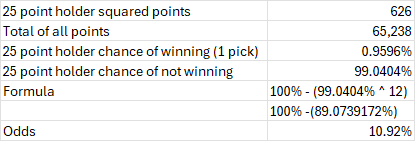
View attachment 408121
SAJ-99
Well-known member
Looking at 2026 results for 100-50 with 12 tags, the 1 applicant with 26 points looks like he was close to that, no? You have remember that still is close to 90% not drawing any of those tags.
Someone with 1 point drew. The odds on that were incredibly small. Probably need an audit on that.

antlerradar
Well-known member
you were never dumbI should have near max bonus points for all 3 species. In college, however, being poor for a few years and not knowing the rules, I didn’t apply 2 years in a row and at the time, you lost all bonus points if you did that. What a bummer that was. I reached out about getting them back now that the rules have changed and they said I was SOL. The price of admission was small but I was young and dumb.

cgasner1
Well-known member
- Joined
- Apr 24, 2016
- Messages
- 5,792
That a jab at @sclancy27 ?you were never dumb
Stone_Ice_1
Well-known member
This is one thing I don't think people are quite understanding. Say for example 4% chance of drawing, which some have said is not possible (it is, I had exactly a 4.0% chance of drawing a Moose tag this year but did not draw). 4% is not a high percent. That equates to if I have a 4% chance of drawing a tag this year, it means I have a 96% chance of NOT drawing.Looking at 2026 results for 100-50 with 12 tags, the 1 applicant with 26 points looks like he was close to that, no? You have remember that still is close to 90% not drawing any of those tags.
Someone with 1 point drew. The odds on that were incredibly small. Probably need an audit on that.
Another way to think about it. With 4% probability, if the drawing was run 25 times for 2026. On average I would draw exactly 1 time out of the 26.
sclancy27
Well-known member
- Joined
- Nov 23, 2022
- Messages
- 1,112
He watched us try and shoot those turkeys, he knows we're both dumb.That a jab at @sclancy27 ?
Similar threads

- Replies
- 70
- Views
- 8K

- Replies
- 53
- Views
- 7K

- Replies
- 200
- Views
- 28K


- Replies
- 17
- Views
- 4K