My expectation, is predicated on what I see on public land. The private land expectation would be different.
I am interested in mule deer, but I hardly ever shoot one. Hell, I ate my last three MT deer tags. I could have easily filled them. Maybe I'm getting soft.
I try to think of it in the context of someone other than me. I get to hunt a lot. Would I feel different when it was back in the day when I got only weekends and a few week days to hunt; back when I was looking to put as much venison in my freezer as possible?
When I think back to those days, I would have gladly hunted in October, if that is when the season was open. I wasn't tied to November mule deer hunting for any reason other than the season was open and I wanted to be out chasing deer. Even with that season open, I shot one mule deer in Eastern Montana in 1993 and shot my next Montana mule deer in 2012. All years in between I shot whitetails, even when I traveled to Eastern Montana for deer hunting. Since then my tally has been close to the same, taking another mule deer on limited entry tags in 2014 and 2018. My prior three limited entry tags didn't get burned on mule deer, rather I shot a whitetail those years.
I chase mule deer in WY, CO, and NV when I can. They have a way better age class, though if I want to hunt regularly I'm relegated to September and October hunts. Montana is for my whitetail itch. What I have seen in hunting mule deer in those other states is that you can still have abundant opportunity with season dates outside the rut.
I could care less if a 5.5 year-old mule deer scores 200" or 140". For me, it is about having diversity in the age class. Maybe someone can point me to studies that show age class is not important for mule deer herd health. If that has been studied, I've failed to read it. I suspect states have adult buck-to-doe ratios in their objectives for some biological measurement criteria. So, until I read otherwise, I'm going with the premise that having a diverse age class is helpful.
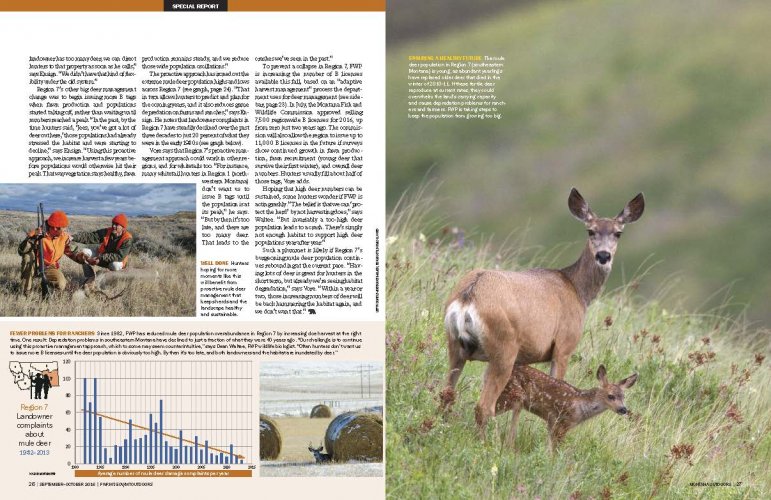
Back to my first point; private and public land herds. It is almost like we have two subsets of mule deer in Montana; herds that live primarily on private land and herds that live some/mostly on public land. If you did a study of each herd, you would see extremely different profiles in herd health, no matter what criteria herd health was measured by.
So, until things change, my expectations are very low for public land mule deer. My expectation is that Montana will continue to drive public land mule deer further into the ditch, then complain to FWP that all the mule deer are on private lands. I expect these public land mule deer will continue to go unappreciated, borderline abused, in terms of management policy. I expect Montana hunters will ignore the resident hunters population increases, the loss of private access that contributes to more public land harvest, and the blame will go on coyotes, wolves, lions, and non-residents.
I also expect Montanans to continue thinking that our Constitutional right includes November rut hunting for mule deer with a rifle. Those who want to defend rifle rut hunting, in spite of any warnings we might have about the health of the public land subset, will claim it is a bunch of trophy hunters pushing the change. I'm not a trophy hunter or meat hunter; I'm just a hunter. I like deer. I like knowing they are doing well on both public and private. That's as complicated as I can make it for my advocacy on behalf of Montana's public land mule deer.