I use to do ladders and once I’d find a “node” I’d load up ten and sometime find that load still wasn’t accurate. Wasted a lot of time and components. Now days I work up to pressure and then back off slightly. Load 3 up. If those 3 show promise I load 7 more and shoot the same target. If it holds true I stick with it. If it falls apart I change powder or bullets. Personally I don’t want a load thats so finicky that 0.5+- a grain of powder throws shit haywire. Ten shots 1.5” I’m happy with.



Navigation
Install the app
How to install the app on iOS
Follow along with the video below to see how to install our site as a web app on your home screen.
Note: This feature may not be available in some browsers.
More options

You are using an out of date browser. It may not display this or other websites correctly.
You should upgrade or use an alternative browser.
You should upgrade or use an alternative browser.
Ladder Test for finding powder charge
- Thread starter Point Creep
- Start date

ImBillT
Well-known member
- Joined
- Oct 29, 2018
- Messages
- 4,032
I have, but it takes a pretty accurate rifle to begin with, and I’m not sure most people doing it are doing it right. My guess is that you haven’t done it with a rifle with a 20” barrel that weighs 5lbs or more, on a rifle with a 3” wide flat forend using a cartridge that barrel recoils.If you think the ladder test really works, then you would be able to repeat it several times and find the same nodes. I have not found this to be true.
I see the biggest differences at 100yds. By 300yds a lot of it is no longer visible to me on target.
You should see similar velocity increase with every charge weight increase. Too small of charge weight increase will muddy the water as bad as too big. Nodes are not about a charge weight window within which velocity doesn’t change much. That is nothing but random velocity spread. Nodes are about a velocity window that shows very little vertical on paper. The barrel is vibrating up and down. If bullets are exiting during the down swing, then a small increase in velocity will result in the bullet not only hitting the target before dropping for as long a time, but also exiting the barrel while the barrel is higher. When doing a ladder test, you should see bullet impacts rise with each increase in charge weight for a period, and then bullet impacts will settle and begin impacting the same position vertically in spite of increasing charge weight, then the impact will drop, and start climbing again. You can hit multiple nodes. Shorter, stiffer barrels have nodes closer together. Short range benchrest shooters can see 3-4 nodes during testing because they will be shooting 18-20” barrels with very little taper. 1000yd benchrest shooters may only find one because their barrels are so long, and it may not be super obvious if they’re tuning at long range, or they may even be picking up on some other effect that isn’t related to barrel vibration. I’ve shot ladders with over ten shots with a .3gr increase in powder charge in every shot that put 3-4 shots into a single small small hole followed by 4-5 shots climbing, then the ending shots all going into a single hole only slightly higher than the first 3-4 shots. The final group being .5” wide by .75-1.25” tall. I’ve also shot rifles that weren’t quite as forgiving, and hunting rifles that didn’t shoot well enough to tease anything useful out of a ladder test beyond max powder charge. But if the rifle is shooting well, it should show a node or two. Those nodes are not charge weights that yield than expected velocity increase with increasing powder charge. That is nothing but random velocity spread. Those nodes are velocity windows where the barrel vibration slightly cancels velocity spread because you’re on the up swing, thus faster bullets exit while the barrel is low, and slower bullets exit while the barrel is high. These velocity windows work with any powder and any bullet weight. Although it tends to be talked about as “finding a node”, in my experience it’s more like the opposite. I find a velocity window or two where vertical dispersion is exaggerated and outside of that, it reduces to near zero. The effect becomes a reduced percentage of your vertical spread on target as range increases, and velocity spread matters more than being on a node. Finding a load with a low velocity spread is much more valuable than finding a velocity node, but it is also much more consumptive of time, components and barrel life.
I doubt most hunting rifles are accurate enough to find nodes reliably. Not all of mine are. It may be more common with some of today’s semi custom stuff getting so good and so common.
I’m going to work my way up to pressure signs on a new barrel or with a new bullet weight anyway. Why not see where it prints and see if I can use that to my advantage? What it really tends to tell me is “this velocity window gives me more vertical dispersion than I want, so test loads above or below that”.
If a rifle consistently shoots groups that are tall and skinny, you probably need to try another powder charge. If it just kinda shoots generally not as good as you want. Then it’s not a node thing. It’s a different tuning issue, or rifle issue or operator issue. And for a hunting rifle, it’s probably still good enough. It’s also sooooo easy to get vertical dispersion just from imperfect gun handling when you’re not shooting a heavy, low recoiling rifle, with a 3” wide flat forend.
ImBillT
Well-known member
- Joined
- Oct 29, 2018
- Messages
- 4,032
Well the whole point of being on a node is that velocity spread doesn’t change poi. You should be able to go quite a bit in either direction without much vertical shift if you found a node. However, +- .5gr isn’t small. That could push you off a node on medium sized cartridges. But being off a nose would just be even worse. But the whole thing really isn’t a giant effect, and its effect becomes increasingly less important as range increases. It’s a effect that isn’t worth concerning yourself with in all scenarios, or even most hunting scenarios, but not tuning for it doesn’t mean that your rifle doesn’t have velocity windows with less vertical dispersion and more vertical dispersion. It just means you aren’t looking for them. Which as I said, isn’t a big deal.I use to do ladders and once I’d find a “node” I’d load up ten and sometime find that load still wasn’t accurate. Wasted a lot of time and components. Now days I work up to pressure and then back off slightly. Load 3 up. If those 3 show promise I load 7 more and shoot the same target. If it holds true I stick with it. If it falls apart I change powder or bullets. Personally I don’t want a load thats so finicky that 0.5+- a grain of powder throws shit haywire. Ten shots 1.5” I’m happy with.

BrentD
Well-known member
You would certainly be surprised at the rifles I have used for this.I have, but it takes a pretty accurate rifle to begin with, and I’m not sure most people doing it are doing it right. My guess is that you haven’t done it with a rifle with a 20” barrel that weighs 5lbs or more, on a rifle with a 3” wide flat forend using a cartridge that barrel recoils.
I see the biggest differences at 100yds. By 300yds a lot of it is no longer visible to me on target.
You should see similar velocity increase with every charge weight increase. Too small of charge weight increase will muddy the water as bad as too big. Nodes are not about a charge weight window within which velocity doesn’t change much. That is nothing but random velocity spread. Nodes are about a velocity window that shows very little vertical on paper. The barrel is vibrating up and down. If bullets are exiting during the down swing, then a small increase in velocity will result in the bullet not only hitting the target before dropping for as long a time, but also exiting the barrel while the barrel is higher. When doing a ladder test, you should see bullet impacts rise with each increase in charge weight for a period, and then bullet impacts will settle and begin impacting the same position vertically in spite of increasing charge weight, then the impact will drop, and start climbing again. You can hit multiple nodes. Shorter, stiffer barrels have nodes closer together. Short range benchrest shooters can see 3-4 nodes during testing because they will be shooting 18-20” barrels with very little taper. 1000yd benchrest shooters may only find one because their barrels are so long, and it may not be super obvious if they’re tuning at long range, or they may even be picking up on some other effect that isn’t related to barrel vibration. I’ve shot ladders with over ten shots with a .3gr increase in powder charge in every shot that put 3-4 shots into a single small small hole followed by 4-5 shots climbing, then the ending shots all going into a single hole only slightly higher than the first 3-4 shots. The final group being .5” wide by .75-1.25” tall. I’ve also shot rifles that weren’t quite as forgiving, and hunting rifles that didn’t shoot well enough to tease anything useful out of a ladder test beyond max powder charge. But if the rifle is shooting well, it should show a node or two. Those nodes are not charge weights that yield than expected velocity increase with increasing powder charge. That is nothing but random velocity spread. Those nodes are velocity windows where the barrel vibration slightly cancels velocity spread because you’re on the up swing, thus faster bullets exit while the barrel is low, and slower bullets exit while the barrel is high. These velocity windows work with any powder and any bullet weight. Although it tends to be talked about as “finding a node”, in my experience it’s more like the opposite. I find a velocity window or two where vertical dispersion is exaggerated and outside of that, it reduces to near zero. The effect becomes a reduced percentage of your vertical spread on target as range increases, and velocity spread matters more than being on a node. Finding a load with a low velocity spread is much more valuable than finding a velocity node, but it is also much more consumptive of time, components and barrel life.
I doubt most hunting rifles are accurate enough to find nodes reliably. Not all of mine are. It may be more common with some of today’s semi custom stuff getting so good and so common.
I’m going to work my way up to pressure signs on a new barrel or with a new bullet weight anyway. Why not see where it prints and see if I can use that to my advantage? What it really tends to tell me is “this velocity window gives me more vertical dispersion than I want, so test loads above or below that”.
If a rifle consistently shoots groups that are tall and skinny, you probably need to try another powder charge. If it just kinda shoots generally not as good as you want. Then it’s not a node thing. It’s a different tuning issue, or rifle issue or operator issue. And for a hunting rifle, it’s probably still good enough. It’s also sooooo easy to get vertical dispersion just from imperfect gun handling when you’re not shooting a heavy, low recoiling rifle, with a 3” wide flat forend.
ImBillT
Well-known member
- Joined
- Oct 29, 2018
- Messages
- 4,032
Based on what you typically shoot, I would be surprised to hear that you spent a decent amount of time behind the sort of rifles this sort of tuning was pioneered in. And from my experience, although I don’t think it’s worthless, I think the effects are small enough that they aren’t going to really show up in most hunting rifles. Vertical dispersion can come from so many other sources as well that I think it can confound things if you don’t have it all pinned down.You would certainly be surprised at the rifles I have used for this.

Mallardsx2
Well-known member
- Joined
- Apr 4, 2015
- Messages
- 3,680
You sure don’t need 10 rounds to find out what’s NOT good. JFC. Ladder test is to get a starting point without shooting a ton of ammo, right?
If you shoot a 2 shot “group” that sucks - why waste 8 more?
I agree with this 100%.
KingOfTagSoup
Well-known member
- Joined
- Nov 29, 2022
- Messages
- 297
This is also pretty much what I do. Pressure check first, if there's no pressure signs I load ten and shoot em. If they go sub moa I'm done.Everyone has a process that works for them, and that’s cool. Here’s mine for bullets with adequate known data. I’ll preface this by saying that making sure action screws are torqued, bases and rings have the correct screws and are torqued correctly on the rifle is important. I have had several rifles now that were not done correctly by either the factory or people that should know better.
I load one at book max for the given powder and bullet.
Seat it to mag length or put the boat tail junction at the neck should junction.
Shoot into the bank behind the garage. If it shows any sign of pressure at all, back off either 1/2 or 1 grain, depending on case size. If it does not show pressure I load 10 more and go to the range and shoot it at 100.
If it meets my needs, then I load the rest and go shoot. Most of the time that gives a load that is usable for our hunting and shooting purposes in 11 shots.
If it does not meet my needs, I change powder and repeat. If a rifle and bullet will not shoot adequately on two different powders I try a different bullet. If it will not shoot on two bullets and four powders, there is something wrong with the firearm.
If there is little or no data available for a given bullet, then a pressure ladder is absolutely necessary. And once I find pressure, I follow the steps above.
I do as well. My point was referencing 3-shot "accuracy nodes". However, 3-shot groups can also hide issues. I've had rifles that print sub-half-MOA groups, but send at least one or two flyers out of ten.I agree with this 100%.
BrentD
Well-known member
I don't think you know what I shoot.Based on what you typically shoot, I would be surprised to hear that you spent a decent amount of time behind the sort of rifles this sort of tuning was pioneered in. And from my experience, although I don’t think it’s worthless, I think the effects are small enough that they aren’t going to really show up in most hunting rifles. Vertical dispersion can come from so many other sources as well that I think it can confound things if you don’t have it all pinned down.
BrentD
Well-known member
Suppose the next eight would have gone into one of the previous two holes?You sure don’t need 10 rounds to find out what’s NOT good. JFC. Ladder test is to get a starting point without shooting a ton of ammo, right?
If you shoot a 2 shot “group” that sucks - why waste 8 more?
But I do advocate shooting two shot groups. However, I shoot a lot of them and do it in a organized fashion as a statistical test of a hypothesis.

Point Creep
Well-known member
Suppose not.Suppose the next eight would have gone into one of the previous two holes?
But I do advocate shooting two shot groups. However, I shoot a lot of them and do it in an organized fashion as a statistical test of a hypothesis.
What I do know is bear season opens next week and I’m ready. I’m zeroed in by using a 15 shot group at 206m which printed all but 3 holes on the orange dot and a 9 SD. I used a zero angle, and the mean radius of the group was .62 & 2955 avg velocity with the 147 eldm. Should work better than okay.
I think people throw out “sub MOA” groups like they’re the norm. I’ve found that not to be the case, but could just be me.
I used the ladder concept to initially test a brand new bullet, with goal of reducing the round count in doing so. Didn’t really work out that way as I burned through close to 60 shots. Also had to accept the reality that I do really want a higher velocity out of my hunting rifle and I really wouldn’t choose to give up 200 fps for a tighter group.
Point Creep
Well-known member
Will be doing the more fun things this weekend - long range bombers at rocks way farther than I’d try at a bear.
ImBillT
Well-known member
- Joined
- Oct 29, 2018
- Messages
- 4,032
I just know that you’re very enthusiastic about very old rifles. Which is totally cool. Am I not allowed to be surprised by your tinkering with an IBS or NBRSA style benchrest rifle? I have no idea what you shoot beyond what you tend to discuss here. Any expression of surprise was not intended to be an expression of disbelief in anything else you’ve spent time shooting. It was simply an expression that you’ve not mentioned shooting such rifles in posts that I’ve seen.I don't think you know what I shoot.
I do think the rifles that I’ve seen you discuss here are super cool works of art and craftsmanship and I can see their appeal. It is with zero disrespect that I would find it surprising if you had spent considerable time shooting rifles that were almost the opposite of that, and had never mentioned it in a post that I had seen. Just isn’t what I expected is all.
Last edited:
ImBillT
Well-known member
- Joined
- Oct 29, 2018
- Messages
- 4,032
Your entire ladder test should be sub MOA or very close to it. If not, the water is too murky to be confident in what you’re looking at.Suppose not.
What I do know is bear season opens next week and I’m ready. I’m zeroed in by using a 15 shot group at 206m which printed all but 3 holes on the orange dot and a 9 SD. I used a zero angle, and the mean radius of the group was .62 & 2955 avg velocity with the 147 eldm. Should work better than okay.
I think people throw out “sub MOA” groups like they’re the norm. I’ve found that not to be the case, but could just be me.
I used the ladder concept to initially test a brand new bullet, with goal of reducing the round count in doing so. Didn’t really work out that way as I burned through close to 60 shots. Also had to accept the reality that I do really want a higher velocity out of my hunting rifle and I really wouldn’t choose to give up 200 fps for a tighter group.
Point Creep
Well-known member
Sub MOA at 300m? Yeah I’d like that. Out of alls the rungs only 2 were 3” + so it was within that realm. There was wind, my shooting and a not ideal reticle for shooting small dots.Your entire ladder test should be sub MOA or very close to it. If not, the water is too murky to be confident in what you’re looking at.
ImBillT
Well-known member
- Joined
- Oct 29, 2018
- Messages
- 4,032
The effects that show up in a ladder test shouldn’t be very prominent at 300yds, but they’re not large effects anyway, and aren’t obvious in a gun that isn’t shooting very small groups already. But hey, maybe a little more than 1MOA. Not much more. I would say that most of my hunting rifles were not really shooting well enough that was certain of what it showed me.Sub MOA at 300m? Yeah I’d like that. Out of alls the rungs only 2 were 3” + so it was within that realm. There was wind, my shooting and a not ideal reticle for shooting small dots.
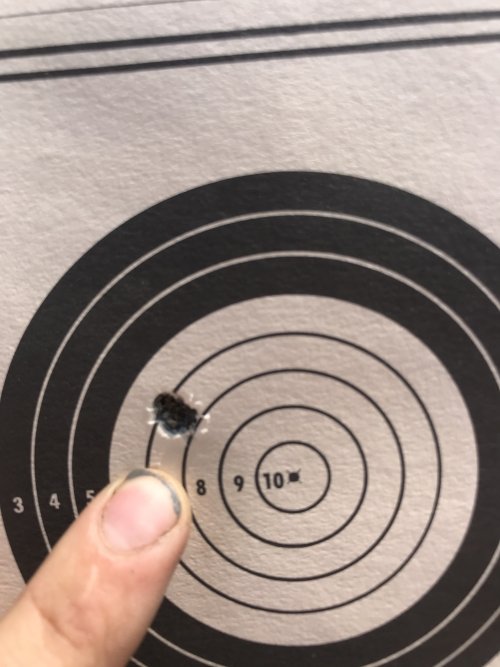
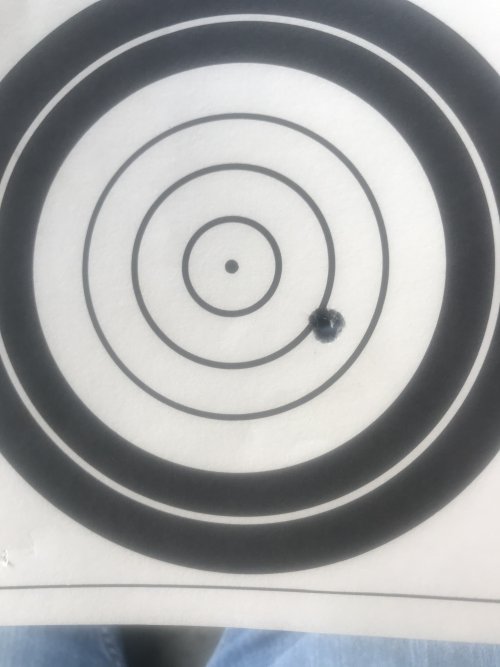
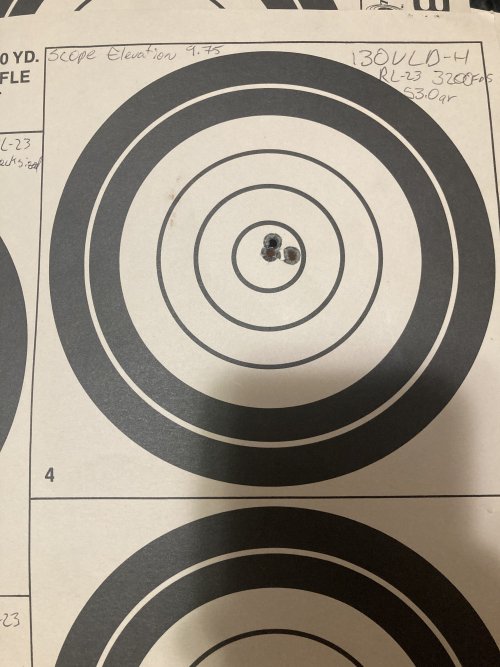
In a quick scan of my phone I didn’t see any pictures of ladder tests, but these are three shot groups at 100 and 200 yards from a rather heavy hunting rifle. Something shooting in this realm is something I would expect to shoot a readable ladder. I didn’t get a reliable ladder test from it because it shot like garbage(about 3/4-1MOA) when I put it together. I had two loads that appeared better than most, but not good. I got new dies for it(it’s a wildcat), and the loads that had previously stood out as being more in the consistent 3/4MOA range began consistently shooting .3 MOA or better These three groups are three shots each and are each under .3 MOA. If the rifle isn’t shooting .5MOA or so, I don’t think you’re likely to see much from a ladder test. The last two rifles that I shot a ladder test in were a 30-06AI with a Remington 30-06 barrel, and a 280AI with a Lilja barrel. The 30-06AI shoots around 1-1.25 MOA and I didn’t get too much from the ladder test beyond a max load, but I would have fired those shots finding a max load anyway. The 280AI shot about .3MOA wide X .75 or 1MOA tall ladder with two apparent nodes. I shoot ladders at 100yds. By 300yds with flat based low BC bullets 300yds are too far because other factors that cause vertical spread have started masking what the ladder does. With high BC bullets maybe it’s still apparent at 300yds. I can’t say that I’ve tried. If you’re saying sub-MOA groups are not the norm. I’m saying that I’m not sure you’ll see much from a ladder test. You also said wind, your shooting, less than ideal reticle etc. You’re not going to see small effects of a load of you have lots of other effects occurring during the test.
I’m not sure that any tuning is obvious enough to be efficient and easy in a rifle that isn’t shooting 1 MOA or better. A really terrible load in a .25MOA rifle is gonna be sub MOA. If a rifle is shooting over 1MOA, it’s likely not super accurate or something other than tuning is wrong. I’ve had loose screws, bad dies, and guns that just weren’t gonna shoot great. Tuning a rifle that just isn’t gonna shoot great could probably help a little but it’s really hard to tease out what was actually a better load from random effects when the group size large.
I’m also not certain that what I call a ladder test aligns with what you’re shooting. I haven’t shot competitively in 12-13 years, or short range benchrest in 15-16yrs. What the internet calls a ladder test may not line up with how the benchrest hall of fame members that taught me to tune over twenty years ago taught me. I grew up on a benchrest range where multiple benchrest hall of fame members shoot, and have learned from them.
Attachments
Last edited:
Point Creep
Well-known member
I clearly don’t know what I was doing, but I do know I’m not doing it again. 
ImBillT
Well-known member
- Joined
- Oct 29, 2018
- Messages
- 4,032
I’m not sure you did anything wrong. It’s just that it isn’t a large effect. It’s not going to make huge differences, and if anything else could be making the groups large, you’re not going to see those differences.I clearly don’t know what I was doing, but I do know I’m not doing it again.
I’m going to work toward a max load any time I shoot a new bullet weight or powder, or get a new barrel. So why not do it .3gr at a time and watch the target? If it prints a group that’s under .5MOA wide and .75-.1.25 MOA tall, and the elevation changes followed the expected pattern, then I know the rifle should shoot pretty well and I know a velocity window that is going to show excess vertical dispersion if my velocity spread is poor. So to me, it’s not a waste of time even if it doesn’t work out. I was going to shoot most of those shots anyway while finding a max load. However, A) if you keep velocity spread low, then vertical dispersion will be low even if you’re in the “bad” velocity window. B) The effect isn’t huge, and diminishes as a percent of your vertical dispersion as range increases. So at ranges where you need minimal vertical, the thing that a ladder test reveals isn’t the primary factor in the vertical dispersion that you see, and at ranges where it helps most, you didn’t need tiny groups to kill a deer anyway. C) If anything else could be contributing to your vertical dispersion, then the data is too murky to rely on. So, no, it’s not a huge thing for a hunter or a hunting rifle.
You of all people have proven that it is entirely unnecessary in the pursuit of bagging dream animals. I find it to be a quick and easy way to make a load slightly more forgiving. It won’t scout, make the stalk or pull the trigger. You’ve clearly go the most important parts of the game dialed in to a very high level.
I think my shooting skills have been declining steadily as I’ve become too busy to get to the range the way that I used to, and frankly I’m not so sure than an accurate rifle is working any better for me than an average one these days. Or perhaps I’d be even worse. I can’t say.

Dougfirtree
Well-known member
This thread, and some gentle challenging from my brother, has been making me take a dive into the subject of sample size and reloading. Way behind the curve, I know... I've been aware, but resistant to the idea that findings that seemed meaningful to me, probably weren't and resistant to a model of reloading that seems to require even more expensive and hard to find components.
Looking at data and some of the big tests done by Hornady and others is making me reckon with the reality of this stuff, and I'm thinking a lot about some of the ways that load development can be reconceptualized to get better data and not go broke (especially since I'm just reloading for hunting and hunting practice). I've enjoyed hearing people's methods. Keep them coming!
Looking at data and some of the big tests done by Hornady and others is making me reckon with the reality of this stuff, and I'm thinking a lot about some of the ways that load development can be reconceptualized to get better data and not go broke (especially since I'm just reloading for hunting and hunting practice). I've enjoyed hearing people's methods. Keep them coming!
Point Creep
Well-known member
@It’s Bucky Those are pretty insane groups
For factory ammo!
For factory ammo!
Similar threads

- Replies
- 26
- Views
- 4K

- Replies
- 5
- Views
- 1K


- Replies
- 44
- Views
- 6K