


Ladder Test for finding powder charge

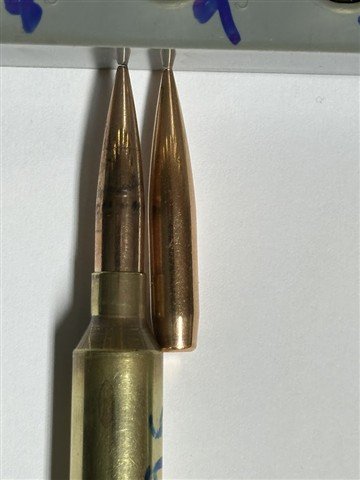
The one thing that affected accuracy the most for me was to put the bullet boat tail jct at the top of the case neck/shoulder radius; night and day difference in two different 7's. No idea what bullet you're loading but the prc is made to seat the bullet long.

View attachment 404859
The bullets I loaded are about like that not much different BTO than Hornady factory loadings of same bullet, just a touch seated out - I’m just under .020” off jamming into rifling on both rifles.

I expected to hit pressure and have to pull a few bullets tonight, but no signs of pressure even a ways over max listed load.

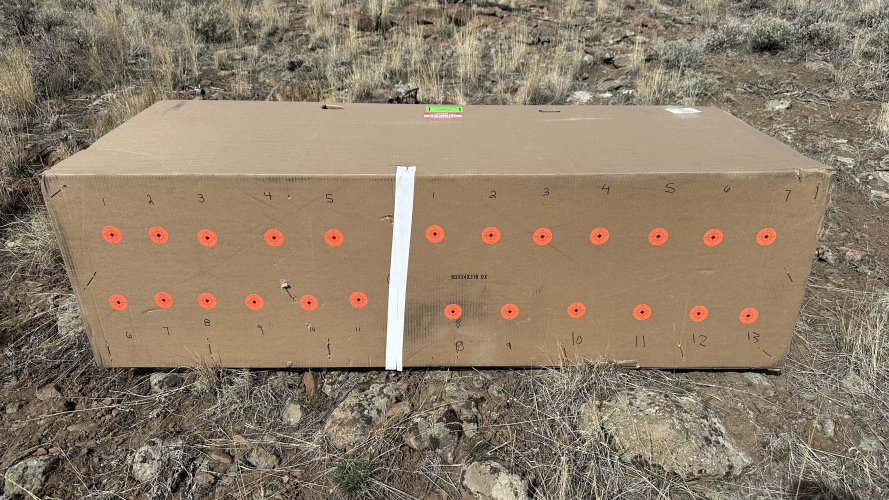
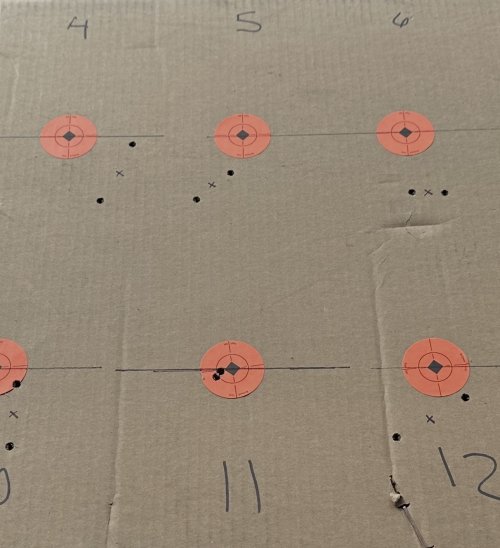
The shooting went well aside from some gusting winds that may have impacted it a little, but at only 300m still some useful data. Will plot out on the node nonsense and report back. The sample of two is almost meaningless but hopefully my choice for a 10 shot test tomorrow pays off I suspect this one from my rifle and also a 2fps velocity difference between the two. #11
IMG_4223.jpeg
IMG_4233.jpegIMG_4234.jpeg
 
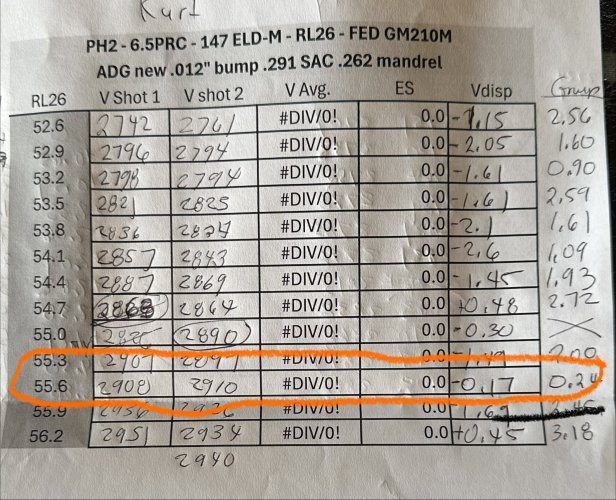
Not sure I'd do that again, especially starting so far below the max listed book value. I prefer accuracy, but I don't think i'd settle for 150 fps lower than I can go with the shorter barrels. I graphed everything out on excel, and it looks like maybe the best "node" for a flat velocity and verticle change across a couple charges, a low ES of 2 and good group of 2 is at 53.2 grains of RL26. But I'm going to stick with the best (lucky) results I had at very near book max of 55.6. It's 100+ fps faster. I'll try 10, and suspect it should be at the "good enough" quality. Will be using once fired and properly sized cases for the 10 shots. Today was new brass on my rifle.

It's really hard to put much stock in 2 shot numbers.

I used H1000 in my sons rifle and it sure is slower than I expected, and the ES/groups, etc were not what I was hoping for. I'll switch to RL26 and shoot a few 5 shot groups at the upper end of the spectrum next time.
 
I'll ask a dumb question, what else are you guys doing if not ladders?

This is the method I have always somewhat followed. It’s always seemed to work really well for me and have been able to find very accurate/consistent long range loads pretty quickly. This guy at Panhandle Precision just always made sense and broke things down simply. When I was first learning I followed his stuff pretty closely and have had great sub .5 moa results with multiple rifles.
I’d listen to Carl though!
 
The bullets I loaded are about like that not much different BTO than Hornady factory loadings of same bullet, just a touch seated out - I’m just under .020” off jamming into rifling on both rifles.

I expected to hit pressure and have to pull a few bullets tonight, but no signs of pressure even a ways over max listed load.

The shooting went well aside from some gusting winds that may have impacted it a little, but at only 300m still some useful data. Will plot out on the node nonsense and report back. The sample of two is almost meaningless but hopefully my choice for a 10 shot test tomorrow pays off I suspect this one from my rifle and also a 2fps velocity difference between the two. #11
View attachment 404876
View attachment 404877View attachment 404878

Good example of the different “node” methodologies not really lining out. For people looking for a flat spot in velocity, that’s definitely flat across 55.3-55.6 gr. But from a ladder test looking at elevation, 11 looks like the worst charge in the picture from an elevation standpoint but the two bullets are touching at 300 yards.

Not a critique, just an observation of things people tie themselves in knots over “tuning” a load but really it’s small sample size random distribution.

If it’s a 20-22” barrel, that low 2900s velocity seems like a reasonable place to be.
 

Latest posts

Forum statistics

Threads
118,735
Messages
2,204,383
Members
38,630
Latest member
Jalenmccarty38
Back
Top