Best Bore sighter?

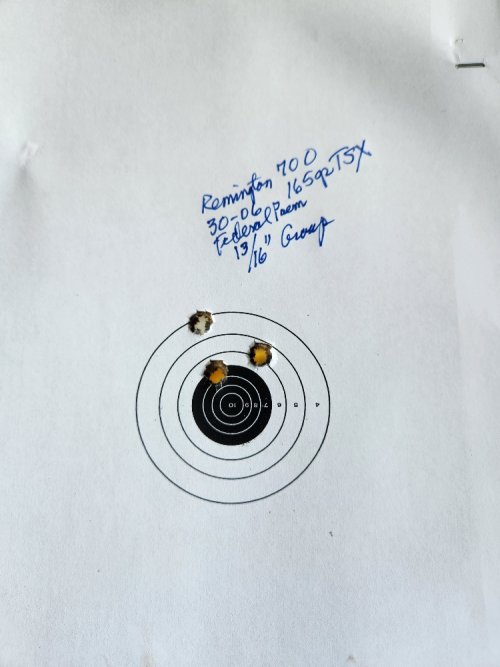
Went to the range today. Yesterday I found old ammo I didn't mind burning up to get the scope adjusted instead of screwing around trying to find the bullseye through the barrel, or buying more shitz off Amazon. I had some 20yr old Hornady Match 168 grain .30-06 ammo, and gradually moved the rear mounts on the scope. Eventually sighted in with Federal Premium 165 grain TSX ammo for deer season. Kinda overkill for deer but hey, this rifle loves Federal ammo.

 

Attachments

  • 20231023_124742_resized.jpg
    20231023_124742_resized.jpg
    196.1 KB · Views: 4
I know this is old af, but You guys really don’t know how to just answer a d*mn question do you!?
I like my sitemark bore scopes
 
I have a lead sled that I use to hold a rifle more perfectly still while visually bore sighting and then adjusting the scope after the first shot.

There's definitely a knack to bore sighting with the naked eye after removing the bolt. Just my opinion but it can best be described as seeing the open hole of the bore with a halo of black to dark gray around it. When everything is lined up right, the target appears in the center of the open hole surrounded by an evenly spaced halo. I can routinely get an initial shot to hit within 6 inches (sometimes less) of the center of a target at 100 yards using this approach. Then I put the rifle back in the lead sled to hold it still with the crosshairs set on the bullseye just as they were with the initial shot after bore sighting. With the rifle now held still, I adjust the windage and elevation so that the crosshairs cover the POI of the initial shot. A second shot should confirm the accuracy of the adjustments by hitting very close if not on the bullseye. Then I make a third shot without the sled to adjust for point blank range, and to remove any possible difference in the POI that might attributed to the recoil resistance created by the sled.

Simply put, I like to use the sled not because I'm recoil sensitive, but because it's easier (at least for me) to hold the rifle more perfectly still for the initial two shots where eliminating human error is most critical, and for holding the rifle still while making the initial scope adjustments. I'm sure there are shooting vises that work equally well if not better.
 
Last edited:
Would it be better at 50 yards instead of 100 yards? That's what I did last time and then fired 2 shots and adjusted accordingly.
 
I might add that in my opinion, there should be no shame in using shooting aids like a vise or lead sled when setting up a new scope. Can human error be minimized with nothing more than sandbags and a good shooting bench? Absolutely. Still, the integrity of the scope, base, and rings is never fully confirmed as long as human error remains a part of the equation.
 
If your boresighter is the type with the stud that fits in the barrel and you attach the boresighter to it (most have a grid) it can also prove useful after sighting in your rifle. Reinstall it after sighting in, and record (in your notes) where the crosshair is on the grid. When you travel to your hunt area reinstall the boresighter and see if it is still aligned. This can really help if for some reason you can't shoot the rifle to confirm zero, you can at least tell if it is still aligned with your recorded spot on the grid. If you shoot different loads out of the rifle (one for deer, one for elk,etc) sight in using that load then record where the crosshair is on the grid, and use it for future reference. When you decide to hunt with the different load, you can always readjust the crosshairs on the grid to site it in for the different load based on your notes. Might save some ammo, but always confirm with a shot or two if you can.
 
Last edited:
Back
Top