


Anybody Buying Yet? Where’s the Bottom?

Already bought one election...


They got ripped off. This latest kerfuffle just transfers money from the average American to the oil co. The World is discovering that energy security is the cornerstone of sovereignty (that and maybe a nuclear weapon). Americans are discovering that $2/gal gas is not a God-given right. The market speaks on where the money is flowing over the last 12 months - XLE is up about 50%, FAN (Wind ETF) up 70%, TAN (Solar) up over 100%.
 
I won't comment about buying elections, etc. The party I more fully identify with, has vilified oil companies for as long as I can remember. Some amount of that is likely well earned. What is not acknowledged by that political party is that fossil fuel energy has been a cornerstone for the standard of living that we have come to enjoy. Yes, it has serious shortcomings. However, you can't walk away from it, without a suitable replacement. Unless, society is accepting of lower living standards.

Wind and Solar will never come close to the amount of energy that oil, coal and natural gas have been providing. The only replacement that could meet that demand is nuclear power. That is also a source that has political problems. It also has actual problems to consider.

It stands to reason that the oil companies support the GOP. Any Democrat openly supporting a fossil fuel company is very likely to have a short career, within the party.

We likely have all heard the acronym TACO, that Trump always chickens out. This morning I heard another acronym NACHO, not a chance Hormuz opens. I am afraid there is much truth in this new one, at least for a while. We are a long way away from returning to a normal energy supply scenario.
 
Wind and Solar will never come close to the amount of energy that oil, coal and natural gas have been providing. The only replacement that could meet that demand is nuclear power.
The vilification of O&G is mostly a narrative created by lobbyists. No politician wants higher fuel prices, but there are certainly differences in the approaches.

The stock market doesn't lie and it disagrees with the "never come close" part. It's just a matter of time. Most of the US economic growth is coming from tech infrastructure, which is power hungry. The only way to add power as fast as you can build datacenters is through solar and wind, which is why they make up 90% of the additions to utility-scale electrical production. There are already some European countries that produce more than half of their electricity from various renewables. California gets an overwhelming majority of its electricity from renewables, and even Texas inches closer to that 50% mark every year. Again, it's just a matter of time.

O&G is certainly not going away anytime soon and will never be 0%, but "all of the above" is the only way to meet future demand. Some countries have figured this out. We continue to make it a d*@%-measuring contest.
 
. California gets an overwhelming majority of its electricity from renewables, and even Texas inches closer to that 50% mark every year. Again, it's just a matter of time.
According to a California website, your statement is not correct. The single largest source of their electricity comes from natural gas. If you toss in nuclear, they provide the majority source of electricity.


Nearly half is from natural gas. If you want to replace that with solar and wind, they have to be increased many fold. The foot print required for that is pretty significant.
 
According to a California website, your statement is not correct. The single largest source of their electricity comes from natural gas. If you toss in nuclear, they provide the majority source of electricity.


Nearly half is from natural gas. If you want to replace that with solar and wind, they have to be increased many fold. The foot print required for that is pretty significant.
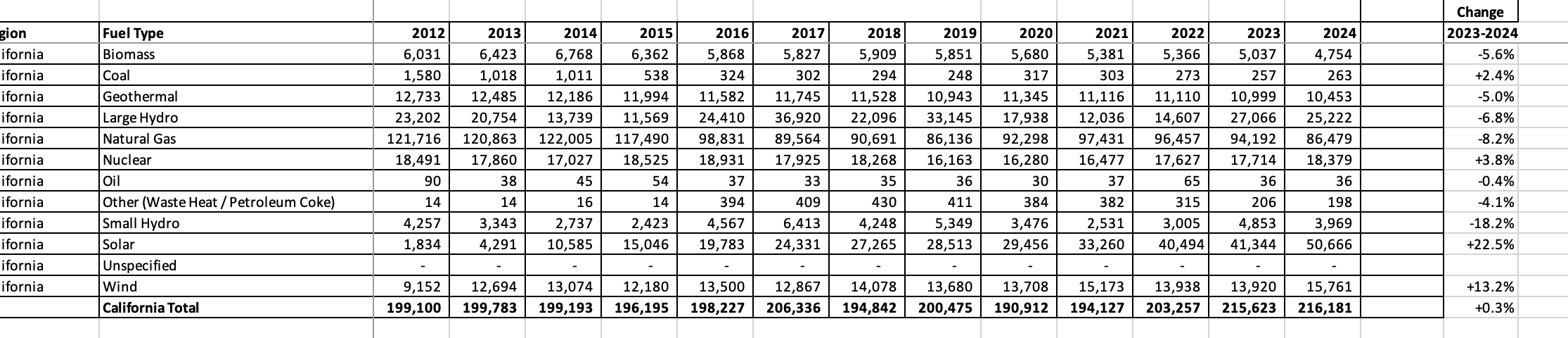
This table below is from the link you posted. Jump to 2024 when a couple of large scale solar farms started up. The 2025 numbers moved in the same direction (less Nat Gas, more wind and solar). Quick math on 2024, excluding nuclear (CA likes to add it in and call the category 'zero carbon'), puts renewables at 51% for 2024. It isn't a debate around which one is biggest. That is clearly Nat Gas. CA also imports a lot of energy from other states and Canada. That can be messy. It should be pretty clear to be skeptical of views that "it can't be done", particularly when it is being done. I acknowledge that none of this is about gasoline. It is just electrical generation.

Screenshot 2026-04-30 at 10.56.52 AM.png

 
Renewables already had a pretty tall task to just replace retiring coal generation.

Now with ai and the data center boom, renewables will be a sideshow if data center construction hits projections. Some data centers have the same electric load as every residence in a medium sized city like Goodyear, AZ where Microsoft’s runway data center is.
 
This table below is from the link you posted. Jump to 2024 when a couple of large scale solar farms started up. The 2025 numbers moved in the same direction (less Nat Gas, more wind and solar). Quick math on 2024, excluding nuclear (CA likes to add it in and call the category 'zero carbon'), puts renewables at 51% for 2024. It isn't a debate around which one is biggest. That is clearly Nat Gas. CA also imports a lot of energy from other states and Canada. That can be messy. It should be pretty clear to be skeptical of views that "it can't be done", particularly when it is being done. I acknowledge that none of this is about gasoline. It is just electrical generation.

View attachment 407307

"California gets an overwhelming majority about half of its electricity from renewables"
 
I acknowledge that none of this is about gasoline. It is just electrical generation.

Consider, how much more electrical demand will grow, if or when the majority of the cars on the road are electric.

Color me skeptical that "renewables" will ever cover our energy needs. The foot print of generating the electricity will be a couple of orders of magnitude, compared to fossil fuels.

Also, neither solar or wind can be relied on entirely for base load. They generate conditionally, depending on the weather.

I expect the demand for lithium will create conflicts over where it's mined and processed.
 
i think we're gonna be forced and end up on a majority nuclear grid. it just feels obvious. it seems to be an inevitability in my mind.

the headwinds are there, sure. but at some point the liberal/green energy side will come to the realization that dozing down the world's habitat and open spaces for wind and solar energy isn't as green as they thought, literally. and with the kind of energy demands our future is pointing to you can't hide from it.

the realities can only be swept under the rug for so long and i think public perception, while like steering the titanic, will eventually shift away from it.

i still maintain the opinion that in 150 years humans will be looking back on this solar and wind push with a lot of head shaking and skepticism about how smart this generation of humans supposedly was.
 
Color me skeptical that "renewables" will ever cover our energy needs. The foot print of generating the electricity will be a couple of orders of magnitude, compared to fossil fuels.
I understand that you are skeptical. I have found it is impossible to change a persons view, even if the data is clear. I'm old enough that I joke- thank goodness for young people because the older people get the more sure they are of stuff that is largely incorrect. Here is an exercise- take a guess on how much of the earth's land mass (%) would need to be in solar panels to meet all of the World's electricity needs. Then Google the answer and see how close you are. Now think if the efficiency of a panel was increased from 20% to 30%.

i still maintain the opinion that in 150 years humans will be looking back on this solar and wind push with a lot of skepticism about how smart this generation of humans supposedly was.
Will we look back and wonder why we pumped so much CO2 and Methane into the atmosphere when we knew it would cook us like a Thanksgiving Turkey? Mostly it seems humans are very good at destroying their habitat. To the Moon we go!!!

It is also hard to ignore that centralize electrical generation (Nat Gas, Nuclear) is an easy target in a "conflict", and global leaders seem to be more willing to ignore any "laws" around war these days. Not sure that toothpaste goes back in the tube.
 
I understand that you are skeptical. I have found it is impossible to change a persons view, even if the data is clear. I'm old enough that I joke- thank goodness for young people because the older people get the more sure they are of stuff that is largely incorrect. Here is an exercise- take a guess on how much of the earth's land mass (%) would need to be in solar panels to meet all of the World's electricity needs. Then Google the answer and see how close you are. Now think if the efficiency of a panel was increased from 20% to 30%.


Will we look back and wonder why we pumped so much CO2 and Methane into the atmosphere when we knew it would cook us like a Thanksgiving Turkey? Mostly it seems humans are very good at destroying their habitat. To the Moon we go!!!

It is also hard to ignore that centralize electrical generation (Nat Gas, Nuclear) is an easy target in a "conflict", and global leaders seem to be more willing to ignore any "laws" around war these days. Not sure that toothpaste goes back in the tube.

I'm sorry but your exercise is, I'll be polite, nonsense. The largest reason is much of the earth's land mass is not suitable for solar power. I have no idea what percentage is suitable, but it's not close to 100%

Back at the beginning, you posted that California's power was overwhelmingly from renewables. Instead, by far, the single largest source is from natural gas. California imports ~25- 30 % of its electrical needs. California also has the highest electrical rates in the lower 48. You'd think if renewables were so efficient, they'd beat someone, other than Hawaii, concerning the price per kWh.
 
I'm sorry but your exercise is, I'll be polite, nonsense. The largest reason is much of the earth's land mass is not suitable for solar power. I have no idea what percentage is suitable, but it's not close to 100%

Back at the beginning, you posted that California's power was overwhelmingly from renewables. Instead, by far, the single largest source is from natural gas. California imports ~25- 30 % of its electrical needs. California also has the highest electrical rates in the lower 48. You'd think if renewables were so efficient, they'd beat someone, other than Hawaii, concerning the price per kWh.
OK, your original comment about "never replacing" was nonsense. Let's put that to the side. When you have a view, spending 15 minutes trying to prove yourself wrong is time well spent.

I admited "overwhelmingly from renewables" should have either said "majority from renewables" or "overwhelmingly from zero-carbon". CA groups the sources in different ways. It's the internet, so give me leeway on that.

CA imports a lot of electricity, but a lot is hydro from the NW. I do assume that the numbers posted on the website you provided break that into the appropriate source. This assumption may be incorrect. I can't easily confirm.

CA has the highest electrical rates for other reasons. You probably think this exercise is nonsense too, but Google US LCOE by source. The EIA also publishes the data. Utility scale solar is easily the cheapest. This is why another 40-60GW will come online in 2026. It's cheap and fast. Best? That is certainly debatable.

I'm not arguing carbon is going away (coal certainly is, but not oil or nat gat), but it's about what is possible. Some people say "it's impossible" and there is some that say "hold my beer" and they get to work. The progress is impressive.
 
the headwinds are there, sure. but at some point the liberal/green energy side will come to the realization that dozing down the world's habitat and open spaces for wind and solar energy isn't as green as they thought, literally. and with the kind of energy demands our future is pointing to you can't hide from it.
I would hope so. But it isn’t looking good at the moment.
 
OK, your original comment about "never replacing" was nonsense. Let's put that to the side. When you have a view, spending 15 minutes trying to prove yourself wrong is time well spent.

I admited "overwhelmingly from renewables" should have either said "majority from renewables" or "overwhelmingly from zero-carbon". CA groups the sources in different ways. It's the internet, so give me leeway on that.

CA imports a lot of electricity, but a lot is hydro from the NW. I do assume that the numbers posted on the website you provided break that into the appropriate source. This assumption may be incorrect. I can't easily confirm.

CA has the highest electrical rates for other reasons. You probably think this exercise is nonsense too, but Google US LCOE by source. The EIA also publishes the data. Utility scale solar is easily the cheapest. This is why another 40-60GW will come online in 2026. It's cheap and fast. Best? That is certainly debatable.

I'm not arguing carbon is going away (coal certainly is, but not oil or nat gat), but it's about what is possible. Some people say "it's impossible" and there is some that say "hold my beer" and they get to work. The progress is impressive.
I am not very well-versed on this, and this is a genuine question, but my understanding with solar has been that the generation isn’t necessarily a problem, it’s the upkeep/maintenance and replacement as panels wear out, get dirty, breakdown, etc. I assume that natural gas, nuclear, etc. all have a much higher upfront cost to construct and get running. But how does that compare to the ongoing maintenance cost for solar?
 
Back
Top