
Wildfire management LTTE

The USFS is currently looking for applicants for several RAC's (Resource Advisory Councils). Those councils help bring local perspectives to land management, as well as help spend Secure Rural Schools funds on approved projects which would include fire resiliency, restoration post fire, etc.

Your congresswoman sits on the Conservation & Forestry subcommittee for the Agriculture committee. She would be a good person to develop a relationship with in order to raise the issue at the federal level (become the PITA I know you can be!)

Run for county commission. CC's have outsized influence on how local lands are managed. They also have to partner with the USFS on roads, etc. it's a good profession to also wear a lot of seersucker suits, smoke cigars and drive a Cadillac w/longhorns on the front.

I'm not aware of NEPA planning with public facing components around a national fire plan. Given that it would also have significant national security issues as well as the need to act fast and be nimble, I can't see the gov't wanting to get too mired in the public process. Here's the FS's fire response page: https://www.fs.usda.gov/managing-land/fire/response
 
Having my house survive a major wildfire when 60 of my neighbors houses burned, I joined the local vfd.
That fire with the wind was traveling much faster than crews could fight.
The origin was lightening. That fire also jumped across a bare summer fallowed field without delay.

Lots of valuable information above but I do think different states have different agenda in fighting fires. I also think the environmental industry has done a disservice to wilderness health. Large beetle killed forests creating heavy fuel loads, are ripe for hot intense fires.
That is a different “fire” than even the next fire in the same location.
 
Final thought...any criticism of fire operations...if federal at least...have to take into account the greatly reduced capacity to fight them due to DOGE/ Trump. Fewer staff will only decrease ability to protect property, and increase the likelihood of closures to hunters and others.
The criticism has been going on since decades ago. Might be less personnel now but the scrutiny isn't new by any stretch. mtmuley
 
Fire just started a bit ago 20 or so miles south of me. Right along a highway and on private, grazed, brushy, weed infested, and what timber is there is big and mature. I’m guessing there wont be any log it, graze it or watch it burn comments on Facebook about this one
 
This is actually what I was looking for:

"The Forest Service has been managing wildland fire on National Forests for more than 100 years. This is more important than ever because over the last few decades, wildland fire management has profoundly changed. Longer fire seasons, more acres burned on average each year, and more extreme fire behavior have become the norm.

To address these challenges, the Forest Service and its other federal, tribal, state, and local partners are implementing a National Cohesive Wildland Fire Management Strategy that has three key components: Resilient Landscapes, Fire Adapted Communities, and Safe and Effective Wildfire Response. One of the methods to help control more extreme wildfire, is to take preventative action with controlled or prescribed burns."


The National Strategy explores four broad challenges:
  1. Managing vegetation and fuels;
  2. Protecting homes, communities, and other values at risk;
  3. Managing human-caused ignitions; and
  4. Effectively and efficiently responding to wildfire.
This does effectively reinforce what I've seen. Minimal effort is made to "put out" naturally caused fires (after all, they're natural, and natural is good, right?). And that no actual value or weighting is applied to societal impacts from unhealthy air quality, though it is acknowledged as a concern, but only for prescribed fires. The document portrays a quite resigned perspective that fires will simply burn, over large areas, for long durations, and at great costs. And there isn't anything to be done.
 
The document portrays a quite resigned perspective that fires will simply burn, over large areas, for long durations, and at great costs. And there isn't anything to be done.
Basically, yes.

Strategic plans are great, but it needs to be implemented tactically. Reality is there are too many fires and not enough resources, so the Strategic Plan isn’t worth the paper it is printed on.

My guess on priorities, in no particular order.
- Urban wildland interfaces with highest density of homes
- National parks
- grazing rangeland
 
Basically, yes.

Strategic plans are great, but it needs to be implemented tactically. Reality is there are too many fires and not enough resources, so the Strategic Plan isn’t worth the paper it is printed on.

My guess on priorities, in no particular order.
- Urban wildland interfaces with highest density of homes
- National parks
- grazing rangeland
Should we have said the same thing about smog?
 
This does effectively reinforce what I've seen. Minimal effort is made to "put out" naturally caused fires (after all, they're natural, and natural is good, right?). And that no actual value or weighting is applied to societal impacts from unhealthy air quality, though it is acknowledged as a concern, but only for prescribed fires. The document portrays a quite resigned perspective that fires will simply burn, over large areas, for long durations, and at great costs. And there isn't anything to be done.

The USFS puts out 98% of wildfires on initial attack (keeping them at less than 10 acres). The Washington DNR claims the same success rate.

The idea that minimal effort is made to put out fires regardless of cause does not comport with the data on the ground. You might have an issue with how a specific fire was handled, but the lion's share are killed on IA regardless of cause.
 
The USFS puts out 98% of wildfires on initial attack (keeping them at less than 10 acres). The Washington DNR claims the same success rate.

The idea that minimal effort is made to put out fires regardless of cause does not comport with the data on the ground. You might have an issue with how a specific fire was handled, but the lion's share are killed on IA regardless of cause.
I simply don't believe that data.
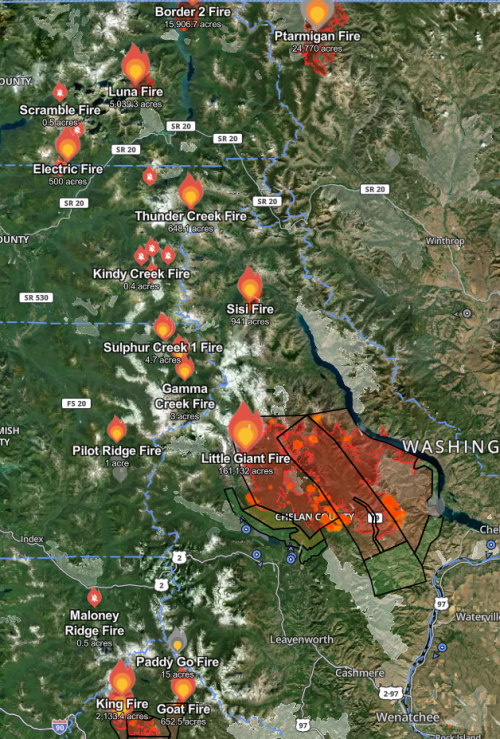
1787932222681.png
the FS isn't even attempting IA on these small starts, everyone is already committed to the big ones that didn't put out during the IA. Thankfully everything west of the crest has seen rain, and will see more rain.

The DNR might do better, and I know our local FD's are doing a helluva lot better. Maybe that's funding. Maybe access. Maybe strategy. Like a combination.
 
Should we have said the same thing about smog?
Not exactly the same. Source of smog was easy to identify and didn’t pop up like a whack-a-mole game. But I can assure you the same argument was made by every coal burning company. Cost cost cost.

To Nameless’s point, the best defense is quickly find them and getting resources on them.
 
The DNR might do better, and I know our local FD's are doing a helluva lot better. Maybe that's funding. Maybe access. Maybe strategy. Like a combination.
Saw an article the other day saying the state has spent $200m so far this year. $200m we don’t have. It is hard to put aside that the majority of the population just DGAF about the burns.
 
I simply don't believe that data.

Then I guess there's no where to go from here.

For example in just the last month, within a portion of the GACC in which you live, there have been 28 wildfires caught and put out at less than 10 acres. I doubt you were aware of any of em. Feel free to look. The idea that the data is fake doesn't align with the fact that the data exists. Here's some data for just a small portion of the state in which you live here:


Our VFD has probably been a part of putting out nearly 100 fires in the last 15 years along with state and federal partners. People didn't read about a single one of em in the paper, nor did they typically make InciWeb/NIFC (what your map is referencing) - because we put them out on IA.
 
I was thinking about this.

You posting a map of the western US and mentioning about how poor we are at putting out fires as a nation, is the equivalent of saying you have a plan to fix the $40T national debt when you just got decline at the grocery store due to a CC overlimit.

There are so many variables to putting out fires, and like has been mentioned what you see on the NFIC map isn't even a full percentage point of the starts that actually occur.

From a fires perspective, its more of throwing jello at the wall until it sticks.

My suggestion if you want to make change.

Join the VFD.

You'll love it.

Or you'll hate it when they demand being on call on weekends for coverage, when your actual response may or may not be needed.
 
Then I guess there's no where to go from here.
Ok, let's say that the data is perfect. Which, based on that data, would mean that effectively the FS (and others) hasn't changed its strategy since the adoption of the "10 am" policy in 1935. Which everyone seems to recognize was, at least initially, so effective that it altered our forests on a continental or at least regional scale.

Yet, we're seeing a difference in more acres burned.

If the FS is still trying to put out every start on the initial attack, then that only really leaves climate change as THE cause of this difference.

However, climate isn't the same everywhere. At any given time, there is a range of climates from desert to rainforest. There were places that were as hot and dry in the 1950's as eastern OR or WA is now. So, if the increase in burn potential is based on the change in temperature and precipitation, it would stand that wildfire here, now, would mimic wildfires there, then. I can try to drive into the data to provide specifics, but I feel like this is a pretty fundamental concept. Yet, that's not what we're seeing. We're generally seeing large fires across all climates and all landscapes. We're still seeing large fires in areas that over the last 20 years have burned repeatedly.

If the argument is that it's the rate of change in the climate that's the issue, that these historically hotter and drier places (in the 1950s) had eons to adapt to fire of a certain severity based on the temperature and precipitation patterns of that area, then, well I guess that's possible, though the actual difference there is much smaller than people see to think. It could also be that like any other natural phenomenon, there is both large and small scale variability, and that we're simply in a multi-decade upswing in natural variability.

Big picture reminder: science is based on developing hypotheses based on logical analysis of data and then having people poke holes in them. I'm poking. My interpretation of the data doesn't lead me to the same conclusions as to the cause/s.

I think there has fundamentally been a deliberate shift that has been underacknowledged publicly to allow fire on the landscape, in a somewhat controlled fashion, that prevents firefighter deaths, at the cost of a house or two, significantly reduced air quality, and large scale recreational access.
 
My suggestion if you want to make change.

Join the VFD.

You'll love it.

Or you'll hate it when they demand being on call on weekends for coverage, when your actual response may or may not be needed.
has 0% to do with the topic at hand, but thanks for the suggestion.
 

Forum statistics

Threads
119,871
Messages
2,241,537
Members
39,040
Latest member
timg
Back
Top