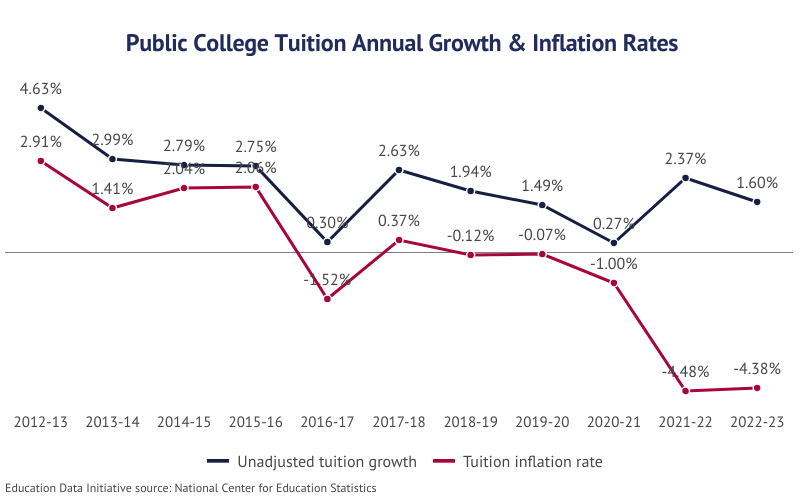

Relax, Everything is Going to be Okay!

I can't work the google fu in my old age, but I'd love to see a chart of federal funding per student. And then index to inflation.
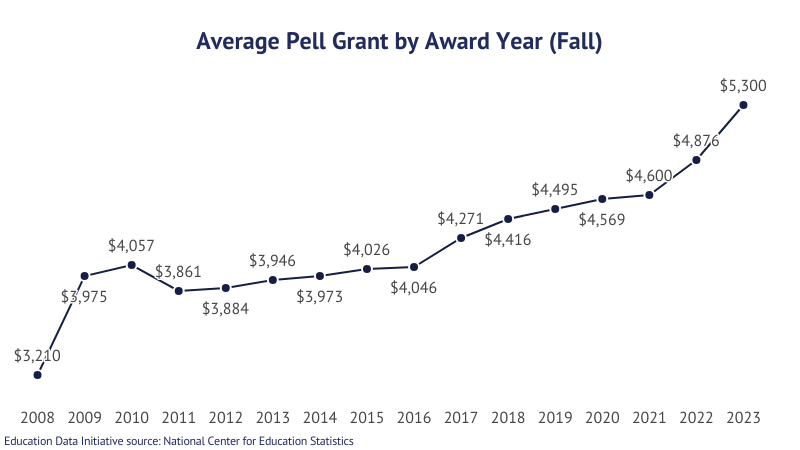
Good luck with that. The chart below does a good job of providing Pell grant data. Pell grants didn't cover my college in the late 80's and early 90's, so it has just gotten worse in that respect. Part of the issue is some comparison of amount per student and Total amount. Yeah, the total amount went up because more students go to college. The site below shows that the average award per student has gone down.

 
Compelling info from the article....


While no single cause is attributed as the primary reason college tuition keeps increasing, several possible explanations have been offered on the subject. Each of these ideas explain the rise in tuition as a result of an imbalance in market-driven economics.

The Bennett Hypothesis

The more grant aid a college student and their family get, the more they are willing to pay for tuition; subsequently, this allows colleges to set higher rates of tuition.

The Golden Ticket Fallacy

Believing any college degree would result in improved future earnings results in college students doing less in-depth research on the cost of college, including tuition.

The Invisible Menu

The published prices of tuition do not include grant aid or discounts the student may receive. With the true cost of tuition obscured, colleges have trouble lowering prices to match their competition.

Oligopolistic Competition

For the majority of college students finding a college constrains them to their local geographic area. Without competition, the small number of local colleges in the area can keep tuition rates high.

Excessive Regulation

Regulation, accreditation, and federal subsidies make it difficult for innovative providers of higher education to emerge and offer the kind of competition the market needs to lower tuition prices.
 
Compelling info from the article....


While no single cause is attributed as the primary reason college tuition keeps increasing, several possible explanations have been offered on the subject. Each of these ideas explain the rise in tuition as a result of an imbalance in market-driven economics.

The Bennett Hypothesis

The more grant aid a college student and their family get, the more they are willing to pay for tuition; subsequently, this allows colleges to set higher rates of tuition.

The Golden Ticket Fallacy

Believing any college degree would result in improved future earnings results in college students doing less in-depth research on the cost of college, including tuition.

The Invisible Menu

The published prices of tuition do not include grant aid or discounts the student may receive. With the true cost of tuition obscured, colleges have trouble lowering prices to match their competition.

Oligopolistic Competition

For the majority of college students finding a college constrains them to their local geographic area. Without competition, the small number of local colleges in the area can keep tuition rates high.

Excessive Regulation

Regulation, accreditation, and federal subsidies make it difficult for innovative providers of higher education to emerge and offer the kind of competition the market needs to lower tuition prices.

As someone who is still entrenched in the world of academia, the most likely and most widely supported reason behind the insane tuition rates is reflected by the Bennett hypothesis. It's become easier for students to get insane loans, and post-secondary institutions want that money.

The regulation hypothesis is flat out stupid, the invisible menu hypothesis is specious at best, and the golden ticket fallacy is just eloquent victim blaming.
 
As someone who is still entrenched in the world of academia, the most likely and most widely supported reason behind the insane tuition rates is reflected by the Bennett hypothesis. It's become easier for students to get insane loans, and post-secondary institutions want that money.
😜 exactly my point. Which wont reflect a difference in operation philosophy at a medical insurance company.

Whats wrong about the golden ticket? Edit: nvm i follow and agree with your point there
 
😜 exactly my point. Which wont reflect a difference in operation philosophy at a medical insurance company.

Whats wrong about the golden ticket? Edit: nvm i follow and agree with your point there
But crazy high student loans aren't actually federal spending; aside from loan forgiveness programs that are excessively complicated and a lot of people wind up not qualifying for, .gov should in theory be making money from student loan programs. If loans were just considered a negative on the balance sheet, there wouldn't be a new bank popping up on every undeveloped piece of land in Helena. 😂
 
But crazy high student loans aren't actually federal spending; aside from loan forgiveness programs that are excessively complicated and a lot of people wind up not qualifying for, .gov should in theory be making money from student loan programs. If loans were just considered a negative on the balance sheet, there wouldn't be a new bank popping up on every undeveloped piece of land in Helena. 😂
I dont believe thats true in practice, for federally subsidized student loans. Open to being wrong though, but heres my understanding on that:

 
As someone who is still entrenched in the world of academia, the most likely and most widely supported reason behind the insane tuition rates is reflected by the Bennett hypothesis. It's become easier for students to get insane loans, and post-secondary institutions want that money.

The regulation hypothesis is flat out stupid, the invisible menu hypothesis is specious at best, and the golden ticket fallacy is just eloquent victim blaming.
The flaw is see in the Bennett Hypo is that the colleges are not swimming in cash, and of late have seen many close. Granted, it depends on the profession because we see private medical schools opening up, which would fit with Bennett more than general college degree. Looking at the pieces (because it is impossible to see the whole) the rise in tuition hasn't shown up anywhere, except maybe the salaries of a few select individuals at the university like the president, AD, and coaches of the popular sports. The rest of costs I have looked into, like staffing salary, construction costs, etc, tracks with the general inflation of the categories. Only a few elite colleges have huge endowments and that money is easier to track. It generally doesn't come from tuition and in fact, the endowments fund a lot of the scholarships.
I dont believe thats true in practice, for federally subsidized student loans. Open to being wrong though, but heres my understanding on that:

I highly doubt the accuracy of that method of calculating the "profit", particularly with the rise in interest rates.

Whats wrong about the golden ticket?
Golden ticket probably explains the overall increase in the percentage of HS graduates choosing college. It might explain some of the rise in cost because a college can only educate a certain number of people at a time. The college needs to expand to keep up with the student population and expansion takes money. I have seen criticism of many colleges for not growing enough. That is how you end up with for-profit colleges, many of which were frauds. So there is some relationship there.

I also note that Golden ticket is mostly supply/demand and would apply to trade schools as well. If kids choose to be electricians because they see the demand and projected salary, the same process plays out where you eventually have too many electricians and they earn less.
 
I think there’s a lot of optimism here on about people actually buying firewood and Christmas tree permits. A lot of firewood and a large percentage of Christmas trees are poached in my area.
Here in MN, tens of thousands of trees in replanted clearcuts were poached for their top 3 ft or so for mini table-top Christmas trees. I imagine it will happen again this year.
 
The flaw is see in the Bennett Hypo is that the colleges are not swimming in cash, and of late have seen many close. Granted, it depends on the profession because we see private medical schools opening up, which would fit with Bennett more than general college degree. Looking at the pieces (because it is impossible to see the whole) the rise in tuition hasn't shown up anywhere, except maybe the salaries of a few select individuals at the university like the president, AD, and coaches of the popular sports. The rest of costs I have looked into, like staffing salary, construction costs, etc, tracks with the general inflation of the categories. Only a few elite colleges have huge endowments and that money is easier to track. It generally doesn't come from tuition and in fact, the endowments fund a lot of the scholarships.

Mileage varies here (the Bennett hypothesis isn't flawless by any means, just the closest to reflecting to what's happening) - some universities are absolutely swimming in cash but I don't have the data to show specifically who and how much (and, frankly, don't really care as that isn't even the point); the point is that they generally wish to maximize their intake of $$$. Whether any particular college or university is flush or existing on thin margins is, in my view, irrelevant to the trend across the board.

The schools with massive endowments are the ones starting tuition-free programs to certain groups (low income, family members of employees, etc). Which is good. However, you'll find that their tuition has risen over the years in relative step with everyone else, regardless of whatever cushy nest egg they might have.
 
Good luck with that. The chart below does a good job of providing Pell grant data. Pell grants didn't cover my college in the late 80's and early 90's, so it has just gotten worse in that respect. Part of the issue is some comparison of amount per student and Total amount. Yeah, the total amount went up because more students go to college. The site below shows that the average award per student has gone down.

You provide good perspective.
It all makes sense now, you are older than I thought.^^😉
 
I didn't want to drop $1,200 on a chainsaw, so I tried one of those clones. It's called NeoTec, 872. It is an exact clone of the Husqvarna 372. Husky (and Stihl) let their patent run out on some older model saws, so there's a few companies that have started making these clones. Figured for $300 it is worth trying. Knock on wood it has been flawless.
Was it the flawless model from the website marketing that sold you on NeoTec?

1000008912.jpg
 

Forum statistics

Threads
117,801
Messages
2,169,675
Members
38,355
Latest member
PUNINGROUP
Back
Top