Me too. Zoom had me on lock down.
Here are some ideas I see in other states, all having mixed results. None will solve all the problems, especially on a complicated and diverse landscape and ownership pattern as Montana has.
I think each idea needs to be considered in the context of what the idea is hoping to accomplish. Is the objective population reduction, financial compensation for crop and property impacts, incentive to increase elk tolerance, other?
I think it is also necessary to understand where it is truly an "uncooperative neighbor" problem and not try to solve that problem. There are just some situations where no level of incentive is going to solve the problem. In those instances it is not an elk problem, rather a neighbor problem, where a neighbor refuses to allow any management of elk by any means.
In SW Montana, we have more and more new landowners who allow no hunting, not by the public, not by friends, not by outfitters, nobody. No amount of incentive is going to work in convincing them that large accumulations of elk have problems for their neighbors who are trying to make a living on the land.
We also need to consider that the blanket approach FWP has used to date is not a solution. What works in Regions 2 or 3 isn't necessarily what works in Region 4, 5, 6 or 7. MT is too diverse to expect a "one-size-fits" all approach. This requires more work by FWP, which I think falls under the responsibility of "management."
I'm tossing out a few ideas for consideration, none of which have been completely vetted in my mind, but are an effort to look at what works in other places and see if they might work here. No order of priority, just the order in which I have them in my notes:
1. PLO - Private Land Only antlerless elk permits might work for some who are being hammered by too many elk. I would be interested in the CO and NM folks to hear how that is working for them. How the tags are issued is to be determined, likely OTC until certain harvest objectives are met.
2. General Fund funding for property damage - We have too many instances where FWP is not going solve the issue. These landowners are not going to allow elk to be managed. There are not enough financial incentives for these billionaire landowners to allow for access that will help with management. This is not a problem the neighboring landowners can solve, nor can hunter, nor can FWP. For those neighbors negatively impacted, we need to compensate them financially from the general fund. I say the general fund, as this is 5th Amendment issue related to property rights, not related to wildlife management. We cannot expect the neighboring landowners to bear the impacts of these "new age landowner's" high elk tolerance. And it is not possible for FWP to change that situation. So, I would propose it comes from the general fund, given it is not a problem specific to FWP.
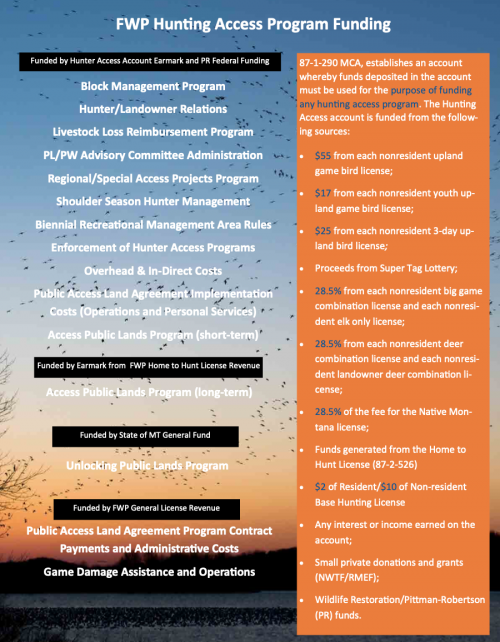
3. Block Management focused more on elk and big game - Wyoming does a great job of allocating their access program money towards properties that have good elk hunting. It costs money and it results in unwanted competition in the mind of outfitters. Yet, it works in Wyoming. Through their access program, WY gets access to private lands that have great elk hunting or those private lands provide access to public lands that have great elk hunting. It also moves elk around the landscape during hunting seasons and allows for a better harvest.
4. Start killing the "problem elk," not the migratory elk - In Montana, our "one-size fits all" approach has resulted in a lot of migratory elk getting shot in these late antlerless seasons, while the elk conditioned to private lands find their sanctuary and are off-limits. This lack of precision allows higher exploitation of herds migrating down low, not knowing the safe spots, and they get toasted upon arrival to the low country. The non-migratory elk know who provides safe boundary and they have lower exploitation than the migratory elk. End results is the harvest goals might get met, but we shoot more of the "well behaved" elk that spend most their time on high ground that is public and we shoot fewer of the "problem elk" that have learned to never leave private. Over time, we get elk herds that have lost the migratory patterns and thus fewer elk on public, while seeing more private land elk that never leave.
5. Improve public land habitat - Elk select for private lands because of habitat and hunting pressure. The private landowners get accused of "harboring elk," a stupid term in my mind. They aren't harboring elk, the elk are just selecting for better habitat and less hunting pressure. If we are not going to manage public lands for wildlife and just let the land manage itself, we will have far fewer elk on public where they can be harvested.
6. Manage Seasons (hunting pressure) with more consideration of how that changes elk behavior - This ties to the point above. Elk select for habitat and safety. When we shoot the hell out of elk for months at a time, elk are going to select for places where they can get away from hunters.
7. Focus on antlerless harvest, not bull harvest - Seems simple, but we often hear about wanting bull tags. Well, we know bulls are not dropping calves in late May. It is hard to take an overpopulation concern seriously when the proposed solution is some sort of bull elk hunting.
8. Get serious about the impact bad hunter behavior has on this situation - Hunters might disagree, but I work with way too many landowners who have had their days ruined by idiots. I know there is the claim of "a few bad apples." Well, in the experience of the many landowners I interact with, there are way more bad apples than hunters are willing to admit. I'm trustee of a ranch that has a lot of public trails through it. To call it a PITA is being kind. I don't see the problem improving, rather declining. We better get serious about this if we expect credibility.
Forget any idea that can be flipped as the old rag of "hunters forcing access to private lands." I've never advocated for any such solution and I would never support such. I'm only interested in working with willing landowners. I want to reward those who are working on solutions. I want to help the working landowner, the landowner I work with in my CPA business, who is trying to make a living from his land.
I'm not interested in wasting time with those who bought their big piece of paradise and feel they have no responsibility to their neighbors. As a public land hunter and a Montana resident, I can't help with that situation. We have big enough issues to solve that we don't need to pretend we can solve the elk issue on lands owned by billionaires. If they want to be included in solutions, that's great, but let's not pretend they are concerned about their working ranch neighbors or the average Montana hunter.
Given how long this issue has been brewing, it's going to take a lot of WORK to solve it. It will take leadership and risk. Like most hunters I know, I'm willing to stick my neck out and work with any group and consider any idea, something that always comes with risk. Without the hard work and some risks taken, progress won't happen.