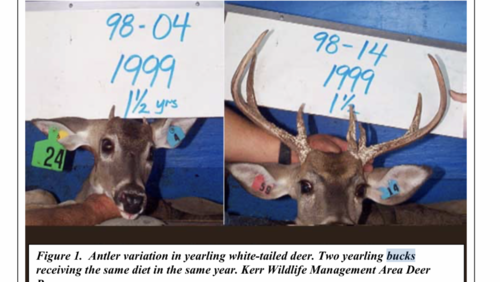
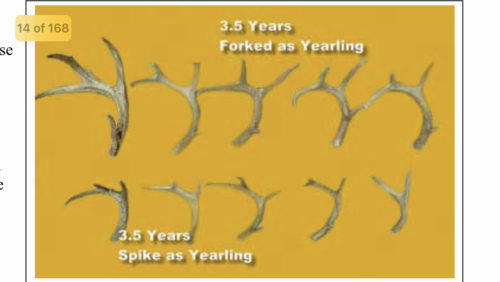
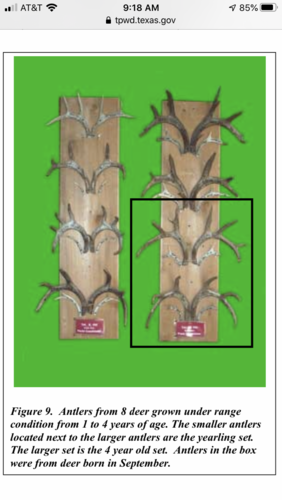
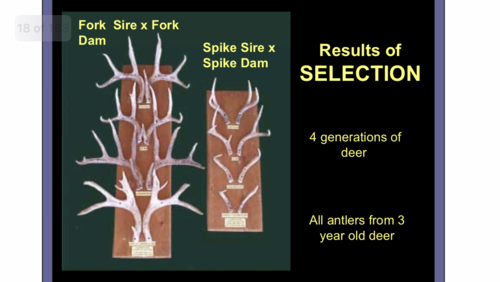
When I first moved onto the property where I live now, we saw lots of spikes. I live next to some public land, so the deer were hunted. The neighboring property was largely un-hunted, except for a few people. It is now leased by an outfitter. Over the last several years, there has been way more emphasis on taking a lot of does during our January season and also during the summer, on depredation permits (which I am fortunate enough to utilize).
As we knocked the population back quite a bit, I have seen fewer and fewer spiked bucks. I am seeing fewer real old does, also. I get a chance, over the summer especially, to look over a lot of deer-both old and young. My observation, now that the herd is getting to a better level, is that bucks with spikes are GENERALLY a deer that was born real late the year before. It is easy to tell one that is not in that category, by looking at body size and type of antler growth. A little common sense goes a long way, in determining which deer to take out and which to leave.
I can legally take any deer in the summer, but since the neighbor has an outfitter pay him a lot of money, I usually leave the bucks alone. HOWEVER, I do shoot some spikes, or culls that are obviously not going to develop into quality deer-which is what they are after. This management on the private land, plus a LOT of doe permits that can be used anywhere, seems to be lowering the incidents of spiked bucks. Just my observation based on this area. Every area is going to have its own nutritional issues etc.
A couple years back, I killed a white-tailed deer on a buddy's ranch. I thought that it was a big, mature doe and it turned out to be a buck with the smallest spikes that I have ever seen (about 1 1/2-2 inches). He definitely needed to be removed from the herd.
I have a hard time wrapping too much faith into a study of a captive deer herd, no matter where it is.