406dn
Well-known member
- Joined
- Dec 12, 2019
- Messages
- 3,028
Possibly.
In chess this is called check mate.



Follow along with the video below to see how to install our site as a web app on your home screen.
Note: This feature may not be available in some browsers.

Possibly.

I'm not a Bundy fan, But it would appear the FBI MO there was to wait and gun down an old man when he was alone.My uneducated guess would be opening fire on a group of people that have assault weapons pointed at another group of people with assault weapons is a no win situation. A officer feeling threatened and dispatching a single armed perpetrator is a total different scenario. I don’t say it to argue the facts of that shooting but I’m sure that how the officer felt at the moment
State by state regulated. And no, I pass on grass. mtmuleyPot is still Federally illegal. I bet a large number of HTer are right now breaking this FEDERAL law. Should they be worried?
Bundy came out against ICE and it’s Minnesota actions.I'm not a Bundy fan, But it would appear the FBI MO there was to wait and gun down an old man when he was alone.
Before ICE there was HRT.
Maybe he will chain himself to a rolling chair in the capital again. That was damned entertaining.Bundy came out against ICE and it’s Minnesota actions.
Strange times.
While various states have legalized weed, the feds still consider it a controlled substance.State by state regulated. And no, I pass on grass. mtmuley
And I don't care. Much less of a threat than alcohol that has been and will continue to cause exponentially more issues. mtmuleyWhile various states have legalized weed, the feds still consider it a controlled substance.
The form filled out to pass a background check is a federal form. So, there are likely millions who have fudged their answer on the question of whether they use a controlled substance.

Pot is still Federally illegal. I bet a large number of HTer are right now breaking this FEDERAL law. Should they be worried?
And I don't care. Much less of a threat than alcohol that has been and will continue to cause exponentially more issues. mtmuley

Pot is still Federally illegal. I bet a large number of HTer are right now breaking this FEDERAL law. Should they be worried?


 www.newsweek.com
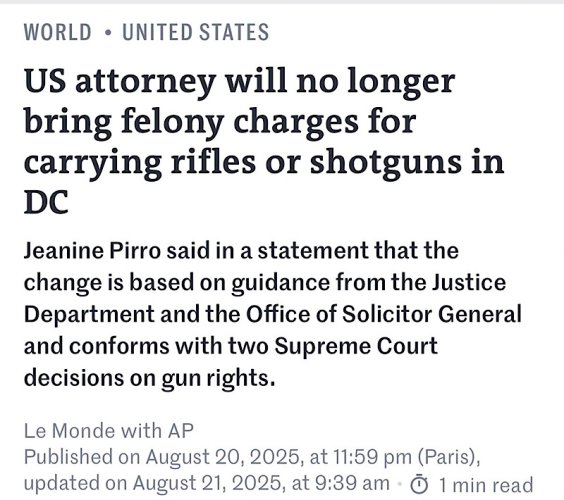
Just send Pirro a case of cheap wine, she'll settle down.Guns no longer allowed in DC? Has it always been this way?
With the barrels, they are claiming it will prevent the usage of “ghost guns” in firearm violence. Ghost guns were banned in the previous 2 dozen gun laws the Dems passed with their near supermajority. Not a real strong case for it being a necessity for public safety.The problem with barrels is that gang bangers and others can keep the gun they used in a crime or to commit murder and just swap out the barrel. Maybe still questionable but I wouldn't say there is no valid reason to regulate.
What concerns me with some red flag laws is not that you can't face the accuser but that done wrong they can discourage someone with mental health concerns from seeking help.
In my state family members. attorneys, and Law enforcement can petition to have guns removed. Two of my kids are therapistts and they all have mandatory reporting requirements but only if they deem the person an imminent threat to themselves or others--and they can't petition to have guns removed, family or LE has to do that. It's up to a judge to decide and it's not permanent--I think the max is up to one year, and the person whose guns are taken can petition to have the order rescinded--but the burden is on them.

Ugly times. Would be pretty cool if the GOP abandoned the requirement to be a Trump puppet to stay in office and emulated Thomas Massie instead. Puppet masters wont let it happen.

 www.thefp.com
I think the traditional ghost gun definition refers to guns made from parts with no trackable serial number.
The difference barrel swapping adds is you can use a gun that is traceable with a different barrel to kill someone...get rid of that barrel...and be unable to use ballistics technology to match the gun that was used to kill someone.

Existing studies, however, count inconclusive responses as correct (i.e., “not errors”) without any explanation or justification. These inconclusive responses have a huge impact on the reported error rates. In the Ames I study, for example, the researchers reported a false positive error rate of 1 percent. But here’s how they got to that: of the 2,178 comparisons they made between nonmatching cartridge cases, 65 percent of the comparisons were correctly called “eliminations.” The other 34 percent of the comparisons were called “inconclusive”, but instead of keeping them as their own category, the researchers lumped them in with eliminations, leaving 1 percent as what they called their false-positive rate. If, however, those inconclusive responses are errors, then the error rate would be 35 percent. Seven years later, the Ames Laboratory conducted another study, known as Ames II, using the same methodology and reported false positive error rates for bullet and cartridge case comparisons of less than 1 percent. However, when calling inconclusive responses as incorrect instead of correct, the overall error rate skyrockets to 52 percent.
Ok, but this bill doesn’t prevent someone from discarding the barrel. Generally for the ballistics technology to work you need the exact barrel, as each barrel is unique, which is the whole point. They still have the record of the firearm and can trace ownership, but how many Glock 17s are out there? Short answer is the bill doesn’t contribute to public safety in any meaningful way. It allows the Colorado Democrat Caucus to punish gun owners again and secure more Bloomberg campaign funds.I think the traditional ghost gun definition refers to guns made from parts with no trackable serial number.
The difference barrel swapping adds is you can use a gun that is traceable with a different barrel to kill someone...get rid of that barrel...and be unable to use ballistics technology to match the gun that was used to kill someone.
How does requiring facing the accuser work when facing that accuser pits a tilted ex or a dangerous stalker who has threatened to kill against the person they have threatened?