The conversation always spirals into buck size. There are areas where the deer are gone or leaving and fwp is asleep at the wheel. Inevitably someone is always going to post I saw lots of deer or shot this “great buck”. Perspectives vary with experience many on here have lots of years in the field and their observation is constant. A few mature buck should be available to hunters that is as much or more important than opportunity to shoot mule deer when they are stupid. A healthy deer herd or at least managing to that goal isn’t that much to ask.We are better off at this point to talk about wanting a mature age class and leave antler size out of the conversation. Just because some guy on the web killed a mature dink doesn’t mean our deer are doing well



Navigation
Install the app
How to install the app on iOS
Follow along with the video below to see how to install our site as a web app on your home screen.
Note: This feature may not be available in some browsers.
More options

You are using an out of date browser. It may not display this or other websites correctly.
You should upgrade or use an alternative browser.
You should upgrade or use an alternative browser.
Montana - Time to Shake it Up?
- Thread starter Big Fin
- Start date

Gerald Martin
Well-known member
- Joined
- Jul 3, 2009
- Messages
- 9,713
The conversation always spirals into buck size. There are areas where the deer are gone or leaving and fwp is asleep at the wheel. Inevitably someone is always going to post I saw lots of deer or shot this “great buck”. Perspectives vary with experience many on here have lots of years in the field and their observation is constant. A few mature buck should be available to hunters that is as much or more important than opportunity to shoot mule deer when they are stupid. A healthy deer herd or at least managing to that goal isn’t that much to ask.
I thinks MT FWP can claim success in improving the quality of our mule deer herd when the number of 3 1/2 year old bucks harvested surpasses the number of 2 1/2 year old bucks harvested and when the number of 4 1/2 year old bucks killed is greater than the 1 1/2 year olds.
That would be a great day for Montana mule deer regardless of antler score.
SAJ-99
Well-known member
I would think that the number of 2 1/2 yo bucks is higher than the number of 3 1/2 yo bucks, though. To get to your goal of success, hunters would need to show an ability to tell one from the other and show some restraint in shooting the forkies. Not holding my breath on that.I thinks MT FWP can claim success in improving the quality of our mule deer herd when the number of 3 1/2 year old bucks harvested surpasses the number of 2 1/2 year old bucks harvested and when the number of 4 1/2 year old bucks killed is greater than the 1 1/2 year olds.
That would be a great day for Montana mule deer regardless of antler score.
Bigger problem is that we have see that managing to buck/doe ratios and older avg age class is contrary to basic CWD parameters.
The rut harvest might skew that statistic a bit. We are selectively harvesting any decent buck at young ages. Where there are still deer you can shoot an older 2 or 3 point. Good reason why rut hunting is no good for shooting older bucks just the bucks that are desirable. October hunts will lead people to being less selective. It would be a win win for mule deer.I thinks MT FWP can claim success in improving the quality of our mule deer herd when the number of 3 1/2 year old bucks harvested surpasses the number of 2 1/2 year old bucks harvested and when the number of 4 1/2 year old bucks killed is greater than the 1 1/2 year olds.
That would be a great day for Montana mule deer regardless of antler score.
WanderWoman
Well-known member
I don’t think you could get here with any other means than severely limiting permits, considering buck survival rates and how many fewer 4.5 year olds there are than 1.5 year olds, etc.I thinks MT FWP can claim success in improving the quality of our mule deer herd when the number of 3 1/2 year old bucks harvested surpasses the number of 2 1/2 year old bucks harvested and when the number of 4 1/2 year old bucks killed is greater than the 1 1/2 year olds.
That would be a great day for Montana mule deer regardless of antler score.
After that, then hunters would have to know what they’re shooting (easy with 1.5 v 4.5, not so much with 2.5 v 3.5).

antlerradar
Well-known member
As much as I hate the idea, I truly believe that an Oct hunt with an APR of three point or better would be more effective at taking older bucks out of the herd than hunting the rut. The hunters that are looking for a better buck would still hold off the trigger until they found one, but now all of the hunters that are more than happy to shoot the first year and a half old forky that they see would be forced to look for an older buck. Just about all the reasons that APR's are a big failure at growing trophy bucks would make them ideal for CWD management.The rut harvest might skew that statistic a bit. We are selectively harvesting any decent buck at young ages. Where there are still deer you can shoot an older 2 or 3 point. Good reason why rut hunting is no good for shooting older bucks just the bucks that are desirable. October hunts will lead people to being less selective. It would be a win win for mule deer.
Last edited:
antlerradar
Well-known member
I don't want @OntarioHunter to think that I am disrespecting his buck. Even through the buck I posted had a slightly better set of antlers at age 2 1/2, the buck he shot is a far better trophy than that buck at that age. I think that there is even a good argument that he has a better trophy then if I had shot the buck at age 4 1/2. The fact that his buck is even older and that he shot the buck on public land using his own two feet make that buck a fine trophy regardless of antler size. Shooting a buck from the hood of the pickup cheapens the hunting experience, Likely part of the reason I did not pull the trigger on the big deer, I haven't shot a buck that way since I was 13 and am not about to start.You may have hit that deer but you completely missed @antlerradar point.
Eastern Montana has long had the reputation of producing bucks with large bodies and relatively small antlers. Is this because these are the only kind of bucks we have or is it because we shoot all the bucks with the potential to grow large antlers long before there bodies have a chance to fill out. I argue that it is latter and Ontario's buck is an excellent example of a large buck with relatively small antlers.
antlerradar
Well-known member
I kind of like to talk about large antlers. I do not think that it is FWP's job to manage solely for large antlered bucks, however I do believe that large antlered old bucks are a leading indicator of herd health. If there are close to zero 6 to 8 year old large antlered bucks on the landscape, you likley have issues with the health of the herd somewhere and if this presisets long enough and is not addressed the issue is going to manifest in other places becides big old bucks.We are better off at this point to talk about wanting a mature age class and leave antler size out of the conversation. Just because some guy on the web killed a mature dink doesn’t mean our deer are doing well
Last edited:
antlerradar
Well-known member
I am going to use the buck I posted as an example of one of the other places I disagree with the professor in the big buck podcast wanderwoman posted up. The professor blames drop off in truly monster 210 class typicals and 240 inch nontypicals in the Henry's on a decreasing in forage quality after the big jump after the early 2000 fires. This may be part of the issue, but it is over shadowed by the real problem. I feel the buck I posted would have had a chance to break the state record at age 6+, the only thing that makes me doubt that is that his right side is five inches weaker than the left. (as if an 82 inch clean four point is weak) If the right was as strong as the left he is close to a 200 inch typical at age four and likely shatters the state record age 6+. I have not been to the Henry's but I am going to bet that a 195 to 200 inch typical is on just about every lucky tag holders hit list. With all the hunters, guides and spotters all armed with the latest technology a buck like the one I posted has only a small chance of living to age five and close to zero chance of making it to six and above even on the Henry's, You are not going to see any 210 inch typicals or 240 inch nontypicals if you shoot every buck that has the potential to grow that big at the age of four or five when they are 195 inch typicals and 220 inch non typicals.
Last edited:
Eastern Montana has long had the reputation of producing bucks with large bodies and relatively small antlers. Is this because these are the only kind of bucks we have or is it because we shoot all the bucks with the potential to grow large antlers long before there bodies have a chance to fill out. I argue that it is latter and Ontario's buck is an excellent example of a large buck with relatively small antlers.
I agree but there are many who won't entertain the thought. I read once that you could substantially change characteristics in a breed of dog in as few as 6 generations, yet people refuse to believe that we can alter wild animal characteristics in 30 or 40 generations. It boils down to efficiency at removing a characteristic from the breeding population. I would argue that Montana is much more efficient at removing young animals with large antler potential than most people will believe.
I would like for someone to explain to me how region 7 just doesn't produce the quality of antelope bucks that it used to even though they can produce record book horns at 2 or 3 years of age. I hunted region 7 for antelope in the 1980s and there were record book bucks that we couldn't kill. Today I would kill them with boring consistency if they were present.
As luck would have it, the cure for what ails us is the same whether you are a believer or not.
Reduce the efficiency of hunters through whatever means possible. For deer I believe that moving the season out of the rut would accomplish that goal while excluding the least number of hunters.

sclancy27
Well-known member
- Joined
- Nov 23, 2022
- Messages
- 1,102
Big bucks are an indicator of habitat health.I kind of like to talk about large antlers. I do not think that it is FWP's job to manage solely for large antlered bucks, however I do believe that large antlered old bucks are a leading indicator of herd health. If there are close to zero 6 to 8 year old large antlered bucks on the landscape, you likley have issues with the health of the herd somewhere and if this presisets long enough and is not addressed the issue is going to manifest in other places becides big old bucks.
I don't know what the definition of "herd health" is. The most logical definition you could give is a population's ability to replace itself, ie reproduction. A good measure of reproduction is the body condition of the females, does. Better body condition of does = healthier fawns and thus better survival rates into adulthood. As a sidebar, big bucks are produced by does in fantastic body condition and there is plenty of research that gives evidence to that. So, what produces healthy does? Is it limiting seasons and not shooting bucks until they are 6 yrs old? Is it limiting doe harvest? Some other management strategy? None of those. Healthy, high body condition does are produced by good to great habitat. So, by that logic, big bucks are indicators of habitat, particularly really good or great habitat.
Now, age has something to do with it and our management style in MT certainly affects age class. But, we get plenty of old bucks that are in no way "big".
Research in both whitetail and mule deer is showing that habitat affects both the resource partitioning to grow large antlers and changes the way genes are expressed for large antlers. In other words, habitat quality increases antler size concurrently and into the future. Good female condition (a surrogate for habitat conditions) can change the genetic expression for antler size of her offspring in a single generation. Stacking years concurrently of good/great female body condition (and thus good/great habitat) over time produces more big antlered deer. "Good genes" = habitat.I agree but there are many who won't entertain the thought. I read once that you could substantially change characteristics in a breed of dog in as few as 6 generations, yet people refuse to believe that we can alter wild animal characteristics in 30 or 40 generations. It boils down to efficiency at removing a characteristic from the breeding population. I would argue that Montana is much more efficient at removing young animals with large antler potential than most people will believe.
I would like for someone to explain to me how region 7 just doesn't produce the quality of antelope bucks that it used to even though they can produce record book horns at 2 or 3 years of age. I hunted region 7 for antelope in the 1980s and there were record book bucks that we couldn't kill. Today I would kill them with boring consistency if they were present.
As luck would have it, the cure for what ails us is the same whether you are a believer or not.
Reduce the efficiency of hunters through whatever means possible. For deer I believe that moving the season out of the rut would accomplish that goal while excluding the least number of hunters.
I won't argue against any of the above. I have lived and hunted north of YNP for many years. When I was young there were very wide bucks and bulls that came out of the park. You could see a picture of an extremely wide buck or bull and know that a buck 30 to 35 inches wide or a bull in the mid 50s to 60 came from the vicinity of the park.
Those days are over because there are few deer left in the park and the elk tend to come out with much greater frequency.
I have seen elk populate areas that had no elk when I was growing up. In 1978 and 1979 for example elk moved into the Bangtails in numbers. I also know of tagged elk being killed just south of Livingston at the same time that had been tagged on the refuge near Jackson hole.
When the elk showed up there were extremely wide bulls present but all were dead within a couple of years. There have been elk present since but we will never see wide bulls there again would be my guess.
Some of these wide animals didn't have exceptional score only exceptional width. All my life I have watched hunters shoot the widest buck, bull elk, bull caribou, or the tallest antelope regardless of actual age or score.
Same goes with extra points, a cheater or 2 has been the death of many younger deer.
You do not have to ever kill a big deer to remove them from a population, you just kill the better young deer and the big ones will disappear in a few years.
Those days are over because there are few deer left in the park and the elk tend to come out with much greater frequency.
I have seen elk populate areas that had no elk when I was growing up. In 1978 and 1979 for example elk moved into the Bangtails in numbers. I also know of tagged elk being killed just south of Livingston at the same time that had been tagged on the refuge near Jackson hole.
When the elk showed up there were extremely wide bulls present but all were dead within a couple of years. There have been elk present since but we will never see wide bulls there again would be my guess.
Some of these wide animals didn't have exceptional score only exceptional width. All my life I have watched hunters shoot the widest buck, bull elk, bull caribou, or the tallest antelope regardless of actual age or score.
Same goes with extra points, a cheater or 2 has been the death of many younger deer.
You do not have to ever kill a big deer to remove them from a population, you just kill the better young deer and the big ones will disappear in a few years.
Outstanding response, and why I believe any true effort forward will have to target improvements to habitat. And, if that means shifting funds-budgeting authority from one area to another than so be it.Big bucks are an indicator of habitat health.
I don't know what the definition of "herd health" is. The most logical definition you could give is a population's ability to replace itself, ie reproduction. A good measure of reproduction is the body condition of the females, does. Better body condition of does = healthier fawns and thus better survival rates into adulthood. As a sidebar, big bucks are produced by does in fantastic body condition and there is plenty of research that gives evidence to that. So, what produces healthy does? Is it limiting seasons and not shooting bucks until they are 6 yrs old? Is it limiting doe harvest? Some other management strategy? None of those. Healthy, high body condition does are produced by good to great habitat. So, by that logic, big bucks are indicators of habitat, particularly really good or great habitat.
Now, age has something to do with it and our management style in MT certainly affects age class. But, we get plenty of old bucks that are in no way "big".
Research in both whitetail and mule deer is showing that habitat affects both the resource partitioning to grow large antlers and changes the way genes are expressed for large antlers. In other words, habitat quality increases antler size concurrently and into the future. Good female condition (a surrogate for habitat conditions) can change the genetic expression for antler size of her offspring in a single generation. Stacking years concurrently of good/great female body condition (and thus good/great habitat) over time produces more big antlered deer. "Good genes" = habitat.

rogerthat
Well-known member
- Joined
- Aug 29, 2015
- Messages
- 3,660
Habitat is definitely a big part of the equation but in Montana our season structure and management supersedes the impact habitat has on big buck production. For example check out the old times thread and a few of the giant bucks that came from Eastern Montana 50-60 plus years ago. Range practices and conditions in eastern Montana are much better now than they were back then. Habitat conditions is not the limiting factor for big buck production in eastern Montana, lead poisoning is. In 2016 I passed up a mule deer buck on public land that was well over 180 inches. He was an 8x10 with 5 inch bases. I could tell that buck was young. My buddy went and shot him 3 days later. Come to find out that buck had been missed by at least two other hunters just days before. He was the talk of the area. He didn’t have a chance. He lab aged 3.5 years old.Big bucks are an indicator of habitat health.
I don't know what the definition of "herd health" is. The most logical definition you could give is a population's ability to replace itself, ie reproduction. A good measure of reproduction is the body condition of the females, does. Better body condition of does = healthier fawns and thus better survival rates into adulthood. As a sidebar, big bucks are produced by does in fantastic body condition and there is plenty of research that gives evidence to that. So, what produces healthy does? Is it limiting seasons and not shooting bucks until they are 6 yrs old? Is it limiting doe harvest? Some other management strategy? None of those. Healthy, high body condition does are produced by good to great habitat. So, by that logic, big bucks are indicators of habitat, particularly really good or great habitat.
Now, age has something to do with it and our management style in MT certainly affects age class. But, we get plenty of old bucks that are in no way "big".
Research in both whitetail and mule deer is showing that habitat affects both the resource partitioning to grow large antlers and changes the way genes are expressed for large antlers. In other words, habitat quality increases antler size concurrently and into the future. Good female condition (a surrogate for habitat conditions) can change the genetic expression for antler size of her offspring in a single generation. Stacking years concurrently of good/great female body condition (and thus good/great habitat) over time produces more big antlered deer. "Good genes" = habitat.
sclancy27
Well-known member
- Joined
- Nov 23, 2022
- Messages
- 1,102
I think that is highly suspect. Eastern MT used to have really good hunting for big antelope bucks. Antelope, unlike deer, do not need age to get big. They can be record-book size in 2.5 yrs in good habitat. So why have record-book antelope become uncommon in eastern MT.....range condition, ie habitat. So, your assertion that conditions are much better now is unlikely to be correct. Further, pronghorn and mule deer habitat have significant overlap in eastern MT (not 100%, but certainly more than 50%). There must be a big part of this that is conditions based.Habitat is definitely a big part of the equation but in Montana our season structure and management supersedes the impact habitat has on big buck production. For example check out the old times thread and a few of the giant bucks that came from Eastern Montana 50-60 plus years ago. Range practices and conditions in eastern Montana are much better now than they were back then. Habitat conditions is not the limiting factor for big buck production in eastern Montana, lead poisoning is. In 2016 I passed up a mule deer buck on public land that was well over 180 inches. He was an 8x10 with 5 inch bases. I could tell that buck was young. My buddy went and shot him 3 days later. Come to find out that buck had been missed by at least two other hunters just days before. He was the talk of the area. He didn’t have a chance. He lab aged 3.5 years old.
None of this is to say that we shouldn't be making some changes from the management side. I am fine with some level of change on that side. But concentrating on the management is an unbelievable mistake where there are bigger issues out there. I would rather see the vitriol be focused on USFS, BLM and the State of MT to do some actual habitat work on these lands.
antlerradar
Well-known member
I agree that all of this can have an effect. However if habitat was the issue in SE Montana we would not be consistently killing elk that land in the top of the record books and the does that spend the summer on my irrigated alfalfa would all be rearing oversized buck fawns.Big bucks are an indicator of habitat health.
I don't know what the definition of "herd health" is. The most logical definition you could give is a population's ability to replace itself, ie reproduction. A good measure of reproduction is the body condition of the females, does. Better body condition of does = healthier fawns and thus better survival rates into adulthood. As a sidebar, big bucks are produced by does in fantastic body condition and there is plenty of research that gives evidence to that. So, what produces healthy does? Is it limiting seasons and not shooting bucks until they are 6 yrs old? Is it limiting doe harvest? Some other management strategy? None of those. Healthy, high body condition does are produced by good to great habitat. So, by that logic, big bucks are indicators of habitat, particularly really good or great habitat.
Now, age has something to do with it and our management style in MT certainly affects age class. But, we get plenty of old bucks that are in no way "big".
Research in both whitetail and mule deer is showing that habitat affects both the resource partitioning to grow large antlers and changes the way genes are expressed for large antlers. In other words, habitat quality increases antler size concurrently and into the future. Good female condition (a surrogate for habitat conditions) can change the genetic expression for antler size of her offspring in a single generation. Stacking years concurrently of good/great female body condition (and thus good/great habitat) over time produces more big antlered deer. "Good genes" = habitat.
sclancy27
Well-known member
- Joined
- Nov 23, 2022
- Messages
- 1,102
You realize that the habitat requirements for elk and mule deer/antelope are different right?I agree that all of this can have an effect. However if habitat was the issue in SE Montana we would not be consistently killing elk that land in the top of the record books and the does that spend the summer on my irrigated alfalfa would all be rearing oversized buck fawns.
Elk prefer habitats that are later on in plant succession, mule deer prefer primary plant succession. Elk can be very successful as grazers, mule deer/antelope are primarily browsers....etc etc.
rogerthat
Well-known member
- Joined
- Aug 29, 2015
- Messages
- 3,660
We have to fix the management side first for the habitat to matter. As far as antelope we have been in some pretty tough drought. I think we will see some good antelope if we stay out of the drought for a few years. Populations have been down yet tags still stay relatively high. That doesn’t help.I think that is highly suspect. Eastern MT used to have really good hunting for big antelope bucks. Antelope, unlike deer, do not need age to get big. They can be record-book size in 2.5 yrs in good habitat. So why have record-book antelope become uncommon in eastern MT.....range condition, ie habitat. So, your assertion that conditions are much better now is unlikely to be correct. Further, pronghorn and mule deer habitat have significant overlap in eastern MT (not 100%, but certainly more than 50%). There must be a big part of this that is conditions based.
None of this is to say that we shouldn't be making some changes from the management side. I am fine with some level of change on that side. But concentrating on the management is an unbelievable mistake where there are bigger issues out there. I would rather see the vitriol be focused on USFS, BLM and the State of MT to do some actual habitat work on these lands.
The mule deer buck issue is not a recent thing. I will take my 43 years of experience coupled with my dads 75 years and his dads 90 years of experience in eastern Montana (I could keep going)and agree to disagree on range conditions. You’re not the first western Montanan to try to explain things to me. Lol

cgasner1
Well-known member
- Joined
- Apr 24, 2016
- Messages
- 5,763
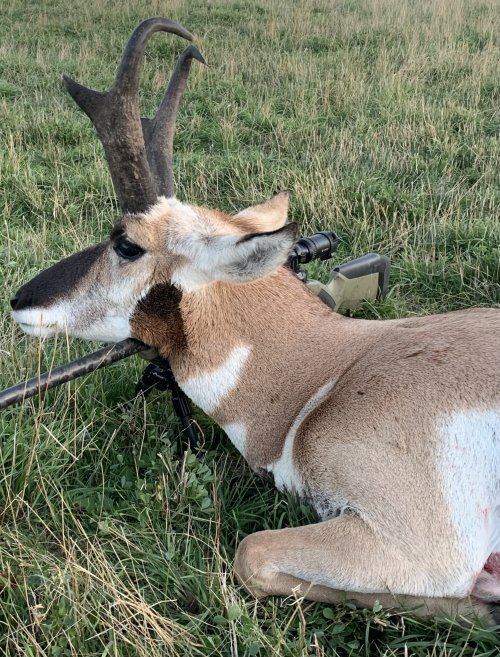
When those antelope where making book after 2.5 years in the 80s how many guys where killing them at 575 yards. Mine missed book by 2” this year. I did not miss at 575.I agree but there are many who won't entertain the thought. I read once that you could substantially change characteristics in a breed of dog in as few as 6 generations, yet people refuse to believe that we can alter wild animal characteristics in 30 or 40 generations. It boils down to efficiency at removing a characteristic from the breeding population. I would argue that Montana is much more efficient at removing young animals with large antler potential than most people will believe.
I would like for someone to explain to me how region 7 just doesn't produce the quality of antelope bucks that it used to even though they can produce record book horns at 2 or 3 years of age. I hunted region 7 for antelope in the 1980s and there were record book bucks that we couldn't kill. Today I would kill them with boring consistency if they were present.
As luck would have it, the cure for what ails us is the same whether you are a believer or not.
Reduce the efficiency of hunters through whatever means possible. For deer I believe that moving the season out of the rut would accomplish that goal while excluding the least number of hunters.
Attachments
rogerthat
Well-known member
- Joined
- Aug 29, 2015
- Messages
- 3,660
I don’t suppose you lab aged him? I got to be honest, I don’t have the age data on the region 7 pronghorn that I do on the mule deer. My brother shot a mid 80s goat in region 7 maybe around 2015 that lab aged at 3.5 years old. Most massive antelope I have ever seen.When those antelope where making book after 2.5 years in the 80s how many guys where killing them at 575 yards. Mine missed book by 2” this year. I did not miss at 575.
Similar threads

- Replies
- 269
- Views
- 17K