Absolutely. Who the hell is pushing back against mandatory reporting, and why? Especially FWP or the committee? I get hunters maybe not wanting to give out specifics (drainages, specific BM), but not wanting to report at all? That is simply stupid. Rally the masses here and tell them where to send the emails.
From asking a couple years ago, the main reason that FWP hasn’t gone to mandatory reporting is because mandatory reporting creates a number of problems for inference. First, it is likely to be biased because there is no statistical way to make inference from those who reported to those who did not. Second, there is no way to measure precision in a mandatory reporting framework because there is no sampling design. Finally, mandatory reporting provides delayed answers. If you have to wait for incentives or penalties to get response rate up, decisions will need to be made before data are available. So, unless you get complete reporting quickly, mandatory reporting is almost always a step backwards.
On FWP’s harvest surveys:
- They talk to a large fraction of hunters to make estimates, but get to decide which ones they talk to using the laws of probability.
- They sample ~60% (or up to 100% for limited licenses and permits)
- They can make estimates of harvest and be very clear about how certain or uncertain they are about those estimates (i.e., generate confidence intervals)
- For the species they conduct their random survey sampling (elk, deer, antelope, UGBs, turkey).. the first point is that these are much, much larger and common hunts. They are not as memorable as say, a bighorn sheep or mountain goat hunt (in which FWP does have mandatory reporting for). Hunters may have multiple opportunities for these species and/or the majority of licenses and permits sold for these species are not tied to a specific area (i.e., general licenses) so it is more difficult to tie where hunting effort/harvest occurred, especially when some hunters don’t remember what district or districts they hunted in.
- They worry about the cost of implementing mandatory reporting for large hunts in MT, especially because they have more licenses and permits issued than most other western states. Compare MT and ID (which has mandatory reporting and comes closest to the # of hunters): MT - 286,315 DEA hunters, 455,885 DEA licenses, $210K. ID - 232,381 DEA hunters, 254,785 licenses, $400K. (These numbers were from a couple years ago.. maybe 2020 or something) So… maybe $800K?
- Other states have referred to enforcement issues/compliance issues with mandatory reporting
- It takes time to process data once it's accumulated, and these estimates are needed by biologists for recommending quotas and season adjustments. Bios need to have these recommendations in with plenty of lead time prior to the draw.
Why imperfect compliance with mandatory reporting is an issue:
- If 80% respond (some states that implement mandatory reporting don't even get that), they cannot say what happened with the other 20% in a mandatory reporting system.
- Put in context of a quota change proposal to decrease the number of permits in an area: with FWP’s sampling system, a biologist can say that even with their uncertainty in harvest estimates they know that the harvest has increased in an area and is putting pressure on a population, vs. with a mandatory reporting system they can say that harvest has increased, but they are not certain how accurate the harvest tally is without assumptions based on compliance rates or a follow-up survey (and assuming they get harvest reports in time).
- In the first situation, they can enumerate the reliability of the estimate, in the second, we cannot.
Mandatory reporting works well in situations with
- small hunts that are relatively rare for hunters - they can remember and want to talk about it - i.e, sheep and goats (on a side note I think moose should be in here, too), bears, lions, wolves (some also on a quota)
- are limited to specific districts, so there is less information they need from hunters about their hunt
- law enforcement to make sure people report what we need them to report by the time biologists need the information
- small numbers of hunters so that the cost of implementing the program is not so great
- Some of the species they survey fit this, and they have mandatory reporting for those. Think about other states and the opportunities offered--most have more limited or specific opportunities so the hunts are probably easier to remember and obtain the information on.
Survey sampling of hunters works well in situations with
- large hunts that are not in focused geographic areas - so memory and timelines become issues when using this information
- compliance rates that will never be close to perfect - so they can quantify and control their uncertainty
- species with large numbers of hunters so that implementing the program would be costly. This is all akin to MT general deer/elk license holders. As stated above, MT does attempt to get all of the LE license holders.
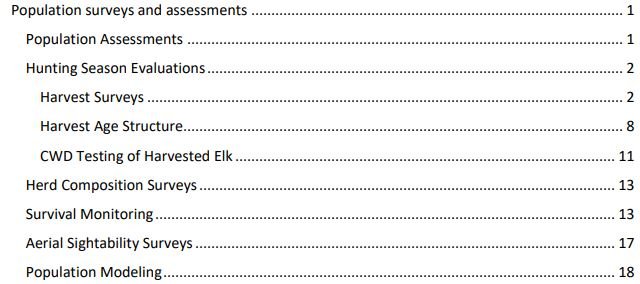
Food for thought, I guess. I’ve also attached a peer-reviewed paper a biologist sent me a while back about harvest sampling strategies.