Yikes, not a pretty read.
Missoula region FWP supervisor retires suddenly prior to elk season upheaval
As of Thursday, Mike Thompson is no longer the FWP Region 2 wildlife manager, according to FWP sources. Thompson’s departure appears to be short-notice, leaving some in Region 2 a little stunned. A few are suspicious.missoulacurrent.com



Navigation
Install the app
How to install the app on iOS
Follow along with the video below to see how to install our site as a web app on your home screen.
Note: This feature may not be available in some browsers.
More options

You are using an out of date browser. It may not display this or other websites correctly.
You should upgrade or use an alternative browser.
You should upgrade or use an alternative browser.
Montana FWP makes seismic shift in elk permits
- Thread starter Ben Lamb
- Start date

rogerthat
Well-known member
- Joined
- Aug 29, 2015
- Messages
- 3,682
I like the last paragraph "I'm not saying that's anybody's fault".Yikes, not a pretty read.
Fault = Hank Worsech... pretty simple for the readers to figure that out and put it in a math equation


Point Creep
Well-known member
FWP: Looking for a few good yes-men.. to do some embarrassing shit..
Would love to see the job descriptions. Bet they are about as misleading to a prospect as the 2022 FWP proposals are to MT sportsmen and women.
Would love to see the job descriptions. Bet they are about as misleading to a prospect as the 2022 FWP proposals are to MT sportsmen and women.
Point Creep
Well-known member
Pretty sure Greg Gianforte cares way way less about the content of that article, than he does knowing to be personally responsible for the big smile on Dan & Farris' faces when they have a handful of long awaited bull elk permits..Missoula region FWP supervisor retires suddenly prior to elk season upheaval
As of Thursday, Mike Thompson is no longer the FWP Region 2 wildlife manager, according to FWP sources. Thompson’s departure appears to be short-notice, leaving some in Region 2 a little stunned. A few are suspicious.

Nameless Range
Well-known member
They're down around 30 positions from Wardens to Bio's. Heard that one of the DO's staff quit as well. She'd been running the admin side of the agency for a long time and was an amazing public employee. The fleeing is real.
Montana is a small town and word gets around, and this is absolutely true. Further, I'd say it's just getting started.
Just acknowledging how much of a shame it is. It's en vogue in a lot of circles to chit on public servants, but many of those jumping ship or entertaining it are good people - hard workers who believed in a mission and wanted a portion of their life's energy to leave a legacy. That desire isn't unique to the public sector, or any realm of work really. But in addition to the perspective that the people of Montana and her resources and so much potential scenarios for the good are losing out with these careers-abandoned, so also is damaged the faith of good folks being told in no uncertain terms that their energies to the public good are wasted and contra to the direction the plutocrats and their bureaucrats want to take us. It's the squandering of giant pile of talent and passion.
It's a lot of literal tragedies, and their effects will echo far beyond this administration into the future, and we need to continue to speak up for them when we can.

shoots-straight
Well-known member
All this mismanagement started because of policy attacks from the ag community, and legislative meddling. I will add that much of the ag attacks were influenced by those wishing to privatize the resource for a long time.Their elk management is brilliant compared to their mule deer management. If I was them, black and white numbers would scare the hell out of me. I am talking numbers before GG, so we can't blame it on him. It would be pretty easy for them to prove me wrong. If I am wrong. I am betting they won't prove anything, because they like gray numbers.

All this mismanagement started because of policy attacks from the ag community, and legislative meddling. I will add that much of the ag attacks were influenced by those wishing to privatize the resource for a long time.
I don't think it's fair to cast it simply as Ag. Stockgrowers, Farmers Union have some big policy differences with the hunting crowd, but they've mostly been willing to work with us to find solutions. Some issues are just bridges too far for their boards.
It's really down to UPOM, Wealthy out of state landowners who hire top-shelf lobbyists and MOGA.
BuzzH
Well-known member
I think another fair assessment is that many times, there was no support, or darn little from within the FWP leadership as well.I don't think it's fair to cast it simply as Ag. Stockgrowers, Farmers Union have some big policy differences with the hunting crowd, but they've mostly been willing to work with us to find solutions. Some issues are just bridges too far for their boards.
It's really down to UPOM, Wealthy out of state landowners who hire top-shelf lobbyists and MOGA.
Field level staff need to know someone has their back...and for a long time, even before things went this far south, that simply wasn't happening.
The FWP leadership pushed back very little against the Gov's office and from what I heard/know, hung their folks out to dry.
BuzzH
Well-known member
I was thinking the same thing. That would be an angle to work. However, I'll just say, from years and years of experience with a public sector Union, its 90% about leadership there too. Some are pretty aggressive and good/smart about things, others are just filling a chair and not so smart about things.Is FWP still union? If the staff are really having issues why aren’t they dealing with it through that?
Eric Albus
Well-known member
- Joined
- May 24, 2012
- Messages
- 1,884
Thanks for the time, effort, and insight.I appreciate the thoughtful response, Eric.
There will be significant opposition to any landowner set aside or transferable license. That is the heart of a lot of this conflict, and if people are serious about ending the conflict and finding better solutions, then I think we need to take the discussion of transferable tags off the table at the very least until people are more trusting of each other. Simply put, leading with ranching for wildlife plays into the concerns that a massive number of resident hunters have regarding the future of wildlife management in Montana, and the concerns that Montanans have regarding this administration. It's politically toxic, and if it's the main thrust of the agency, PLPW or any politician, it will just be more rallies, more initiatives and more conflict.
There are a lot of other options out there relative to wildlife management than giving away prized permits for sale to keep encouraging the same poor behavior. I don't think that transferable tags get to the heart of the issue - wildlife population management using public hunting as the management tool. I know that the bon mot offered by those seeking to privatize wildlife management is that objective numbers will be going up, but I think that's happening anyway. I do think that Montana needs to be far more progressive in approaching the elk distribution issue though, and that's where a type 3 Block Management prescription could be helpful:
This would be different than types 1 or 2 in that it would have to be a whole herd unit Block Management Agreement. It's not punitive, it's inclusive. By getting a majority of landowners to agree to a hunting plan that is administered by the agency (no special picks for friends or families and if you lease or are outfitted, you will need to justify participation since you're already making money off the resource). Having the majority of landowners work with FWP to develop a management plan for the EMU, alongside hunters or through the local CAC could open those participating landowners up for the max payment (as opposed to being based on only hunter days), more fencing, deterrents in the form of EMU specific damage hunts, and compensation for lost forage through a game damage fund that's paid for out of general tax dollars, and not hunter license revenue. I don't think that's punitive, and gets to the heart of the issue - increasing harvest rates and decreasing animal concentrations where they're not wanted at the correct times.
The only ones claiming that cow only would be punitive are the ones who have created the situation of harboring through outfitting or leasing, that I'm aware of.
I think we need to come up with something better than BM.
I been thinking about a program that pays landowners who provide successful hunting opportunities. The Current program pays LO’s for providing access to what looks like ground zero for wildlife. It’s opportunity to go on an armed hike. A program that actually pays a LO for access to quality is what I think needs developed.
This along with pick region, area, weapon, ect. is a good start.
The “opportunity state “ providing hunting with no restrictions for 6 months a year has gotten us here, to the point of change finally being demanded by the masses.

antlerradar
Well-known member
I am liking all of this and pray you are right on the last part.Thanks for the time, effort, and insight.
I think we need to come up with something better than BM.
I been thinking about a program that pays landowners who provide successful hunting opportunities. The Current program pays LO’s for providing access to what looks like ground zero for wildlife. It’s opportunity to go on an armed hike. A program that actually pays a LO for access to quality is what I think needs developed.
This along with pick region, area, weapon, ect. is a good start.
The “opportunity state “ providing hunting with no restrictions for 6 months a year has gotten us here, to the point of change finally being demanded by the masses.
Thanks for the time, effort, and insight.
I think we need to come up with something better than BM.
I been thinking about a program that pays landowners who provide successful hunting opportunities. The Current program pays LO’s for providing access to what looks like ground zero for wildlife. It’s opportunity to go on an armed hike. A program that actually pays a LO for access to quality is what I think needs developed.
This along with pick region, area, weapon, ect. is a good start.
The “opportunity state “ providing hunting with no restrictions for 6 months a year has gotten us here, to the point of change finally being demanded by the masses.
We agree on the basic thrust, that's what, along with acknowledging that large landowners have a chance to work with the department to focus hunting pressure, is where I'm coming from.
Good start towards consensus.

Nameless Range
Well-known member
If it comes to revamping Block Management in Montana, I would hope for great caution. Yes, it is true that some BMAs are largely void of game, but that is true of large expanses of Montana period, and is more a function of season structure and "opportunity" for opportunity's sake, than it is those BMAs being poor habitat or hunting grounds.
I guess I am somewhat protective of BM. Some of my best hunting has occurred within that system.
I guess I am somewhat protective of BM. Some of my best hunting has occurred within that system.
If it comes to revamping Block Management in Montana, I would hope for great caution. Yes, it is true that some BMAs are largely void of game, but that is true of large expanses of Montana period, and is more a function of season structure and "opportunity" for opportunity's sake, than it is those BMAs being poor habitat or hunting grounds.
I guess I am somewhat protective of BM. Some of my best hunting has occurred within that system.
I think that you can do that - Keep both type 1 & type 2. Type 1 is more like public land, open for all with a payment for the landowner. It works for a large number of folks in the program. Keep that.
Type 2 needs some reform relative to how reservations are made. Ideally this can be done through the FWP website that's been in the planning stages for a long time. There's $10 million in license dollars available for a new, state of the art, web interface/management tool. Let's use it and get it done.
Type 3 can be what @Eric Albus has suggested where it's about hunter success rather than just hunt days. When this was tried in the past, landowner set-aside licenses are what killed the bill in the session. However, I do think we need to be honest about what the financial incentive for Block Management truly is compared to leasing/outfitting, and we have to be prepared to increase that max payment even more.
Type 4? Maybe that's the whole herd unit type where even more programs become available, like game damage payments, increased fencing, habitat improvement through WHIP, etc.
shoots-straight
Well-known member
So did you not read my entire post?I don't think it's fair to cast it simply as Ag. Stockgrowers, Farmers Union have some big policy differences with the hunting crowd, but they've mostly been willing to work with us to find solutions. Some issues are just bridges too far for their boards.
It's really down to UPOM, Wealthy out of state landowners who hire top-shelf lobbyists and MOGA.
That would be the sources you posted. I'll write larger fonts for your old eyes next time.I will add that much of the ag attacks were influenced by those wishing to privatize the resource for a long time.
So did you not read my entire post?
That would be the sources you posted. I'll write larger fonts for your old eyes next time.
The way you wrote it, it came across as impugning all of the ag groups. I admit I need a new prescription, though. It's been a couple of years since I got the last one.

Irrelevant
Well-known member
Man, reading that, I really feel like a manager might have a pretty good claim if they were fired for implementing policies that are actually based on science and the resource.Missoula region FWP supervisor retires suddenly prior to elk season upheaval
As of Thursday, Mike Thompson is no longer the FWP Region 2 wildlife manager, according to FWP sources. Thompson’s departure appears to be short-notice, leaving some in Region 2 a little stunned. A few are suspicious.
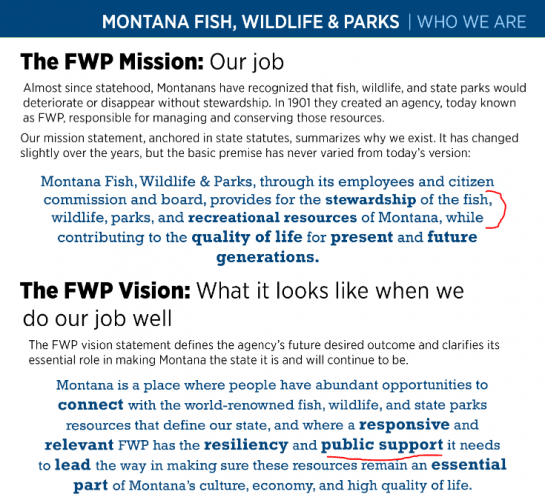
BuzzH
Well-known member
You and shoots-straight act like an old married couple...funny stuff.The way you wrote it, it came across as impugning all of the ag groups. I admit I need a new prescription, though. It's been a couple of years since I got the last one.
Similar threads


- Replies
- 269
- Views
- 18K