One of the things that's interested me the most since getting to know the rocky mountain states is the decline in hunting quality in the Bob/Scapegoat/Spotted Bear area of Montana. Seems like such a storied place with so many older hunting stories associated with it. But I don't understand how the animals actually use the landscape. Do the elk migrate or stay? What about deer and moose? It seems like the entire area is too high in elevation to support many critters during the winter, but maybe the wind keeps west/south faces snow free. I spent a little time on Google but didn't come up with any migration studies for that area, did my google-fu lead me astray or do none exist? If you know of any I would greatly appreciate some links. The more I read about the area the more interested I am in the history and ecology of it.
Neffa3,
If you read some of the past history associated with the Bob, and talk to people that hunted there in the 50's, 60s', and 70's it was absolutely some of the best elk hunting found anywhere. I would argue that even in the 80's-early 90's it was still pretty good. I had several friends who hunted and guided the Danaher, Youngs Creek, Big Prairie and all through the central and southern end of the Bob. IMO, winter range is not the problem on the Southern end. Those elk have a lot of choices to winter on places like Ovando/Marcum Mountain, Kleinshmidt Flat, and all sorts of low country around Ovando, Helmville, clear to the BCWMA. I also know that some of those elk winter off the East side of Rogers pass on Sugarloaf, Falls Creek, area...I used to pick up a couple hundred pounds of elk antlers out that way each year. Even then, right before I left for Wyoming (2000) the number of elk antlers I picked the last couple years I lived there was declining. One of the ranches I looked behind for antlers, asked to buy a set of sheds I found off a bull a client of theirs killed, that I found the year before. It, along with 10 of its buddies, were killed on one hillside, in one morning hunt. The next year the same landowner was complaining because they "just aren't finding the sheds like they have in the past"...oh, really?
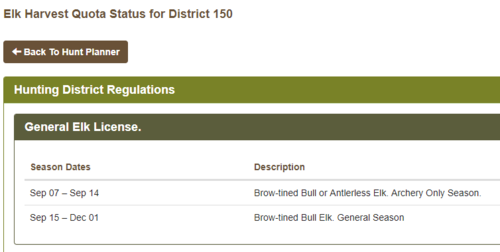
The issue with the drastic decline in elk in the Bob is not a habitat related issued, its a lead poisoning issue conducted via early rifle hunts starting 9/15 and going until late November/early December. Now, there is no doubt in my mind, that many of the cow elk that summer in the Bob are also subjected to UNLIMITED numbers of cow b-permits in most all of the wintering areas I mentioned above valid clear until the end of the general season (Dec. 1 this year). Those elk are suffering from lead poisoning as well. It makes NO sense to kill elk for just being elk. I don't have a problem with the FWP shooting the elk there in the early fall on unlimited b-permits in September. Those elk are local and probably never see the Bob Marshall...but the ones they're killing in November...yeah, they're killing the wrong elk.
This is another classic case of elk mismanagement, killing elk that are doing what elk are supposed to do...live in the high country in the spring/summer/fall and then migrate out to winter range. What they receive for being elk and migrating to winter range is shot, all through November. It wont be long and those elk b-tags will also be valid in December, January, and February...furthering the problem of killing elk that spend a lot/most of their time in the Bob.
Not to get too far out in the weeds, but I also know that its very likely some of the elk wintering on the BCWMA (Boyd Mtn), come from the Missions, Swan, Flathead Reservation, and some of the country around Game Ridge, Belmont Peak, and Upper Gold Creek. Again, if those elk are subjected to the b-permits, they're killing the wrong elk.
Its a total cluster-shag with nearly all public land elk and deer hunting in Montana right now. I used to think it was about impossible to mismanage whitetail deer...boy, was I wrong about that.
If what I am experiencing was an isolated incident, I probably wouldn't say much, but its pretty much across the board when I talk to some of the best hunters in the State and they see the same things.
Text books should be written on how poorly Montana big-game is managed...as a classic case of what not to do.