Point Creep
Well-known member
@It’s Bucky Those are pretty insane groups
For factory ammo!
For factory ammo!



Follow along with the video below to see how to install our site as a web app on your home screen.
Note: This feature may not be available in some browsers.


I would consider th 6.5CM to be a more accurate rifle than 1 MOA, but not the other three, only because I don’t see data that suggests otherwise, and none of those groups look like what you would see in a ladder test from a .25-.5MOA rifle. Obviously you weren’t shooting a ladder test. I would not consider any of them fliers. I don’t consider a shot to be a flier unless I feel myself flinch, and then I don’t say “look how good this is except for that flier”. That said, using cheap ammo, it’s likely that something about the ammo caused the groups to be around 1MOA, and likely that better ammo would shoot better, but I’m not going to guess how much better. I honestly haven’t shot a single round of factory center fire rifle ammo in well over 20 years. Likely fewer than 100 in my lifetime. So if you post tiny groups with something else, that’s great. And yes it’s possible for a rifle to shoot some excellent three shot groups occasionally simply due to random distribution. There’s a reason that no competitions use three shot groups. But even then, in your targets, other than the 6.5CM, there are not three consecutive shots in .25MOA anywhere in them, except possibly the one where I can’t find shot number five. Also, I’ve seen the Hornady 140BTHP shoot very well for others. You may not shrink groups a ton with different ammo for the 6.5CM, but you might.@ImBillT you’ve put a lot of thought into this. What are your thoughts on the following:
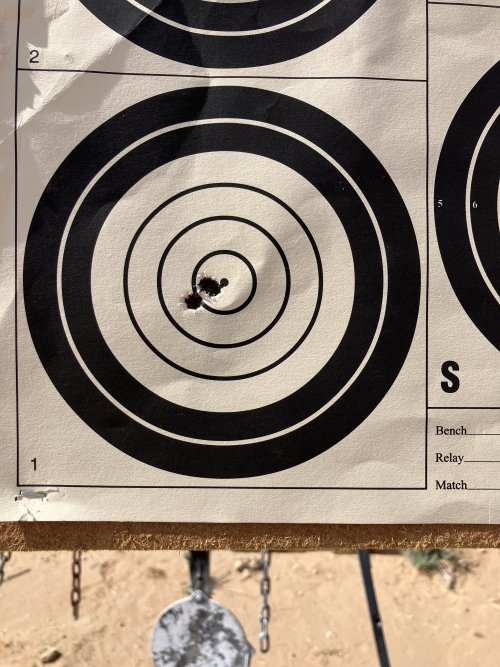
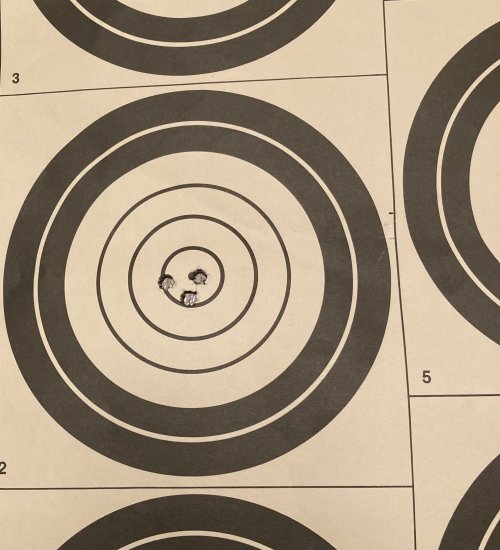
How many random .25MOA 3-shot groups can you find in these photos? Are these .25MOA rifles or 1MOA rifles? Would you throw any of the shots out as ‘flyers’ when determining your group size or zero?
All 4 loads are the cheapest factory ammunition I could find for each rifle. I chickened out on shooting 10 with the 6.5CM, but wish I would have.
Statistics definitely need to be considered, and the less accurate a rifle is, the larger the sample size has to be to show the difference between tuning and random shot distribution, and that gets ridiculous fast. If a rifle isn’t shooting really really well, I’m not likely to bother trying to tune it.This thread, and some gentle challenging from my brother, has been making me take a dive into the subject of sample size and reloading. Way behind the curve, I know... I've been aware, but resistant to the idea that findings that seemed meaningful to me, probably weren't and resistant to a model of reloading that seems to require even more expensive and hard to find components.
Looking at data and some of the big tests done by Hornady and others is making me reckon with the reality of this stuff, and I'm thinking a lot about some of the ways that load development can be reconceptualized to get better data and not go broke (especially since I'm just reloading for hunting and hunting practice). I've enjoyed hearing people's methods. Keep them coming!

This is me.Suppose not.
... Also had to accept the reality that I do really want a higher velocity out of my hunting rifle and I really wouldn’t choose to give up 200 fps for a tighter group.
I’m not trying to school him on practical shooting. Load tuning, isn’t practical shooting. He has proven that he has all the important pieces of killing trophy animals figured out and figured out well. The purpose of a ladder test is to identify the velocity windows that give less vertical dispersion than velocity spread suggests and windows that give more. But that effect diminishes as range increases, which makes it less important than other factors. From a hunting standpoint, it is a low value form of tuning. But from how he said he did it, I don’t think he was likely to get much from it, even though doing it properly wouldn’t make a big difference in hunting success. At 500yds, almost every other factor is more important than staying in the velocity windows that your ladder showed. The effect isn’t zero, but it’s not huge. @Frequently Banned Troll has proven that he doesn’t need any further load tuning to be more successful than I’ll ever be.I think trying to school @Frequently Banned Troll on practical shooting is kind of funny. Kurt has put more pounds of game meat on the ground than I ever will.
This is me.
I want my hunting rifles to hit as hard as safely possible. SUB MOA is just a bonus. I have never taken a 500 yard shot in the field. We are figuratively aiming at a dot on a volleyball. I don't have to hit the dot to pop the volleyball. I want that dot to be the focus of my attention, but I don't sweat missing it so long as I pop the volleyball. Aim small, miss small if you want to say it that way.
I will take that 1 MOA rifle and make sure I can bang a 6" gong with it from practical field situations. If I can't, I need to shorten my range before I change my load.
What really interests me is how much time some handloaders spend to get 1/2 MOA groups when they spend far less time practicing wind calls and knowing their ballistics.


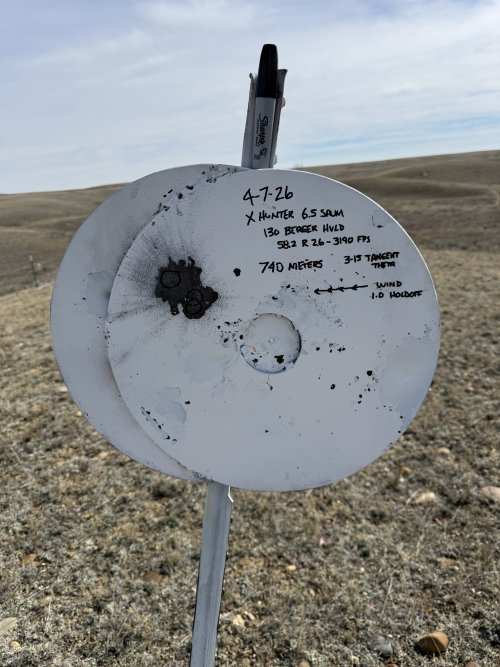
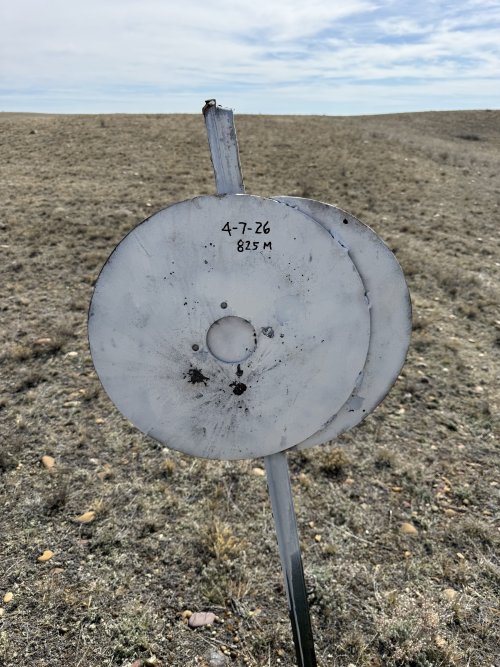
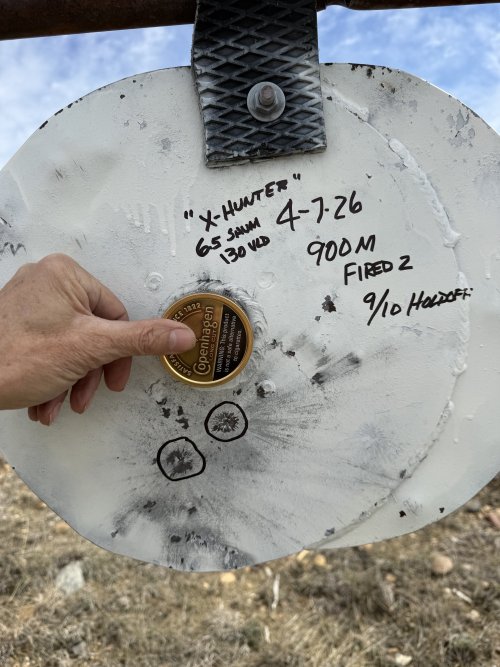
I don’t think you need to do a ladder test for what you’re doing. The effects of being on a velocity node are linear, and that’s about barrel angle when the bullet exits. Your drop as range increases is not linear. As range increases, velocity spread is dramatically more important than being on or off a velocity node. In fact, if velocity spread is zero, then being at the worst possible point between nodes, will still show zero vertical. It’s not a particularly important part of load development. I would not shot a ladder as an additional step. I do it while finding max pressure, which is a step you’re doing anyway. If the rifle proves to be accurate enough that I think the ladder showed me soemthing then I note what velocity window is not ideal, and move on from there.I’ve never done a so called “ladder test”.
My process for finding the load I want to use is pretty simple…
Find zero @ 100M
Find pressure
Find seating depth
Find consistent SD
Send rounds down range (lots of them)
While I’m doing this I work on consistent shooting techniques. Lighter weight hunting rifles require more thought on being as repeatable as possible, as in hand pressure, shoulder pressure, trigger break, follow through, eye relief, and so on.
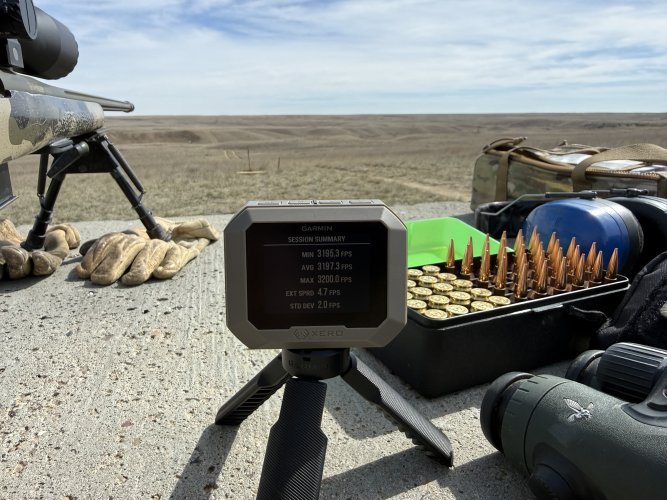
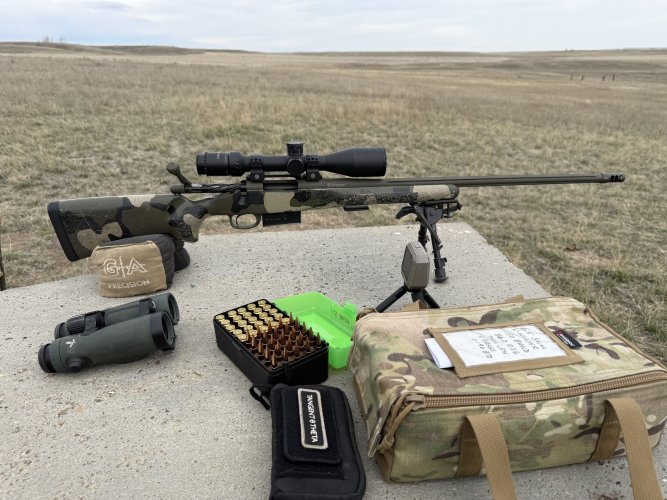
Today’s range day there was a steady right/left cross wind. I shot steel from 400 meters out to 900 meters. This rifle has a brand new Bartlein 3B barrel I had put on over the winter. It gained 125fps after the first 200 rounds. The accuracy stayed consistent throughout the entire velocity gain. That tells me the velocity “node” could be consistent from 3075fps, to 3200fps…
Trigger time and spend primers are always the ultimate tutorial.
Kurt, you really need to come to my shoot…
Ride on out here with Jake!View attachment 405642View attachment 405643View attachment 405644View attachment 405645
Kurt, you really need to come to my shoot…
Ride on out here with Jake!
Not pointing at any one poster, just the way this thread is going.I’m not trying to school him on practical shooting. Load tuning, isn’t practical shooting. He has proven that he has all the important pieces of killing trophy animals figured out and figured out well. The purpose of a ladder test is to identify the velocity windows that give less vertical dispersion than velocity spread suggests and windows that give more. But that effect diminishes as range increases, which makes it less important than other factors. From a hunting standpoint, it is a low value form of tuning. But from how he said he did it, I don’t think he was likely to get much from it, even though doing it properly wouldn’t make a big difference in hunting success. At 500yds, almost every other factor is more important than staying in the velocity windows that your ladder showed. The effect isn’t zero, but it’s not huge. @Frequently Banned Troll has proven that he doesn’t need any further load tuning to be more successful than I’ll ever be.
I don’t spend much time trying to get sub .5MOA. If the rifle is good, and the components are good, I’ll be there very quickly unless something is wrong, and when something is wrong, it’s not shooting .6MOA. It’s shooting a lot worse. On the other hand, if it’s a factory barreled hunting rifle, if it shoots 3/4-1.25 MOA and nothing is screaming “wrong”, then I’ll just call it a 3/4-1.25MOA gun and live with it. I prefer 1MOA or better or feel a little iffy taking a 500yd shot.
I could use some practical shooting practice. Since my son was born six years ago, I’ve done three very short tuning sessions. Two with new rifles, and one with a different weight bullet. For each session it was a 15-20 shot ladder, load three, and be happy or unhappy. One rifle shoots decent with both bullets. The other is meh. 100% of my shooting outside those three sessions has been pre-hunt checks. Three shots at 200yds from a bench to check zero. Dial to 500 and shoot three from sticks to make sure the scope is still dialing properly. Dial back to 200 and take three more shots from sticks to confirm that it dialed back to zero properly and my form with sticks isn’t causing the group to print high. That’s it. I’ve taken nine shots, six from sticks before each hunt, and under sixty shots of load developement in the last six years. I had a few pre-hunt checks where things weren’t doing what I expected, so I just grabbed a different rifle and worked well enough. Those were all with the “meh” rifle. It may be an ammo issue or a barrel issue. It’s not a tuning issue. I haven’t had time to bother trying to figure it out. I’d like to rebarrel it going forward anyway.
I’ve never done a so called “ladder test”.
My process for finding the load I want to use is pretty simple…
Find zero @ 100M
Find pressure
Find seating depth
Find consistent SD
Send rounds down range (lots of them)
While I’m doing this I work on consistent shooting techniques. Lighter weight hunting rifles require more thought on being as repeatable as possible, as in hand pressure, shoulder pressure, trigger break, follow through, eye relief, and so on.
Today’s range day there was a steady right/left cross wind. I shot steel from 400 meters out to 900 meters. This rifle has a brand new Bartlein 3B barrel I had put on over the winter. It gained 125fps after the first 200 rounds. The accuracy stayed consistent throughout the entire velocity gain. That tells me the velocity “node” could be consistent from 3075fps, to 3200fps…
Trigger time and spend primers are always the ultimate tutorial.
Kurt, you really need to come to my shoot…
Ride on out here with Jake!View attachment 405642View attachment 405643View attachment 405644View attachment 405645
Barrel number three right now, with 299 rounds through it...That rifle on barrel 1, the threads on the hide about it, and talking to Sikes (were budddies from HS) are what got me to jump into reloading and my first custom, a 6.5 saum spec’d close to the xtreme hunter.
How many barrels has that one been through?
Haven't talked in a handful of years but he's always been a gem!Say hi to Sikes for me! He's a good shit.
I’ve hunted and shot with him quite a bit over the years. Fun dude to hang with…Haven't talked in a handful of years but he's always been a gem!