Point Creep
Well-known member
My son’s rifle didn’t like the eldx as much , but not too bad.



Follow along with the video below to see how to install our site as a web app on your home screen.
Note: This feature may not be available in some browsers.

I'll ask a dumb question, what else are you guys doing if not ladders?

 panhandleprecision.com
The bullets I loaded are about like that not much different BTO than Hornady factory loadings of same bullet, just a touch seated out - I’m just under .020” off jamming into rifling on both rifles.
I expected to hit pressure and have to pull a few bullets tonight, but no signs of pressure even a ways over max listed load.
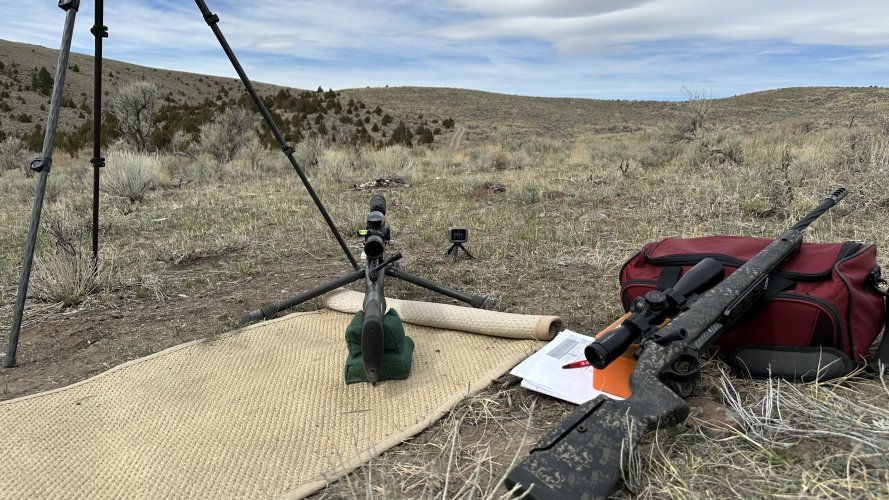
The shooting went well aside from some gusting winds that may have impacted it a little, but at only 300m still some useful data. Will plot out on the node nonsense and report back. The sample of two is almost meaningless but hopefully my choice for a 10 shot test tomorrow pays off I suspect this one from my rifle and also a 2fps velocity difference between the two. #11
View attachment 404876
View attachment 404877View attachment 404878
This, 100%. Pretty sure I won’t ever do this again, and the time spent and shot count could have been greatly reduced for what I got out of it. Given 300 meter shots, 2 each in some variable gusts of 8-10 mph wind, doesn’t add any real solid info on where the bullets land. The little chrono sure gives good input generally, but I could have got that same info, with a couple shots in my garage.Good example of the different “node” methodologies not really lining out. For people looking for a flat spot in velocity, that’s definitely flat across 55.3-55.6 gr. But from a ladder test looking at elevation, 11 looks like the worst charge in the picture from an elevation standpoint but the two bullets are touching at 300 yards.
Not a critique, just an observation of things people tie themselves in knots over “tuning” a load but really it’s small sample size random distribution.
If it’s a 20-22” barrel, that low 2900s velocity seems like a reasonable place to be.

There not a lot of questions that I don't run by chat. It just retaught me calculus.Also if you haven’t asked reloading or results questions to chat GPT you’re missing out. It’s pretty wild.
I want to hear more about how you chrono your rifles in your garage haha
 when my neighbors are out side I tell them. I’ve got excellent neighbors. My sons rifle has a brake so it’s like a nuclear explosion. I have a ring camera which catches some mid my stupid ideas/habits.
That is awesome!
View attachment 405066

Ha! I’ve shot inside with a bare muzzle, a brake would be nasty. Surprised it didn’t take pictures off your wall.
View attachment 405066
I looked and my ring camera got that on video.Ha! I’ve shot inside with a bare muzzle, a brake would be nasty. Surprised it didn’t take pictures off your wall.

After having done that one, I can say with certainty my interest in finding a “node” is gone with the wind. I did shoot a good 10 shot group at 200m yesterday that I honed in on with a 2 shot group from the ladder test, but it was not really any node and total luck. In the future I plan to test as max published with 1 shot, then load up some in that ballpark and try a few. Kinda what I’ve done for a long time


Hoping to see that on IG soon.I looked and my ring camera got that on video.

So do you start with a grain under book maximum to start?I do a 10 shot string to find pressure at my chosen jump distance, then I back off about 1 grain from pressure and load up 10. If that groups, cool; if not, load up 10 more at - 1.5 grains from pressure.
Maybe give it 10 at -2 gr from pressure. If it still isn’t acceptable after that I try a different bullet or power or change both.
When I first moved into my house and 5 acres we had a ground squirrel (gopher) issue. I took care of them with a.22 LR. My neighbor was kinder. He tried the method of a rodent control outfit. Waste of money. I have a 6 foot French door in my daylight basement overlooking his property. Set up the bench, open the doors and my .222 Remington vaporized gophers out to about 300 yards. Problem solved. Interestingly he never said a word about the rugged out pests. All shots were safe before anyone asks. mtmuley