Here's my thoughts:
Still can't see #1, so I will refrain from that.
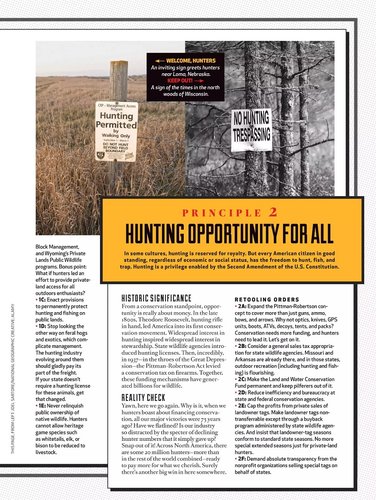
#2: He's got some good ideas relative to broadening what gear falls under PR/DJ/WB legislation and of course I like permanent reauthorization and fully funding the Land & Water Conservation Fund.
Some of the concepts he posits are good in theory, but in application would be next to impossible as they are subjective. What constitutes inefficiency in a state wildlife agency? 2B, a sales tax, would have to be done on a state by state basis, and even then you'll run in to issues regarding states that have no sales tax. Federally, sales taxes are political suicide. When the congress tried to tax internet sales, they had to back away from it quickly. Given the political climate, it would make much more sense to focus efforts like this at the state level, which many states are already doing, as is the Blue Ribbon panel on Hunting & Fishing, chaired by former Wyoming Governor Dave Freudenthal. 2E, the landowner tag issue is another one that each, individual state would have to take up, leading to either a perceived takings from landowners or in erosion of the NAM as the political process picks the "wrong" winner. It's not a bad idea, but one that needs to be approached very cautiously. Lest anything think I support transferable LO tags, I don't. I think they lead to greater privatization of wildlife and should be eliminated where possible, and never allowed to establish where they do not exist.
3: The Wildlife Management Institute has repeatedly said that the social sciences are important when it comes to wildlife management. Many professionals will tell you quietly that wildlife management is primarily people management. Glad to see he is recognizing that in his suggestions. As this section relates to public land management, I have concerns. Especially with EAJA. Under no circumstance, should Americans give up the right to seek redress against their government. That means we find a better way to eliminate the lawsuits including better funding for land management agencies and finding other paths, like what was in the last farm bill or possibly even changing how we engage in planning altogether. While we all agree that the level of lawsuits has hit an epidemic level, eliminating the rights of people in favor of development is anti-conservation, and should not be welcomed too eagerly. Prioritizing where funds go happens in every agency. I'm not sure what he means with that, especially given the science on predators is pretty clear in relation to increasing fawn survival and recruitment. If we want to do that, then let's prioritize funding for habitat improvement over wasting it on gov't spending for predator control, which has had no fruit borne from those very expensive loins. The last two seem fine to me. But I'm an opportunity kind of guy.
4.) I think the author gets that one pretty correct.
5.) The prohibition on the commercial sale of wildlife should not be messed with. Creating a market for wild goose pate sounds good when there is an over-abundance, but what happens to the resource when the market demand far outstrips available supply? Wildlife populations are cyclical, and creating a market based on consumption is what led us to the downfall we saw in the 1800's. Although I very much agree with his point 5A.
6.) Again, I think it is short-sighted to eliminate the will of the people when it comes to wildlife management. Montana, for example, would still have problems with game farms if not for ballot initiatives. Initiatives are important tools especially when we cannot get our legislatures to act appropriately. Yes, anti-hunters use them to limit activities not based on science or ethics, but on their feelings, but that's part of being an American - fighting for what you believe in. If we cannot withstand poorly thought out initiatives, I don't think it's worth reducing the level of freedoms we enjoy in this country. Scrapping# 6 is a very bad idea, especially since it simply removes the voice of the owner of wildlife - the people. All people. Not just hunters.
7.) On the surface, I think I could support that. It's important to remember, however, that the USFWS isn't a state game agency, focused on opportunity for hunters. They have a much broader role than that these days, as do all wildlife agencies. We can't get to a bright future by clinging to the past just as we can't find a better direction by ignoring the sucesses of yesteryear.
Thanks for posting. Nice, thought-provoking article. OL continues to put out good content.