Heading to WY for an elk hunt in October. Horses are used everyday in the remote area these guys hunt. They are saying 1-2 hours every morning to get in, then again to get out. I have ridden, but its been a while. I have free access to horses and plan to start putting in time on them. How long would you guys recommend I ride before this hunt? I have no clue.


Navigation
Install the app
How to install the app on iOS
Follow along with the video below to see how to install our site as a web app on your home screen.
Note: This feature may not be available in some browsers.
More options

You are using an out of date browser. It may not display this or other websites correctly.
You should upgrade or use an alternative browser.
You should upgrade or use an alternative browser.
Horseback hunting
- Thread starter LongCut
- Start date

thundermountain
New member
It isn’t going to hurt to get some saddle time if it’s easily accessible in your situation, but the vast majority of clients don’t and they are just fine 
Go ride those horses! Get your ankles, hips, lower back moving and grooving - you won't be sorry. A couple hours a couple times a week will get your body adjusted just fine. The last thing you want is to wake up one morning on the trip and wish your sore body could have a day off.
I think what's most important is knowing how to properly ride. Especially when in varied terrain. Major points, stay balanced, understand where your feet and legs should be when going up, down and side hills, same with how you sit (lean forward going up - conversely going down. Hand placement and when to be in the horses mouth and when not.
Living in NE Ohio you would benefit from riding in Beaver Creek State Park. Steep, rocky with several 3' plus creek crossings.
Being competent in the saddle not only you saves the riders body discomfort but really helps out the mount.
Living in NE Ohio you would benefit from riding in Beaver Creek State Park. Steep, rocky with several 3' plus creek crossings.
Being competent in the saddle not only you saves the riders body discomfort but really helps out the mount.
If you are not a horse person, any prep will help but nothing will truly prepare you for the long rides and riding horseback each and every day. I've done two big time horseback hunts in AK and wouldn't care to do another, got tossed off a couple times. Biggest thing is to get the stirrup length set correctly so you can stand off the saddle and get some weight off your butt when necessary. You'll feel it pretty good in the knees too, horses bend your knees a little bow legged. About the end of your trip, you'll start getting more comfortable with the horses.
Horses can be dangerous, so be careful. Weird stuff spooks them and there's a rodeo in all of them. Don't be bashful about asking questions and getting suggestions from the guides and wranglers.
Horses can be dangerous, so be careful. Weird stuff spooks them and there's a rodeo in all of them. Don't be bashful about asking questions and getting suggestions from the guides and wranglers.

Straight Arrow
Well-known member
You can cut that time down with proper horsemanship.They are saying 1-2 hours every morning to get in, then again to get out.

2rocky
Well-known member
Go trail riding with your horse contacts as often as you can. To me any less than an hour is a waste of time unless I'm schooling a young horse. Repetition is more important than duration in terms of "getting in riding shape"
Best practices to prepare for Horseback hunting:
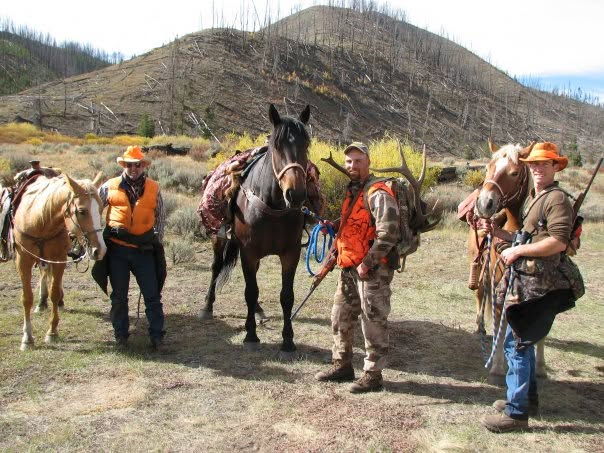
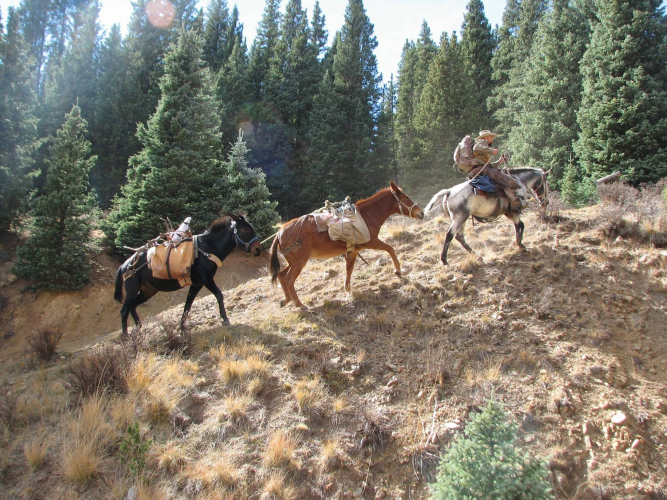
Best practices to prepare for Horseback hunting:
- Figure out what stirrup length you like. Ride in your hunting boots and pants.
- Get a scabbard you know fits your rifle and rig it up to know where you like it to ride. Decide if you are a butt forward or back preference.
- Ride in the hills so you learn how to lean forward on the uphill and back on the downhill.
- Get comfortable bridling a horse and learn how to tie one securely in a fashion that can be untied with one hand.
- Learn what a tight cinch feels like and a loose cinch feels like so you can tighten your own cinch and not tip over

406dn
Well-known member
- Joined
- Dec 12, 2019
- Messages
- 3,006
As you can tell by my avatar, I am comfortable on a horse.
I would expect the guide will help you get the stirrup length adjusted for you. If they are too long, your ride will be rougher, as you can't use your legs well to move with the horse. If they are too short, your, knees will be talking to you loudly, after a longer ride.
After, say an hour, give or take, the cinch will need to be checked, and likely tightened. Horses are pretty savvy about holding some air, when they are first cinched up. It is not fair to a horse to over tighten a cinch however.
The biggest thing I see with new riders is that they use the horse's mouth as a point of balance. That is, they are having trouble keeping their balance in the saddle, without having their hands leaning on something. A horse is much happier if you aren't in its mouth, all the time. Try to keep your balance, without using the reins as a balance point. When you do pick up the reins, the pressure on the horse's mouth should be as light as will get the response, you want.
Some horses, will pull tricks on a novice rider. A common one is to brush past a tree so closely, that your leg will hit the tree. If the horse you ride, does this, anticipate it and put that leg against its side a few feet from the tree, and move the reins, with both hands, away from the tree.
Horses have kept this old man in the elk hunting game. There are many things they do for you, that make hunting in the mountains less physically draining.
I would expect the guide will help you get the stirrup length adjusted for you. If they are too long, your ride will be rougher, as you can't use your legs well to move with the horse. If they are too short, your, knees will be talking to you loudly, after a longer ride.
After, say an hour, give or take, the cinch will need to be checked, and likely tightened. Horses are pretty savvy about holding some air, when they are first cinched up. It is not fair to a horse to over tighten a cinch however.
The biggest thing I see with new riders is that they use the horse's mouth as a point of balance. That is, they are having trouble keeping their balance in the saddle, without having their hands leaning on something. A horse is much happier if you aren't in its mouth, all the time. Try to keep your balance, without using the reins as a balance point. When you do pick up the reins, the pressure on the horse's mouth should be as light as will get the response, you want.
Some horses, will pull tricks on a novice rider. A common one is to brush past a tree so closely, that your leg will hit the tree. If the horse you ride, does this, anticipate it and put that leg against its side a few feet from the tree, and move the reins, with both hands, away from the tree.
Horses have kept this old man in the elk hunting game. There are many things they do for you, that make hunting in the mountains less physically draining.
Thanks for all the advice fellas. My brother went to MT on an elk trip over 20 years ago, and learned how to ride before he went. He has owned horses ever since. So he can teach me most everything that has been mentioned thus far.
This is not a guided hunt. Just a bunch of guys that have been doing this for many years. I finally got vouched for and bought enough points to score a tag for this upcoming season. This will obviously be my first horseback hunt and I am very excited. I'm just trying to prepare myself as best as I can.
This is not a guided hunt. Just a bunch of guys that have been doing this for many years. I finally got vouched for and bought enough points to score a tag for this upcoming season. This will obviously be my first horseback hunt and I am very excited. I'm just trying to prepare myself as best as I can.
2rocky
Well-known member
Then you will be involved more than an average guided hunter. If you can spend time riding your brothers horses before the hunt it will help all involved be better prepared. Enjoy all the things that go into it. it is a lot like hound hunting in the amount of year round activity and prep with your animals to be successful.

My horse journey really started last year, after moving to Wyoming a couple of years ago. I spent the summer taking horse‑handling and riding lessons, which were great for learning the basics and getting comfortable around horses. My girlfriend, who lives with me, has owned horses in the past, and when it came time to use them for hunting, her experience gave me a lot more confidence. Without her knowledge, I don’t think I would have felt ready.
This year we’ll have horses for three to four months and will be using them on several hunts here in Wyoming. A couple of the places we plan to go are spots I wouldn’t attempt without horses or some other pack stock—like llamas, which I’ve used before.
One thing I learned the hard way is how tough long rides are on my knee, which has been through surgeries. After a few miles, getting off the horse left my knee stiff and painful enough that I could barely stand. I think mixing in some walking will help, at least for me. With more time on horseback this year, I’m going to focus on details like dialing in my stirrup length and improving my riding position.
Horses really are incredible, especially in areas where roads don’t exist and you need them to reach the best hunting. I’m still cautious around them, though, and having someone like my girlfriend—who shows confidence to both me and the horses—makes a huge difference. I think your brother will be invaluable for you in the same way.
This year we’ll have horses for three to four months and will be using them on several hunts here in Wyoming. A couple of the places we plan to go are spots I wouldn’t attempt without horses or some other pack stock—like llamas, which I’ve used before.
One thing I learned the hard way is how tough long rides are on my knee, which has been through surgeries. After a few miles, getting off the horse left my knee stiff and painful enough that I could barely stand. I think mixing in some walking will help, at least for me. With more time on horseback this year, I’m going to focus on details like dialing in my stirrup length and improving my riding position.
Horses really are incredible, especially in areas where roads don’t exist and you need them to reach the best hunting. I’m still cautious around them, though, and having someone like my girlfriend—who shows confidence to both me and the horses—makes a huge difference. I think your brother will be invaluable for you in the same way.
I have to walk some with my left knee too, it really helps the horses on downhill sections too.My horse journey really started last year, after moving to Wyoming a couple of years ago. I spent the summer taking horse‑handling and riding lessons, which were great for learning the basics and getting comfortable around horses. My girlfriend, who lives with me, has owned horses in the past, and when it came time to use them for hunting, her experience gave me a lot more confidence. Without her knowledge, I don’t think I would have felt ready.
This year we’ll have horses for three to four months and will be using them on several hunts here in Wyoming. A couple of the places we plan to go are spots I wouldn’t attempt without horses or some other pack stock—like llamas, which I’ve used before.
One thing I learned the hard way is how tough long rides are on my knee, which has been through surgeries. After a few miles, getting off the horse left my knee stiff and painful enough that I could barely stand. I think mixing in some walking will help, at least for me. With more time on horseback this year, I’m going to focus on details like dialing in my stirrup length and improving my riding position.
Horses really are incredible, especially in areas where roads don’t exist and you need them to reach the best hunting. I’m still cautious around them, though, and having someone like my girlfriend—who shows confidence to both me and the horses—makes a huge difference. I think your brother will be invaluable for you in the same way.
406dn
Well-known member
- Joined
- Dec 12, 2019
- Messages
- 3,006
Another thing to settle on and get right, for yourself is how to hang the scabbard from the saddle. Everyone has an opinion, and there is not a perfect for everyone way to do it.
I hang mine on the left side, stock forward, high, sloping down. If hung too high, it will bother my knee. I'd say a downside is that the weight of the rifle can cause the saddle to tilt to that side. A plus is it is right there, when you dismount. I've considered hanging it almost vertical, but then can get it the way, when using the reins.
I carry a high line set up in a saddle bag. If you have two or more horses, it's easier to find couple of suitable trees for a high line, than it is a tree that you can tie multiple horses to. The horses will relax more readily if they are tied fairly close to each other. Obviously not so close, that they get tangled up, or can start messing with each other.
Another thing that gets used, nearly every ride is a saw. Something will pop up on most rides, that a saw will solve.
I hang mine on the left side, stock forward, high, sloping down. If hung too high, it will bother my knee. I'd say a downside is that the weight of the rifle can cause the saddle to tilt to that side. A plus is it is right there, when you dismount. I've considered hanging it almost vertical, but then can get it the way, when using the reins.
I carry a high line set up in a saddle bag. If you have two or more horses, it's easier to find couple of suitable trees for a high line, than it is a tree that you can tie multiple horses to. The horses will relax more readily if they are tied fairly close to each other. Obviously not so close, that they get tangled up, or can start messing with each other.
Another thing that gets used, nearly every ride is a saw. Something will pop up on most rides, that a saw will solve.
Another thing to settle on and get right, for yourself is how to hang the scabbard from the saddle. Everyone has an opinion, and there is not a perfect for everyone way to do it.
I hang mine on the left side, stock forward, high, sloping down. If hung too high, it will bother my knee. I'd say a downside is that the weight of the rifle can cause the saddle to tilt to that side. A plus is it is right there, when you dismount. I've considered hanging it almost vertical, but then can get it the way, when using the reins.
I carry a high line set up in a saddle bag. If you have two or more horses, it's easier to find couple of suitable trees for a high line, than it is a tree that you can tie multiple horses to. The horses will relax more readily if they are tied fairly close to each other. Obviously not so close, that they get tangled up, or can start messing with each other.
Another thing that gets used, nearly every ride is a saw. Something will pop up on most rides, that a saw will solve.
Do you high line while out hunting or just in camp? One thing I have not really done yet, but will be this year is taking the horses out hunting and not just to get into camp. Been researching and watching a lot on what people do and how to safely secure a to trees for the time out hunting. One other concern is places where there might not even be good trees to either tie or high line.
406dn
Well-known member
- Joined
- Dec 12, 2019
- Messages
- 3,006
Do you high line while out hunting or just in camp? One thing I have not really done yet, but will be this year is taking the horses out hunting and not just to get into camp. Been researching and watching a lot on what people do and how to safely secure a to trees for the time out hunting. One other concern is places where there might not even be good trees to either tie or high line.
I have high lined mostly while actually hunting. In camp, if I there aren't corrals, I have picketed them. My horses get picketed whenever I am at field trials, with my dogs. So they are very used to it.
Picketing works really well, especially if there is some grass for them to graze. You can also set it up so that they have access to a water tub. I also always make salt available, for them in camp.
Picketing does take a little learning on the horse's part, on how to free themselves from tangles.
Since I generally camp at a trailhead, it is easy for me to bring horse blankets for them. If it's forecast to snow or rain, I put them on, since they are stuck out in the weather.
Ride 4–6 times minimum in the next few weeks, mixing 1–2 hour sessions.
Focus on walk trot, getting your legs hips back used to it again, and building some confidence on trails. A few longer rides closer to the trip would help. You'll be sore at first, but it'll come back quick if you're reasonably fit. Better to feel solid than get wrecked on day one in the mountains. Enjoy it!
Focus on walk trot, getting your legs hips back used to it again, and building some confidence on trails. A few longer rides closer to the trip would help. You'll be sore at first, but it'll come back quick if you're reasonably fit. Better to feel solid than get wrecked on day one in the mountains. Enjoy it!
Similar threads


- Replies
- 12
- Views
- 2K