


Federal Land Sales for Affordable Housing?

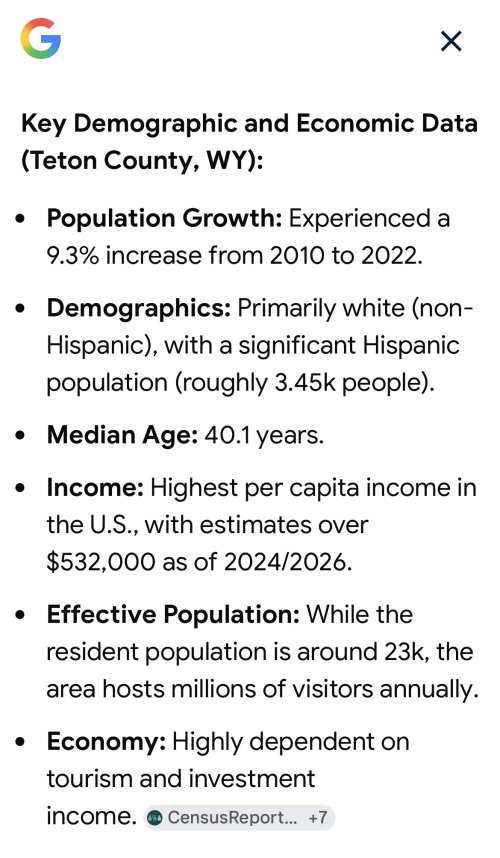
I'll bump the topic with this article. Small giveaways are the new land-transfer. The application of a special use permit to build permanent housing looks like a new strategy. Relying on a legal victory from a private individual in this case shows how fully unprepared we are for these types of things.

 
I'll bump the topic with this article. Small giveaways are the new land-transfer. The application of a special use permit to build permanent housing looks like a new strategy. Relying on a legal victory from a private individual in this case shows how fully unprepared we are for these types of things.

Haha. You just now noticed this? I'm not the smartest but this was easy to see. mtmuley
 
I'll bump the topic with this article.

Though probably not the reason you posted the article, I found this part thought-provoking:

Other residents are more lukewarm but see little alternative in the face of intense pressure and housing costs. “I don’t think it’s right to expand in that direction,” said Sara Kirkpatrick, a teacher at Jackson Elementary School in an interview. “But where shall we live? Where do we go? All the homes we used to rent and live in sit empty, remodeled and owned by some third or fourth homeowner, and it makes everything else so expensive,” added Kirkpatrick, who is currently searching with her husband for a larger home to accommodate their two growing children. “We should stop approving all these luxury condos and developments.”

On one hand, does it not dawn in this women that perhaps the most expensive zip code in the country is not the only option for her family to live? On the other, is it fair to expect the middle class to just raise the white flag on living somewhere that they have their roots (and who, if anyone, fills these roles if the leave?)?

I’m not sure what the right answer is that that dilemma, but it’s interesting to ponder.
 
Though probably not the reason you posted the article, I found this part thought-provoking:

Other residents are more lukewarm but see little alternative in the face of intense pressure and housing costs. “I don’t think it’s right to expand in that direction,” said Sara Kirkpatrick, a teacher at Jackson Elementary School in an interview. “But where shall we live? Where do we go? All the homes we used to rent and live in sit empty, remodeled and owned by some third or fourth homeowner, and it makes everything else so expensive,” added Kirkpatrick, who is currently searching with her husband for a larger home to accommodate their two growing children. “We should stop approving all these luxury condos and developments.”

On one hand, does it not dawn in this women that perhaps the most expensive zip code in the country is not the only option for her family to live? On the other, is it fair to expect the middle class to just raise the white flag on living somewhere that they have their roots (and who, if anyone, fills these roles if the leave?)?

I’m not sure what the right answer is that that dilemma, but it’s interesting to ponder.
I certainly have taken heat for my answer, but it remains the same-Move. Society does not owe any individual affordability in the zip code of their choice. And once the answer becomes a handout the answer to every future problem will be a handout.
 
I certainly have taken heat for my answer, but it remains the same-Move. Society does not owe any individual affordability in the zip code of their choice. And once the answer becomes a handout the answer to every future problem will be a handout.
Exactly! I would love to live on the beach in Maui. I can’t afford it, but I don’t expect someone to sell me a spot for a reduced price either.
 
I certainly have taken heat for my answer, but it remains the same-Move.

That’s my first thought as well. But if I follow that to the logical conclusion (in my head anyway), in this case it means a teacher cannot afford to live in Jackson- which leads to schools not being able to function there, which leads to families not being able to live there, which leads to the garbage man or nurse not being able to live there etc…

It’s an interesting social urban planning challenge.

But also, yeah- it’s not a birthright to live in a super expensive place just because you were born there or enjoy living there.
 
That’s my first thought as well. But if I follow that to the logical conclusion (in my head anyway), in this case it means a teacher cannot afford to live in Jackson- which leads to schools not being able to function there, which leads to families not being able to live there, which leads to the garbage man or nurse not being able to live there etc…

It’s an interesting social urban planning challenge.

But also, yeah- it’s not a birthright to live in a super expensive place just because you were born there or enjoy living there.
Costs adjust. The cost of living in California is very high. Somehow they have teachers. Jackson can tax the residents to pay teachers the appropriate wage. The wealthy will also find a way to get their garbage picked up. No one wants to pay taxes but want what the taxes provide. This isn’t a handout to the working class. It’s so the rich get the service they feel they deserve.
 
Costs adjust.

Ideally, yes. Practically, I’m not sure- especially so for the public employee portion of these units.

13 of the housing units are slotted for USFS workers. I don’t think their income will adjust commensurate to COL in Jackson (perhaps I’m wrong), so I get the subsidy there. Just not sure it needs to be on federal land.

The private sector units kind of seem like bunk all the way around, though.
 
Ideally, yes. Practically, I’m not sure- especially so for the public employee portion of these units.

13 of the housing units are slotted for USFS workers. I don’t think their income will adjust commensurate to COL in Jackson (perhaps I’m wrong), so I get the subsidy there. Just not sure it needs to be on federal land.

The private sector units kind of seem like bunk all the way around, though.
This problem with federal workers and teacher pay is not limited to just Jackson. Many of the places that FS, BLM, etc. workers could afford to live in the "less desirable" places throughout the West, are now where the cool kids want to live. We've been fighting this for at least the past 10 years and the agencies know it won't get better until Federal wages are compensable to private sector. I'm thankful that I got in when I did, before everyone wanted to live in the West and closer to public lands. I'm also in the desirable position that I was able to afford to live where I do, got in when I did, and that I'm retirement eligible. I feel bad for young federal workers just starting out...they're hosed.

Also, locality pay is a convoluted mess for the Federal Government and moves at glacial speed being adjusted to keep pace. We typically lag 5-10 years behind keeping pace with the private sector.

It's a tough nut to crack because the people that need to do the work for the BLM, FS, School teachers, etc. pretty much have to live close. It wouldn't make sense to try to manage the Bridger Teton from 200 miles away where things may be more affordable. In the past, nobody wanted to live in Pinedale, Laramie, Dillon, Steamboat, Bend, Lander, etc. etc. Now, everyone wants to live in those places.

These smaller towns were just not prepared for the influx of money people were bringing with them or the demand for living close to public lands.

I don't have the answers, although I've been directly involved in looking for solutions for FS employees...not an easy answer to the problem.
 
This problem with federal workers and teacher pay is not limited to just Jackson.

I agree, and that is why I found the quoted part thought-provoking- this is a reoccurring theme.

The easy answer is to “let the market sort itself out,” but it seems a bit lazy to just end the thought there.

I don’t know what the solution is here either, I can see this one from multiple viewpoints. The answer lies somewhere between pure free market capitalism and a more socialistic approach.
 
Lots of factors at play. Severe underfunding of NPS, USFS, and other related federal programs and agencies becomes a burden for working families in local communities. Lots of great solutions that lack the support to become a reality. Among a host of bad ideas, my pick is a 50-year lease (or similar).
 
I don’t like the idea of a handout to the highest income county in the country. If we want stuff, we have to pay for it. The answer is a tax. If you can’t house enough working people to service the tourists, they can go to Cody. Economics is about tradeoffs. Slowly degrading the ecosystem that attracted people to the place seems asinine.
IMG_2605.jpeg
 
I don’t like the idea of a handout to the highest income county in the country. If we want stuff, we have to pay for it. The answer is a tax. If you can’t house enough working people to service the tourists, they can go to Cody. Economics is about tradeoffs. Slowly degrading the ecosystem that attracted people to the place seems asinine.
View attachment 404022
Then Cody experiences the same thing...or more to the point, already is.

Moving the problem down the road to the next place isnt solving anything. Ask Star Valley and Driggs.
 
Then Cody experiences the same thing...or more to the point, already is.

Moving the problem down the road to the next place isnt solving anything. Ask Star Valley and Driggs.
Yes. I agree and understand that for Federal employees this is happening in a lot of places. I might even be more accepting of just building the units for the Federal employees. I don't think the units for locals is appropriate. This specific problem is not happening in Cody, but certainly could. This problem is seen in places like Big Sky, Vail, Jackson. The attractiveness of these places to the wealthy has made the economic structure of the region untenable, so they complain. My view - let the market work it out. Trying to "solve" this leads to a lot of unintended consequences, and it certainly won't result in better affordability for anyone but the few in those homes. We are just keeping the places attractive and letting people avoid the tradeoffs.

I tend to think that the cost of this is a pimple on the ass of the federal budget so if it needed those employees to be there they could throw a little money at it and fix it. It is amazing what the US government can do if the motivation is high enough. That leads me to believe that this crazy idea is just to benefit someone specific.
 
These places are desirable for a reason, and that demand isn't going away. I have mixed feelings about this one. This sort of, "the Forest Service does not have the financial capacity to build housing. This project is a symbiotic arrangement", is something I sense there will be an increase in, and not just in housing - could be road/trail building, planning, etc. Some contingent has a project that will benefit them, the USFS can't do it, so a sort of "we'll do the work if you let us" comes along. Maybe the work is needed and it's the only way, maybe it's not but these sorts of public/private partnerships are en vogue. In an ideal world the USFS would have the resources it needs to execute projects as they see fit.

I do think no industry is as quietly insidious as tourism for a community in the long term.
 
This sort of, "the Forest Service does not have the financial capacity to build housing. This project is a symbiotic arrangement", is something I sense there will be an increase in, and not just in housing

The US government literally built a couple of cities for the Manhattan Project. When needed, it is amazing what the US can accomplish.
 
Back
Top