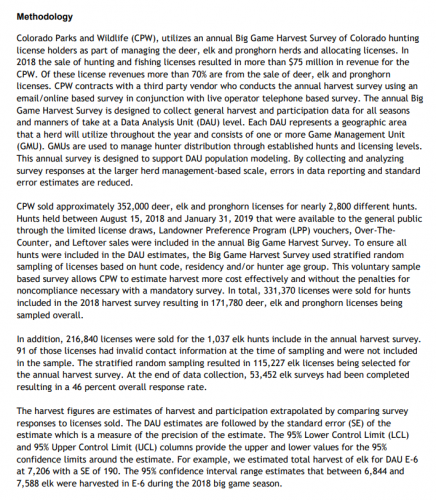
So there is a secret cabal of hunters in one or two DAUs that have figured out how to game the survey in order to make the unit level statistics significantly worse?
Colorado uses stratified random, this methodology has been shown to produce the most statistically accurate results. There are a number of peer reviewed studies on the topic and false reporting is a factor that these methodologies attempt to account for false reporting. The likelihood of any resident giving false information is probably uniform across the state. It is likely that all units are under reported by a similar degree. Furthermore, there is no reason to assume that non-residents report any more or less accurately than residents for specifically the same reason you stated.
The primary issue I have with COs method of surveys is that there are a few specific units / seasons with so few tags issued that no hunter is ever contacted.
I killed an elk in 371 with a muzzy in 2018, the harvest statistics say that for that unit + method of take the harvest rate was 0%. This is because no one for that unit and method was surveyed. The smaller the number of tags issued for any hunt the more inaccurate the data will be, the more tags issued the more accurate it will be. This, among other reasons is why there is mandatory reporting for some species.
I'm not rolling my eyes with the claim that the data is inaccurate, I'm rolling my eyes at the fact that you think you and your buddies are keeping your spot secret by lying to the state agency.
The idea is so unoriginal and pervasive that you can statistically account for it... if you have enough data points.
I don't know much, I do know that folks a heck of a lot smarter than you anticipated your move.
View attachment 123094
The work cited from the first paper that came up on the topic on the google...
AAPOR. 2003. “
Interviewer Falsification in Survey Research: Current Best Methods for Prevention, Detection and Repair of Its Effects.”
Benford, Frank. 1938. “
The Law of Anomalous Numbers.” Proceedings of the American Philosophical Society.
Bredl, Sebastian, Peter Winker and Kerstin Kötschau. 2012. “
A statistical approach to detect cheating interviewer falsification of survey data.” Survey Methodology.
Bredl, Sebastian, Nina Storfinger and Natalja Menold. 2011. “
A literature review of methods to detect fabricated survey data.” Discussion Papers from Justus Liebig University Giessen, Center for international Development and Environmental Research (ZEU).
Converse, Philip E. 1964. “
The nature of belief systems in mass publics.” In Joseph W. Elder, ed., “Ideology and Discontent.”
Crespi, Leo P. 1945. “
The Cheater Problem in Polling.” Public Opinion Quarterly.
Diekmann, Andreas. 2002. “Diagnose von Fehlerquellen und methodische Qualität in der sozialwissenschaftlichen Forschung.” Institut fuer Technikfolgenabschaetzung (ITA).
Diakité, Souleymane. 2013. “Statistical methods for the detection of falsified data by interviewers and application survey data in Africa.” Sixth International Conference on Agricultural Statistics.
Groves, Robert M., Floyd J. Fowler Jr., Mick P. Couper, James M. Lepkowski, Eleanor Singer and Roger Tourangeau. 2009. “Survey Methodology.”
Hood, Catherine C. and John M. Bushery. 1997. “
Getting More Bang from the Reinterview Buck: Identifying ‘At Risk’ Interviewers.” Proceedings of the American Statistical Association.
Judge, George and Laura Schechter. 2009. “
Detecting Problems in Survey Data Using Benford’s Law.” The Journal of Human Resources.
Koch, Achim. 1995. “
Gefälschte Interviews: Ergebnisse der Interviewerkontrolle beim ALLBUS 1994.” ZUMA Nachrichten.
Kosyakova, Yuliya, Jan Skopek and Stephanie Eckman. 2015. “
Do Interviewers Manipulate Responses to Filter Questions? Evidence from a Multilevel Approach.” International Journal of Public Opinion Research.
Kuriakose, Noble and Michael Robbins. 2015. “
Falsification in Survey Research: Detecting Near Duplicate Observations.” American Political Science Association Annual Meetings 2015.
Li, Jianzhu, J. Michael Brick, Bac Tran and Phyllis Singer. 2009. “
Using Statistical Models for Sample Design of a Reinterview Program.” Proceedings of the Research Methods Section, American Statistical Association.
Loosveldt, Geert. 2008. “Face-To-Face interviews.” In Edith D. deLeeuw, Joop Hox and Don Dillman, eds., “International Handbook of Survey Methodology.”
Lyberg, Lars and Paul Biemer. 2008. “Quality Assurance and Quality Control in Surveys.” In Edith D. deLeeuw, Joop Hox and Don Dillman, eds., “International Handbook of Survey Methodology.”
Lyberg, Lars and Diana Maria Stukel. 2010. “Quality Assurance and Quality Control in Cross-National Comparative Studies.” In Harkness, Janet A., et al., eds. “Survey Methods in Multinational, Multiregional, and Multicultural Contexts.”
Menold, Natalja and Christoph Kemper. 2014. “
How Do Real and Falsified Data Differ? Psychology of Survey Response as a Source of Falsification Indicators in Face-to-Face Surveys.” Journal of International Public Opinion Research.
Reuband, Karl-Heinz. 1990. “
Interviews, die keine sind – ‘Erfolge’ und ‘Mißerfolge’ beim Fälschen von Interviews.” Kölner Zeitschrift für Soziologie und Sozialpsychologie.
Schnell, Rainer. 1991. “
Der Einfluß gefälschter Interviews auf Survey Ergebnisse.” Zeitschrift für Soziologie.
Schraepler, Joerg-Peter and Gert Wagner. 2005. “
Characteristics and impact of faked interviews in surveys – An analysis of genuine fakes in the raw data of SOEP.” Allgemeines Statistisches Archiv.
Schreiner, Irwin, Karen Pennie, and Jennifer Newbrough. 1988. “
Interviewer Falsification in Census Bureau Surveys.” Proceedings of the Research Methods Section, American Statistical Association.
Singer, Eleanor. 2008. “Ethical Issues in Surveys.” In Edith D. deLeeuw, Joop Hox and Don Dillman, eds., “International Handbook of Survey Methodology.”
Winker, Peter, Natalja Menold, Nina Storfinger, Sabrina Stukowski, Christoph J. Kemper, and Sabrina Stutkowski. 2013. “
A Method for ex-post Identification of Falsifications in Survey Data.”
NTTS 2013 – Conferences on New Techniques and Technologies for Statistics.
Zaller, John R. 1992. “The Nature and Origins of Mass Opinion.”




 . They then went and sat right in the middle of where we were glassing. It’s public land, but still really annoying. I’d rather hunt a unit with less animals, just so there was not that much pressure.