Point creep will get worse every year in states with Preference Point systems. It's just a function of the number of point buyers compared to actual applicants.
I am surprised by the number of people "surprised by point creep." It is so obvious if we look at the numbers in Preference Point states. If we look at the history in Colorado, the first state with a PP system, every other state is following suit, just a function of degrees, with "degrees" being what percentage of their tags are subject to PP system and how long the system has been in place.
Wyoming is following Colorado to a T, though not quite as fast, given 25% of Wyoming tags are issued randomly. Utah is following the same path, just as bad for some species, as demand is just so high relative to tags issued, even though only half the tags are on a true PP system. Arizona is seeing the same thing as it relates to the 20% that is given away based on max points.
The point creep is not due to new people jumping in. Point Creep is due to how many people have been in the game a long time and are on the sideline buying points, or as I call them, "Point Buyers." These are the folks creating point creep.
I have an upcoming podcast with Brady Miller and a YouTube video I've scripted that goes into this topic in a lot of details. Brady and I have pondered this issues for the last four years, as to why folks are so surprised about point creep. We have both concluded, maybe incorrectly, that folks are not looking at how many Point Buyers have been accumulating on the sidelines for the last 10-25 years and are now jumping into the game and actually applying for tags.
I'll use Utah elk as my example because it illustrates what I'm talking about. I'll use Matthew, who has 16 Utah elk points last year and will have 17 this year.
UT DWR issues reports that show how many non-residents are in the tunnel applying for elk tags in Utah.
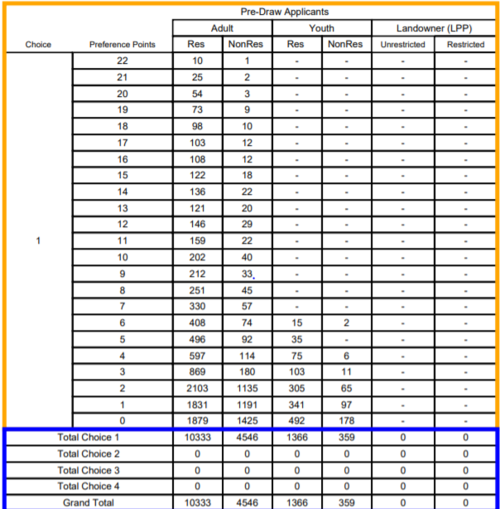
Pages 185 and 186 at this link, showing applicants by point level and "point buyers" at point level.
One report is the point buying crowd and at what point level they are at. When measured across all point layers, there are almost as many non-residents buying points for elk in Utah as actually apply for elk - 16,423 point buyers last year, compared to 17,958 who actually apply for the 274 tags that were issued to non-residents last year.
Some are riding the possibility of drawing a random tag, of which there were 157 random tags last year and 17,841 people applied for a draw odds of .88%. About what the draw odds are in many of the raffles sponsored by conservation groups.
When you break that out by point layers, it gets very revealing and really disappointing if you think you are close to a tag in Utah. I'll try to explain
If I use Matthew's point pool of 16 points last year, 890 people applied who had more points that him. The folks above him drew 69 of the bonus permits and 8 of the random permits, so when I take those 77 people out of the pool, there are still 813 of last year's applicants ahead of him for 2021. That seems bad enough, but when I show below where the true point creep comes from, it is eye opening.
Like most states, the "Point Buyers" are usually the folks who have been in the game the longest. Utah is a perfect example. This next paragraph is why point creep in Utah (every PP state for that matter) should not be a surprise.
At the point levels above Matthew (17+), there were 1,378 folks who just bought points. Ouch. Those people don't show up if you only look at last year's application percentages, as they aren't included in the 2020 applicant numbers.
For 2020, there were way more non-residents with more points than Matthew who just bought points, compared to those who actually applied (890).
Read that again - THERE ARE 55% MORE PEOPLE BUYING POINTS AT 17+ THAN ACTUALLY APPLY FOR THE TAGS.
^^^^^That is where point creep comes from. Ignore that large pool of Point Buyers and it makes sense why a person might be surprised at point creep. Keep tabs on those Point Buyers and point creep makes complete sense.
When I add those point buyers, who will someday jump in and apply, to the numbers of 17+ point holders who applied last year, I get 2,191 people in the Utah system that have more points that Matthew, who has 17 after last year. If I only looked at the 2020 applicant pool I would be way off in my expectation of point creep as I am only considering the 813 people still above Matthew and I am disregarding the other 1,378 above Matthew who are Point Buyers.
That pile of "Point Buyers" is where point creep comes from. It is that pool of long time applicants, those I call "point buyers," that newer applicants should be looking at to get a feel of what level of point creep will really be there.
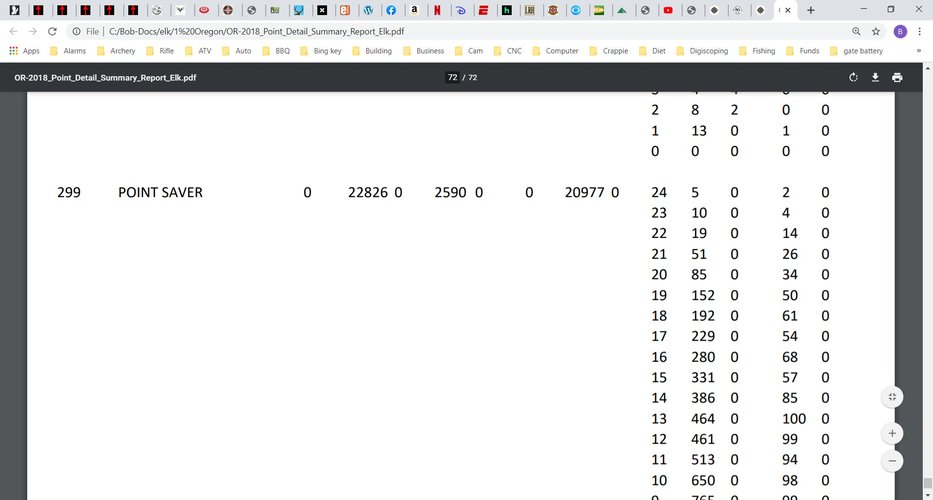
If you look at Wyoming, Oregon, Arizona, and Colorado, it is the same as what I showed in the Utah elk example, just a bit varied depending upon the species, how long the system has been in place, and what percentage of tags are subject to a Preference Point system. And the percentage of "Point Buyers" at the high point levels in those states mirrors what I showed in Utah.
Brady and I have spent a lot of time on this topic. He is finalizing a goHUNT INSIDER strategy article that will highlight all of this by state and species, hopefully lowering the frustration level folks are expressing when it comes to point creep.
Unless all those high point holders who are just buying points decide to get out of the system, expect point creep to get worse every single year. Plan accordingly.
Good luck in 2021.