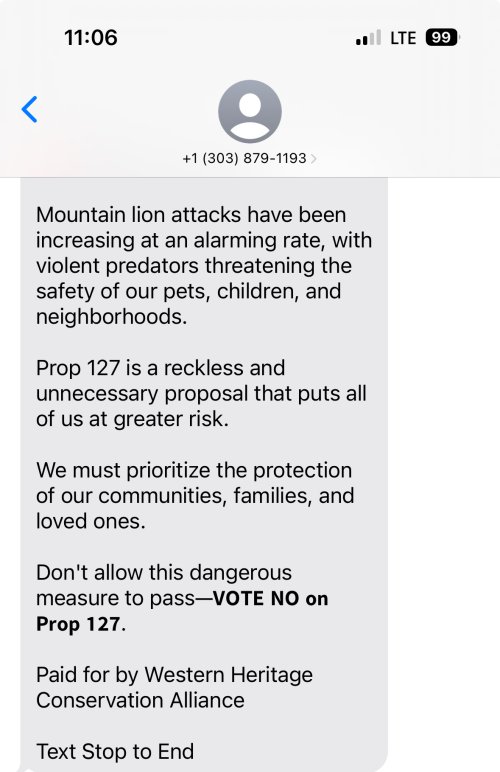
I'm not sure if any of you looked at the link attached in the Boulder Weekly newsletter article that Oak posted above? I found it interesting that there are both direct and indirect effects on bighorn sheep lamb survival. It is an extremely detailed journal publication with numerous references to other similar research.
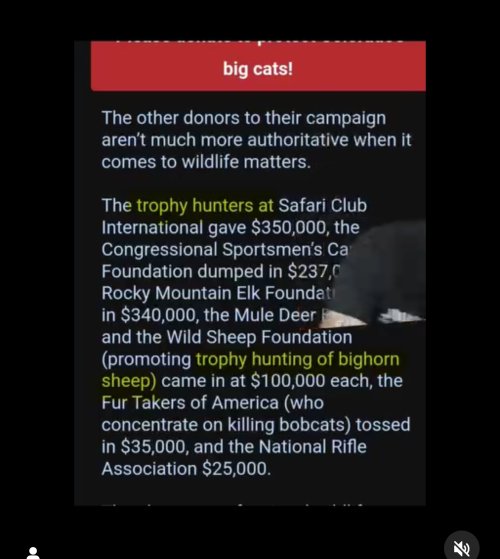
There is a lot more ecology and science involved than lions just killing prey. You may want to read some of the results I posted immediately below. It mentions the direct and indirect effects predators have not only on wild sheep, but elk, moose, mtn goats, and even pika! This is a prime example of science-based, long-term research. The anti-hunter's campaign has very little science to back their claims.
Direct and indirect effects of cougar predation on bighorn sheep fitness
Predation had strong negative effects on lamb survival through both direct and indirect effects. For neonatal survival, the best model retained the effect of cougar predation in the year of conception, suggesting an indirect effect on this vital rate. Although we cannot assess the physiological mechanisms involved, perhaps females that experience intense predation suffered high energy costs. Bighorn females adopt a conservative reproductive strategy (Douhard et al.,
2018; Festa-Bianchet & Jorgenson,
1998; Gaillard & Yoccoz,
2003), suggesting that they may respond to the energetic costs of predator-induced stress (Boonstra et al.,
1998) and possibly lower foraging efficiency by curtailing allocation to reproduction. For lamb survival to weaning and overwinter, we cannot partition the relative importance of direct and indirect effects as we do not have data on causes of mortality. Cougars prey on lambs (Ross et al.,
1997); therefore, part of the reduction in lamb survival is due to direct predation. However, indirect effects may also be involved, because low mass at weaning reduces survival (Bourbeau-Lemieux et al.,
2011; Feder et al.,
2008).
Our conclusions support the findings by Bourbeau-Lemieux et al. (
2011) who reported that intense cougar predation induced indirect effects on lamb body size, which in turn contributed to lower overwinter survival. Similarly, Dulude-de Broin et al. (
2020). found that high predator occurrence reduced fecundity in mountain goats (
Oreamnos americanus). Yin et al. (
2017) analogously found detrimental effects of predator presence on reproduction by plateau pika (
Ochotona curzoniae). Our research also sheds light on the controversy about the role of indirect effects on wolf–elk interactions (Creel et al.,
2007,
2009). Some authors questioned the interpretation that wolf predation caused large indirect effects on female elk reproductive performance. White et al. (
2011) found no evidence of indirect effects of wolf predation in the same elk population. Middleton et al. (
2013) also argued against the indirect effect of wolf predation on elk. They measured a low encounter rate, suggesting that on average an elk was within 1 km of wolves only once every 9 days, and these interactions did not reduce calf production. Middleton et al. (
2013) additionally claimed that coursing predators such as wolves cannot apply a pressure strong enough to induce indirect effects. For example, White and Berger (
2001) found that although moose (
Alces alces) responded to coursing predators by increasing maternal vigilance and reducing foraging when their calf was active, they were able to compensate by increasing forage intake when the calf was inactive. Compared with coursing predators, stalking/ambush predators tend to hunt in a smaller area, leading to a higher encounter rate of prey with predators and likely generating a greater perception of risk by prey (Sommer et al.,
2023). Our results support the predator-sensitive food hypothesis, suggesting a trade-off between predation risk and foraging behavior (Sinclair & Arcese,
1995). Future research should seek to quantify the causal mechanisms for the indirect effects of predation. For example, during predation years, space use and gregariousness patterns may have differed compared with non-predation years.