noharleyyet
Well-known member
DWTSNew day
Honorable mention



Follow along with the video below to see how to install our site as a web app on your home screen.
Note: This feature may not be available in some browsers.

DWTSNew day
Honorable mention


My bad! I forgot what day it is.Christmas tunes ain't till Friday.
Respect the thread creep.

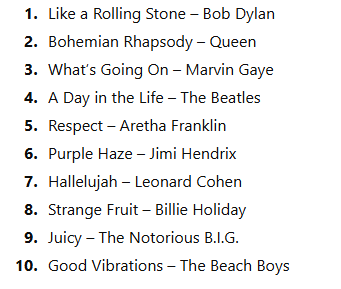
THis was Chat's All-Time Top Ten
View attachment 396331
My bad! I forgot what day it is.
It's the best one on that list and not even Biggie's best.Except for Juicy, this is pretty much the soundtrack to The Big Chill.

That's easy. Halved and roasted. No contest.JFC
I might as well have asked for the best brussel sprouts recipe. This is ridiculous...

See ? We are way more smarter than AI!I told Chat it was full of shit. Try harder. It did better.
1. Amazing Grace – John Newton (1772)
Few songs in history have matched its global reach, durability, and emotional universality. It transcends genre, religion, nationality, and era. Sung at funerals, protests, religious services, and state events worldwide, it functions as a shared human language of loss and redemption.
2. The Star-Spangled Banner – Francis Scott Key (lyrics), John Stafford Smith (melody)
As a national anthem, it has been performed, argued over, and reinterpreted more than almost any song in history. Its significance lies not just in patriotism, but in how it has become a cultural battleground reflecting American identity across centuries.
3. Like a Rolling Stone – Bob Dylan (1965)
This song permanently altered popular songwriting, proving that a hit single could be long, literate, confrontational, and emotionally complex. It marks the moment pop music grew up and demanded to be taken seriously as art.
4. I’m So Lonesome I Could Cry – Hank Williams (1949)
Perhaps the purest distillation of American loneliness ever written. Its influence reaches far beyond country music—into folk, rock, and singer-songwriter traditions. The song’s emotional clarity and restraint are studied, not just admired.
5. Yesterday – The Beatles (1965)
A model of melodic economy and emotional directness, and one of the most covered songs in history. It demonstrated that vulnerability and simplicity could carry as much weight as innovation or spectacle.
6. Strange Fruit – Billie Holiday (1939)
One of the most consequential protest songs ever recorded. Its power lies in its restraint and stark imagery, bringing moral reckoning into popular music decades before it was common or safe to do so.
7. This Land Is Your Land – Woody Guthrie (1940)
Often misunderstood as patriotic, it is actually a subversive democratic anthem. Its endurance reflects its flexibility—equally at home in classrooms, protests, and political movements. Few songs have been so widely repurposed without losing meaning.
8. Beethoven’s Symphony No. 9, “Ode to Joy” (Finale)
While not a “song” in the pop sense, it is arguably the most recognizable and influential vocal melody in Western music history. It has served as an anthem for unity, revolution, and humanism for over two centuries.
9. What’s Going On – Marvin Gaye (1971)
This song redefined soul and R&B by merging social consciousness with musical warmth. It legitimized introspection and political reflection in mainstream Black popular music without sacrificing accessibility.
10. Hallelujah – Leonard Cohen (1984)
A rare modern entry whose mythic structure and lyrical ambiguity have allowed endless reinterpretation. Its afterlife—through covers and cultural moments—has eclipsed its original release, a hallmark of truly enduring songs.
I told Chat it was full of shit. Try harder. It did better.
1. Amazing Grace – John Newton (1772)
Few songs in history have matched its global reach, durability, and emotional universality. It transcends genre, religion, nationality, and era. Sung at funerals, protests, religious services, and state events worldwide, it functions as a shared human language of loss and redemption.
2. The Star-Spangled Banner – Francis Scott Key (lyrics), John Stafford Smith (melody)
As a national anthem, it has been performed, argued over, and reinterpreted more than almost any song in history. Its significance lies not just in patriotism, but in how it has become a cultural battleground reflecting American identity across centuries.
3. Like a Rolling Stone – Bob Dylan (1965)
This song permanently altered popular songwriting, proving that a hit single could be long, literate, confrontational, and emotionally complex. It marks the moment pop music grew up and demanded to be taken seriously as art.
4. I’m So Lonesome I Could Cry – Hank Williams (1949)
Perhaps the purest distillation of American loneliness ever written. Its influence reaches far beyond country music—into folk, rock, and singer-songwriter traditions. The song’s emotional clarity and restraint are studied, not just admired.
5. Yesterday – The Beatles (1965)
A model of melodic economy and emotional directness, and one of the most covered songs in history. It demonstrated that vulnerability and simplicity could carry as much weight as innovation or spectacle.
6. Strange Fruit – Billie Holiday (1939)
One of the most consequential protest songs ever recorded. Its power lies in its restraint and stark imagery, bringing moral reckoning into popular music decades before it was common or safe to do so.
7. This Land Is Your Land – Woody Guthrie (1940)
Often misunderstood as patriotic, it is actually a subversive democratic anthem. Its endurance reflects its flexibility—equally at home in classrooms, protests, and political movements. Few songs have been so widely repurposed without losing meaning.
8. Beethoven’s Symphony No. 9, “Ode to Joy” (Finale)
While not a “song” in the pop sense, it is arguably the most recognizable and influential vocal melody in Western music history. It has served as an anthem for unity, revolution, and humanism for over two centuries.
9. What’s Going On – Marvin Gaye (1971)
This song redefined soul and R&B by merging social consciousness with musical warmth. It legitimized introspection and political reflection in mainstream Black popular music without sacrificing accessibility.
10. Hallelujah – Leonard Cohen (1984)
A rare modern entry whose mythic structure and lyrical ambiguity have allowed endless reinterpretation. Its afterlife—through covers and cultural moments—has eclipsed its original release, a hallmark of truly enduring songs.
They sure didn't ask me! I wouldn't pick any of those!This list right here should tell you that AI is run by boomers.
Back in college bars would play that song and everyone knew the words.Well, it was all
That I could do to keep from crying'