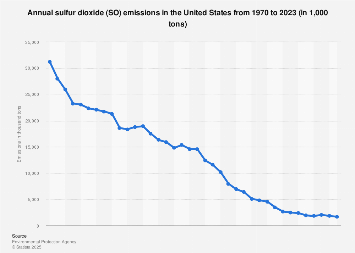
No, it's quite a bit more than that. There should be a rigorous debate on smart policy and regulations. But my side of the aisle too often goes quite a ways out on the point of diminishing returns.
A half a lifetime ago, when I was first employed by big oil, the sulfur content in diesel was capped at 0.50%. Some years later, to reduce SO2 emissions, the limit was lowed to 500ppm. The refinery had to make some investments to make meet this limit. Then a few year before I retired the limit was reduced to 15ppm. The effect of that is that the diesel leaving the refinery is essentially sulfur free. This is since any contamination outside of the refinery can make the diesel outside of the regulation.
To do this, they had to not use the heaviest molecules that had historically become diesel. The way a refinery strips sulfur from a molecule is causing a reaction with hydrogen, that takes the sulfur off the molecule, and creates a H2S molecule. On large molecules, this reaction also often cracks the molecule into two or more smaller molecules, unsuitable for diesel.
Refineries cannot produce as much diesel from a barrel of crude, as before. This is one reason there is the spread between gasoline and diesel.
Switching subjects, but still on the point of diminishing returns. There is an oncoming requirement for new home construction to put in furnaces that are 95% efficient. This requires a more complicated furnace and installation. I recently decided to replace our 20 year old furnace. We went with an 80% efficient furnace. Out of curiosity, I got a bid on the cost of a 95% furnace. It was ~$3k more than the other one. Since our gas bills run around $100/month. During the non heating season, the gas bill is $25 or so.
So the gas to heat our home is ~$75/month for say five months. The 95% efficient furnace would knock about $12/month off the bill. The pay off would be ~50 years.
This is the kind of regulation that pushes many people away from the Democratic party.