

Wildfire management LTTE

I’d say that chart is an N-of-1. Folks above have mentioned that we used to do a lot more fuels reduction by way of merchantable timber and that’s part of it, but that 40 year span of suppression also built a hell of a lot of fuel up on the landscape and became unsustainable. I don’t think the increases in acres-burned over the last 30 years are chiefly driven by a different management perspective on wildfire.

I believe we are better at firefighting now than ever before and we are catching fires much earlier than ever before with better technology than ever before all while spending more money than ever before.

If I were king for a day and solely with reducing the amount of smoke folks experience in the summer in mind, we would log a heck of a lot more. Litigants would have no options. We would engage in more prescribed burning, which really only touches very small acreages compared to what’s out there, has a ridiculously small window of efficacy seasonally, and I would remove the liability concerns associated with that activity.We would engage in far more fuels reduction efforts, which make no money whatsoever and quite the opposite. All of those efforts would have to be repeated at particular intervals. Fuels reduction isn’t something you do and walk away from- it’s a literal maintenance schedule. We would be far more aggressive in our stage restrictions - limiting the ability of the public to have campfires and such - and we would put a lot more heads on pikes. We would heavily restrict where people could build structures because those areas get a disproportionate focus to other areas that might produce more smoke. We would probably also restrict access to the woods far more aggressively when it’s dry out.

Pros and cons. None of it particularly feasible. And I suspect we’d still have big damn fires. Here in the Pyrocene.
I agree with the majority of your comments.

It's hard for me to reconcile a mere 40 years of suppression, and the amount of fuels created during that time, as being some overwhelming factor in our current situation when the fire intervals for much of the western forests range from 5-100 years, especially if you've ever had analyzed naturally occuring data and taken a statistic course. However, if it's true. If we just need to make up for the fuels that weren't burned, over that period, then by god, we shouldn't anything to worry about here in the very near future. There's not a patch that hasn't burned in the last 30.

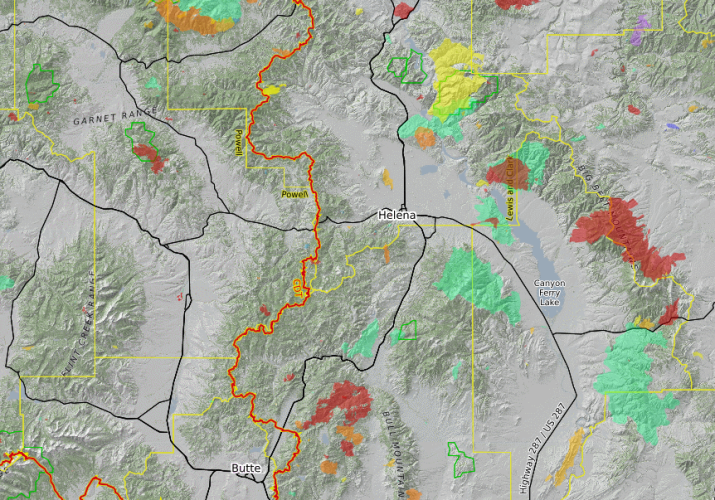
The little giant fire, which drove the aqi up to 180 yesterday, has burned over 100k acres of forest that burned in the last 40 years (give or take, I was pretty rough in my mapping).

I get that depending on where you live, it's easier to believe that it's the lack of fire that's causing the "un-fightable" nature of our fires.
1788361514230.png
In the last 120 years, large swaths of MT haven't seen the flame.
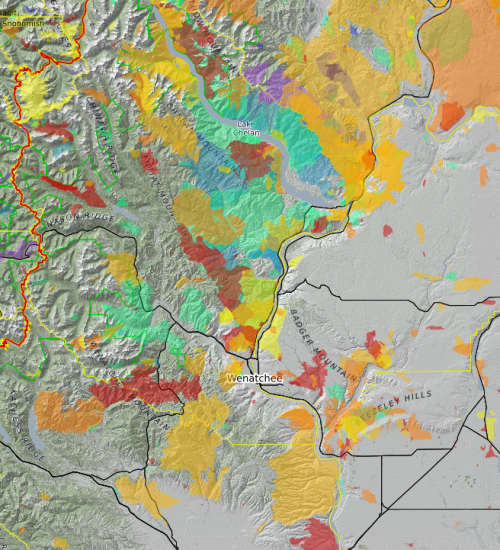
But it's a lot harder for me to reconcile. There are fires, on top of fires, on top of fires.
1788361605365.png
 
I agree with the majority of your comments.

It's hard for me to reconcile a mere 40 years of suppression, and the amount of fuels created during that time, as being some overwhelming factor in our current situation when the fire intervals for much of the western forests range from 5-100 years, especially if you've ever had analyzed naturally occuring data and taken a statistic course. However, if it's true. If we just need to make up for the fuels that weren't burned, over that period, then by god, we shouldn't anything to worry about here in the very near future. There's not a patch that hasn't burned in the last 30.

The little giant fire, which drove the aqi up to 180 yesterday, has burned over 100k acres of forest that burned in the last 40 years (give or take, I was pretty rough in my mapping).

I get that depending on where you live, it's easier to believe that it's the lack of fire that's causing the "un-fightable" nature of our fires.
View attachment 416126
In the last 120 years, large swaths of MT haven't seen the flame.
But it's a lot harder for me to reconcile. There are fires, on top of fires, on top of fires.
View attachment 416128
Little Giant was made the top priority fire in the nation last week. 50% contained now. I think it is a legit question to ask for an explanation why it took so long. You may not like the answer. I tend to trust the people in charge. If there is some grand plan to “let it burn” I doubt they are going to admit to it publically.

Bottom line is we are getting dryer. With less than 10in of precipitation, you live in a desert with trees. The entire Columbia basin and central Oregon look pretty similar to that map you posted. I don’t know the answer and think there probably isn’t one the majority are willing to accept.
 
Commissioners wrote in the final version of the letter that the county has lived with wildfires for too many seasons.
"Our communities living with this is not a viable option," they wrote. "Over the past 10 years, Chelan County has lost over 500,000 acres of land due to wildfires, approximately 30% of the county. As a result, residents have struggled with the financial, economic, physical, emotional, and social impacts of wildfires."

The commissioners are asking Congress to "drastically increase the pace, scale, and investments in these forest treatments, removing the overabundance of smaller trees, clearing underbrush, and applying prescribed fire following the strategic thinning."

More air resources to initially attack fires is the second request in the commissioner's letter. Commissioners are calling for an increase to air assets to provide an "overwhelming initial attack" no later than in the first 24 hours.

And lastly, the commissioner requests post-fire restoration given the problems downed trees make as well as how severely burned areas facilitate landslides and debris flows during heavy rain or "rain-on-snow events," according to the letter.

Murray said in a statement Friday she would be ensure that Chelan County and the entire state has a voice in funding negotiations. "I will do everything in my power to ensure Chelan County has every federal resource it needs to rebuild and our first responders continue to have the support they need to be prepared," she said. Schrier said on Wednesday following her meeting with local officials that she agrees with the commissioner's letter and "more than happy to do my bes with my colleagues to make sure that we we follow through on that."
 
Commissioners wrote in the final version of the letter that the county has lived with wildfires for too many seasons.
"Our communities living with this is not a viable option," they wrote. "Over the past 10 years, Chelan County has lost over 500,000 acres of land due to wildfires, approximately 30% of the county. As a result, residents have struggled with the financial, economic, physical, emotional, and social impacts of wildfires."

The commissioners are asking Congress to "drastically increase the pace, scale, and investments in these forest treatments, removing the overabundance of smaller trees, clearing underbrush, and applying prescribed fire following the strategic thinning."

More air resources to initially attack fires is the second request in the commissioner's letter. Commissioners are calling for an increase to air assets to provide an "overwhelming initial attack" no later than in the first 24 hours.

And lastly, the commissioner requests post-fire restoration given the problems downed trees make as well as how severely burned areas facilitate landslides and debris flows during heavy rain or "rain-on-snow events," according to the letter.

Murray said in a statement Friday she would be ensure that Chelan County and the entire state has a voice in funding negotiations. "I will do everything in my power to ensure Chelan County has every federal resource it needs to rebuild and our first responders continue to have the support they need to be prepared," she said. Schrier said on Wednesday following her meeting with local officials that she agrees with the commissioner's letter and "more than happy to do my bes with my colleagues to make sure that we we follow through on that."
Good luck with that. That 30% seems small. I would have guessed it to be a lot higher. let us know when they have a raking party.
 
I didn't finish reading this thread but I think I got through most of it well enough.

I think it would be wise to point out that forest fire frequency, size, and intensity/severity is increasing globally in recent decades. Europe has had a mind bending hell of a summer with forest fires.

This is not a uniquely American or North American trend and it really seems doubtful that the lowest common denominator in cause or potential culpability on a global scale is a mismanagement of fire response across every pertinent jurisdiction.

I can't really weigh in on specific issues beyond that. But I think it's very important high level thing to keep in mind.
 
@Irrelevant I perused this thread, and I hear your frustrations. I don't know if you ever got some of the answers you were seeking. There has been a lot of good discussion thus far. So I will try to either answer some, or direct you to where you might find some answers. Apologies that this post may jump around some, or is irrelevant at this point.

Wildfire Plan - to my knowledge there is a not a specific plan for wildfires, however, NFMA 1976 states that every Forest must have a Forest Plan. That Forest Plan, broadly speaking, directs all activities, desired conditions, management areas by type, acceptable/desired actions by area, must be updated on a regular basis, etc. and is subject to public scoping/comments. A forest plan could allow for wildfire in certain areas under specified conditions. Unfortunately, I am not familiar with the Okanogan - Wenatchee to know where they are at in the updating process. The following paragraph may be completely moot, but I am including the information for context.

The FS webpage directs to a Forest Plan from 1980 for the Wenatchee National Forest https://www.fs.usda.gov/r06/okanogan-wenatchee/planning. pdf page 57 "It should be emphasized that all wildfires that occur on the Wenatchee National Forest have been managed utilizing a cost-effective suppression strategy and this will continue after the implementation of this plan". However, pdf page 458 says, "The objectives of fire management in widerness are to:
A. Permit lightening-caused fires to play, as nearly as possible, their natural ecological role in wilderness.
B. Reduce, to an acceptable level, the risks and consequences of wildfire within wilderness or escaping from wilderness.
Upon completion of Wilderness Fire Management Plans, naturally occurring fires will be managed as prescribed fires as long as Wilderness Fire Management Objectives are being met." Wilderness fires are definitely no longer classified as prescribed fires, following the 1995 Wildfire Policy Review, I think.

Okay, so that paragraph may not be relevant at all due to the Northwest Forest Plan which amended the Forest Plans across the Northwest. I am ignorant on how the NWFP influences and interacts with Forest Plans with respect to wildfires. The NWFP is currently going through revision. Google sucks now so I'm really struggling to find wording in the NWFP on wildfire management. The best I've come up with is "resilience to wildfire" which is really open to interpretation. In practice, and I'm speculating here, sometimes resilience to wildfire means having more, small fires on the landscape, so when it is a hot dry year the larger fires are broken up/slowed down. Obviously, that's not always how things play out. I perused this article on the NWFP and wildfires: https://www.sciencedirect.com/science/article/pii/S0378112725007704#ab0015

Back to wildfire suppression plan - the plan for suppression is a list of priorities, and not so much a strategy/tactical guide. Priority one is firefighter and public safety. And on an emerging incident, impact of smoke would not be considered. This is immediate concerns due directly to flames.

Full-suppression terminology. There is rightly so a ton of confusion over this, made worse this year by direction that all fires were to be fully suppressed. Tactics under a full suppression strategy include direct attack, indirect attack, point protection. So there could be a full suppression fire with one area of point protection while the rest is uninhibited. There was an attempt to clean up terminology recently, but I don't think it worked.

Based on the information provided of rappelers and 22 other folks on the ground, I would say managers fully intended to suppress the fire if possible. It is worth keeping in mind that Oregon blew up on 7/16 so that may contribute to a shortage of aircraft. The Great Basin was also still holding onto aircraft. So a tough time to get aircraft on an IA way out in the mountains when there are other fires threatening communities. And Oregon was primed to burn this year due at least in part to drought.

The NYT had an article earlier this year on the impact of wildfire smoke (the cited study is not without some detractors): https://www.nytimes.com/2025/09/18/climate/wildfire-smoke-health-deaths.html
And here is one from 2024 regarding California: https://theconversation.com/wildfir...-heres-why-and-how-to-protect-yourself-231916

The Wenatchee area has been getting hammered and harmed by the impacts of wildfire the last couple of years. I hope you catch a break soon.
 
@Irrelevant I perused this thread, and I hear your frustrations. I don't know if you ever got some of the answers you were seeking. There has been a lot of good discussion thus far. So I will try to either answer some, or direct you to where you might find some answers. Apologies that this post may jump around some, or is irrelevant at this point.

Wildfire Plan - to my knowledge there is a not a specific plan for wildfires, however, NFMA 1976 states that every Forest must have a Forest Plan. That Forest Plan, broadly speaking, directs all activities, desired conditions, management areas by type, acceptable/desired actions by area, must be updated on a regular basis, etc. and is subject to public scoping/comments. A forest plan could allow for wildfire in certain areas under specified conditions. Unfortunately, I am not familiar with the Okanogan - Wenatchee to know where they are at in the updating process. The following paragraph may be completely moot, but I am including the information for context.

The FS webpage directs to a Forest Plan from 1980 for the Wenatchee National Forest https://www.fs.usda.gov/r06/okanogan-wenatchee/planning. pdf page 57 "It should be emphasized that all wildfires that occur on the Wenatchee National Forest have been managed utilizing a cost-effective suppression strategy and this will continue after the implementation of this plan". However, pdf page 458 says, "The objectives of fire management in widerness are to:
A. Permit lightening-caused fires to play, as nearly as possible, their natural ecological role in wilderness.
B. Reduce, to an acceptable level, the risks and consequences of wildfire within wilderness or escaping from wilderness.
Upon completion of Wilderness Fire Management Plans, naturally occurring fires will be managed as prescribed fires as long as Wilderness Fire Management Objectives are being met." Wilderness fires are definitely no longer classified as prescribed fires, following the 1995 Wildfire Policy Review, I think.

Okay, so that paragraph may not be relevant at all due to the Northwest Forest Plan which amended the Forest Plans across the Northwest. I am ignorant on how the NWFP influences and interacts with Forest Plans with respect to wildfires. The NWFP is currently going through revision. Google sucks now so I'm really struggling to find wording in the NWFP on wildfire management. The best I've come up with is "resilience to wildfire" which is really open to interpretation. In practice, and I'm speculating here, sometimes resilience to wildfire means having more, small fires on the landscape, so when it is a hot dry year the larger fires are broken up/slowed down. Obviously, that's not always how things play out. I perused this article on the NWFP and wildfires: https://www.sciencedirect.com/science/article/pii/S0378112725007704#ab0015

Back to wildfire suppression plan - the plan for suppression is a list of priorities, and not so much a strategy/tactical guide. Priority one is firefighter and public safety. And on an emerging incident, impact of smoke would not be considered. This is immediate concerns due directly to flames.

Full-suppression terminology. There is rightly so a ton of confusion over this, made worse this year by direction that all fires were to be fully suppressed. Tactics under a full suppression strategy include direct attack, indirect attack, point protection. So there could be a full suppression fire with one area of point protection while the rest is uninhibited. There was an attempt to clean up terminology recently, but I don't think it worked.

Based on the information provided of rappelers and 22 other folks on the ground, I would say managers fully intended to suppress the fire if possible. It is worth keeping in mind that Oregon blew up on 7/16 so that may contribute to a shortage of aircraft. The Great Basin was also still holding onto aircraft. So a tough time to get aircraft on an IA way out in the mountains when there are other fires threatening communities. And Oregon was primed to burn this year due at least in part to drought.

The NYT had an article earlier this year on the impact of wildfire smoke (the cited study is not without some detractors): https://www.nytimes.com/2025/09/18/climate/wildfire-smoke-health-deaths.html
And here is one from 2024 regarding California: https://theconversation.com/wildfir...-heres-why-and-how-to-protect-yourself-231916

The Wenatchee area has been getting hammered and harmed by the impacts of wildfire the last couple of years. I hope you catch a break soon.
I appreciate the thoughtfulness and balance of your response.

I'm still suspicious of how the interpretation of the various "plans" are actually implemented. I think there's a lot of deliberately vague or misleading language to allow actions that openly wouldn't be tolerated. I've seen and read nothing that leads me to believe that there's many true considerations beyond direct public/FF safety.

Let's bring 2k people in to brush roads 20 miles away and a couple helicopters to sprinkle water for a month...

It's like if you let it burn for a month you're going to get a windy day or three that makes it all for naught.
 
I'm still suspicious of how the interpretation of the various "plans" are actually implemented. I think there's a lot of deliberately vague or misleading language to allow actions that openly wouldn't be tolerated. I've seen and read nothing that leads me to believe that there's many true considerations beyond direct public/FF safety.

In a general sense, discretion on strategy (full suppression or 'manage' (which isn't really an option these days)) is granted to the local Duty Officer while tactics (direct/indirect) are determined by the IC. The Duty Officer (DO) is also working with the local Agency Administrator (AA) to develop the strategy. To get really speculative, it is possible to have a DO and AA that decide to back off a fire for various legitimate, or perhaps 'personal' reasons. Legitimate reasons could include safety, likelihood of success, higher priority elsewhere. But to continue speculating, 'personal' reasons might include that a fire 'emergency' allows the FS to bypass (or decrease) NEPA, allowing: timber extraction for fuel breaks; future timber salvage opportunities; future opportunity to rehabilitate roads; a desire for more fire on the landscape (resilience?). And then use then justification of firefighter safety to not suppress the fire. I feel like this might be what you're trying to get at.

Let's bring 2k people in to brush roads 20 miles away and a couple helicopters to sprinkle water for a month...

It's like if you let it burn for a month you're going to get a windy day or three that makes it all for naught.

Risk transference is a very real discussion point for managers. There are really difficult discussions on the overall risk exposure to 4 firefighters in a snag patch, on steep timbered terrain, hours from a road (evac) for three days, compared with 500 people on/near driveable roads for two months. You're likely to have more injuries the longer the incident extends, but more likely to have a fatality if something goes wrong on Initial Attack in timbered country (citation needed). I think these decisions are often colored by personal biases from tragic events. Although the set up is pretty different (WUI compared with remote areas), I wonder if (really, to what extent) the Twisp River 2015 incident impacts decisions. Undoubtedly, there numerous other close calls with respect to fuels, topography, weather, and drought in the Pacific Northwest that can give hesitation for engagement (but also sometimes, bias to act quickly over these fears).

One of the tools the DO has for informing decisions is the Risk Management Assistance (RMA) Dashboard Link. Under the Analytics Layer are options for National Snag Hazard, Firefighter Estimated Ground Evacuation Time, Suppression Difficulty Index, and Potential Control Location. This is one method to quantify risk versus likelihood of success. I have no idea/insight on what tools were used, or what decisions were made in the initial phases for Little Giant.

Regarding fire history and previous burns. It is pretty well documented that wildfires in timbered areas can reburn an area within 10 years so I don't know why managers continue to think burn scars will hold fire. Often the fire behavior changes (due to changes in fuels), it can be more or less intense, depending on the initial fire and how long ago it was. Due to the change in fuels, different tactics might be possible.
 
But to continue speculating, 'personal' reasons might include that a fire 'emergency' allows the FS to bypass (or decrease) NEPA, allowing: timber extraction for fuel breaks; future timber salvage opportunities; future opportunity to rehabilitate roads; a desire for more fire on the landscape (resilience?). And then use then justification of firefighter safety to not suppress the fire. I feel like this might be what you're trying to get at.
I haven't had much time to comment on this thread but this is something I had planned on mentioning and I think you nailed it on the head. Add to this the reality that fire fighting is a major industry for private sector and even non fire agency personnel do a lot of fire work and count on it as part of their salary, and everyone would rather get their time in close to home if possible so a strategic fire in the backyard is desirable from that standpoint.
 
I haven't had much time to comment on this thread but this is something I had planned on mentioning and I think you nailed it on the head. Add to this the reality that fire fighting is a major industry for private sector and even non fire agency personnel do a lot of fire work and count on it as part of their salary, and everyone would rather get their time in close to home if possible so a strategic fire in the backyard is desirable from that standpoint.

It is my understanding that Region 6 is one of the more contractor friendly/reliant regions as well. And contractors were making plenty of noise about not getting out at PL4 nationally prior to mid July. That said, I don't know of anyone who sets out to get a 172k acre fire just so some contractors get paid. I'm sure some of the larger contractors have sway with representatives/congressional but not to let a fire go.

Aviation contracts and allocation is a whole other conversion. Finite resource that managers don't want to lose once they have them. Helicopters can go for upwards of 20k a day for availability and $5k an hour for operations (I'm sure it is more expensive now) so taxpayers don't want a bunch of helicopters not being utilized during slow months/years. It seems like there's a couple weeks a year where everyone needs helicopters and no one can get them, but the rest of the time the helicopter owners can take their toys home.


But back to Little Giant. My reading of the limited public information available (Watch Duty and associated Forest FB updates) on the initial attack strongly suggest that intent was to put the fire out in the early stages. Quarter acre in the 2003 burn scar on discovery the morning of 7/16, rappelers on scene with the fire around 5 acres that evening. Seven other fires were addressed that day, including Three Queens which was at 25 acres. On 7/17, with eight rappelers on scene, the fire grew to 15 acres which is definitely not a good sign. By the end of 7/18 the fire was at 70 acres and crews disengaged, which seems fair to me. You have to know when to cut your losses, regroup, and come up with a new plan.

I can't really comment on the plan once the Type 3 organization took over. It is highly likely they tried to order resources but had no chance competing with all the fires in Oregon. And the fire grew incrementally to 1091 acres on 7/22. Then made a run on 7/23 burning up 7591 acres. I wont rehash the whole timeline, but I can see how things wound up where they're at.

Of note, the 7/17 Forest FB post stated the Ptarmigan Fire and Crater Fire were both being monitored by aerial resources. I would consider these two fires to have not been engaged or suppressed. The Ptarmigan Fire is probably closest to what could be considered a 'managed' fire. After the fire was established, smoke jumpers were inserted for point protection, but not to take actions on putting out the whole fire.
 

Forum statistics

Threads
119,972
Messages
2,245,393
Members
39,067
Latest member
romar212
Back
Top