


COEngineer
Well-known member
- Joined
- Jul 6, 2016
- Messages
- 1,679
I didn't read it like that, so perhaps you are being overly defensive, but your perspective is real. I ask this plainly - are you sure "your people" own the land they are on? I grew up in farm country and didn't realize for decades that the farmers didn't own much of the land they worked. They had become tenant farmers even though they lived in the same place their grandparents did.I have a gut reaction to this article, and the way certain groups talk about public land ranchers, and my reaction comes from actually knowing the humans in my neck of the woods that they are talking about. I can’t speak to other states, but can to the geography I know. Just focusing on the USFS lessees I know within a half hour of my house in the county in which I live, you're mainly looking at half a dozen families – none of which are reflected in group’s like Western Watersheds Project’s or other’s rhetoric about public land ranchers. Between all of them, they provide over 30,000 acres of Block Management Access – again that’s within a half hour of my home address, and they count on those public land leases. Not a damn one of them would I consider “wealthy” beyond the land they own, and they don’t live like it either.
That’s not to say that better lease contracts shouldn’t be implemented - offsite watering, riparian fencing, more leeway for enforcement and protection of the land, etc. But I see that as a federal issue and not one to be directed at locals. Instead of putting the onus on the lessor, and more accurately those who dictate what the lessors can do, where it should be, I see a direction chosen by a lot of groups who are distant from the land and its people to vilify lessees, who are my neighbors.
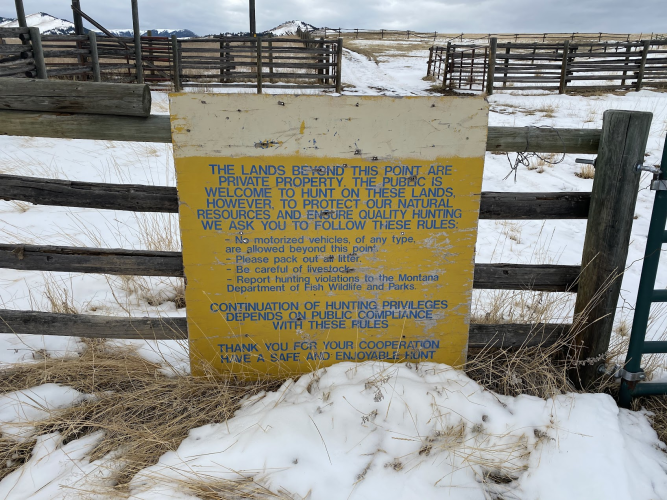
From last hunting season, I have a pronghorn, an elk, and 2 deer in the freezer - all from public lands and all in the presence of cowpies. In many ways, the subsidization of agriculture on public land is the subsidization of a culture and a people. Though I live in a subdivision, I grew up here, and they are my people and it is my culture.
It's similar to putting any other cohort in a bucket – treating a very diverse group as a monolith – nearly always a mistake in terms of encapsulating the second and third order consequences of the finger pointers getting what they wish for .
"Roughly two-thirds of the grazing on BLM acreage is controlled by just 10% of ranchers, our analysis found. And on Forest Service land, the top 10% of permittees control more than 50% of grazing. Among the largest ranchers are billionaires like Stan Kroenke and Rupert Murdoch, as well as mining companies and public utilities."