

Ranching Subsidies ProPublica Article

I have a gut reaction to this article, and the way certain groups talk about public land ranchers, and my reaction comes from actually knowing the humans in my neck of the woods that they are talking about. I can’t speak to other states, but can to the geography I know. Just focusing on the USFS lessees I know within a half hour of my house in the county in which I live, you're mainly looking at half a dozen families – none of which are reflected in group’s like Western Watersheds Project’s or other’s rhetoric about public land ranchers. Between all of them, they provide over 30,000 acres of Block Management Access – again that’s within a half hour of my home address, and they count on those public land leases. Not a damn one of them would I consider “wealthy” beyond the land they own, and they don’t live like it either.

That’s not to say that better lease contracts shouldn’t be implemented - offsite watering, riparian fencing, more leeway for enforcement and protection of the land, etc. But I see that as a federal issue and not one to be directed at locals. Instead of putting the onus on the lessor, and more accurately those who dictate what the lessors can do, where it should be, I see a direction chosen by a lot of groups who are distant from the land and its people to vilify lessees, who are my neighbors.

From last hunting season, I have a pronghorn, an elk, and 2 deer in the freezer - all from public lands and all in the presence of cowpies. In many ways, the subsidization of agriculture on public land is the subsidization of a culture and a people. Though I live in a subdivision, I grew up here, and they are my people and it is my culture.

It's similar to putting any other cohort in a bucket – treating a very diverse group as a monolith – nearly always a mistake in terms of encapsulating the second and third order consequences of the finger pointers getting what they wish for .
I didn't read it like that, so perhaps you are being overly defensive, but your perspective is real. I ask this plainly - are you sure "your people" own the land they are on? I grew up in farm country and didn't realize for decades that the farmers didn't own much of the land they worked. They had become tenant farmers even though they lived in the same place their grandparents did.

"Roughly two-thirds of the grazing on BLM acreage is controlled by just 10% of ranchers, our analysis found. And on Forest Service land, the top 10% of permittees control more than 50% of grazing. Among the largest ranchers are billionaires like Stan Kroenke and Rupert Murdoch, as well as mining companies and public utilities."
 
Like I GAF if Rancher Bill goes tits-up when he doesn't allow public hunting.
I do.

Rancher bill might not let you have access - but many let family and friends hunt and its possible to enroll in an access program. Billionare Ben isnt going to let anyone on unless they're disabled, dying, or mamed from war (for the PR) or they get a bull or severall bull tags to go with. Billionare Ben hires lobbyist Lenny to advocate for things like more tags, transerable tags, and inlcusions for special classes of people.

At least where i live - we have enough Bens and Lennys.
 
I didn't read it like that, so perhaps you are being overly defensive, but your perspective is real. I ask this plainly - are you sure "your people" own the land they are on? I grew up in farm country and didn't realize for decades that the farmers didn't own much of the land they worked. They had become tenant farmers even though they lived in the same place their grandparents did.

"Roughly two-thirds of the grazing on BLM acreage is controlled by just 10% of ranchers, our analysis found. And on Forest Service land, the top 10% of permittees control more than 50% of grazing. Among the largest ranchers are billionaires like Stan Kroenke and Rupert Murdoch, as well as mining companies and public utilities."


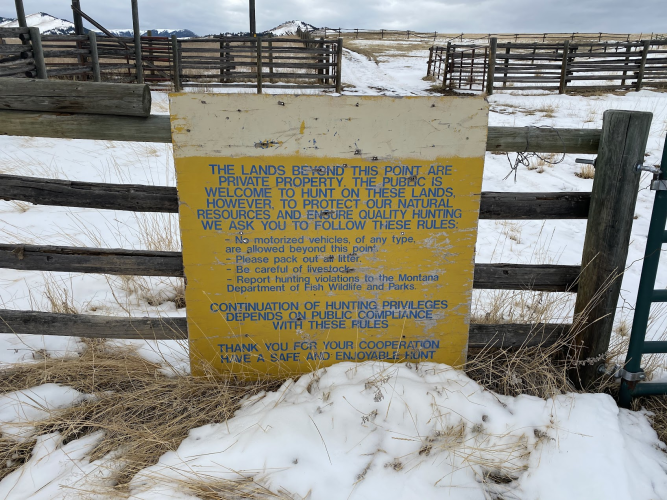
For the most part, yes. I can think of one local outfit owned by a very wealthy man who visits the ranch like once a year, but the other 51 weeks of the year the foreman, who graduated high school with my brother, runs the show. They employ locals, and provide about 6,000 acres of public access via block management, and allow public access like hiking the rest of the year. I don't know how raising lease rates to market or something closer would effect that specific operation, but I know some of the others I was referring to personally. Their finances aren't any of my business and maybe my concern is overblown, but there's still a lot of "little guys" out there.

It's not invalid to say "That's their problem and the public trust shouldn't be a prop to business models no longer viable" but when I look around Montana to the places where the local longtime ranchers have given up the ghost on their operations I don't see it as an improvement - for the communities or the land. Part of this is the fact that though Montana has 30 million acres of public ground, we've got 60 million of private, and in some of the best parts of Montana those two categories of ownership have an interplay.

1768315167389.png
 
Last edited:
Like I GAF if Rancher Bill goes tits-up when he doesn't allow public hunting. Maybe there is some carrot-and-stick to be applied? Perhaps require public hunting access in order to qualify for reduced grazing prices. But then you're injecting state wildlife agencies into federal land management decisions. Hmm,
lots to chew on for sure...

I am a strong advocate for public hunting access, but also for private property rights. Rancher Bill and his neighbors will already inevitably deal with the consequences (good and bad) of how they administer hunting access in their property.

Us who don’t own land may not be able to hunt given property, but we benefit from the wildlife habitat that Rancher Bill provides. Having wildlife habitat and needing more access might not always be as nice as having wildlife habitat AND access, but it’s a whole lot better than not having either. Access is harder to get back once it’s lost. Wildlife habitat lost to development is impossible.

I agree there are cases where grazing/anything management can be improved on public lands, but I’d rather see it remain accessible to traditional landowners so we can hold on to both summer and winter ranges and everything in between, in a world where all of it is diminishing far too quickly. Punishing 90% of the lessees because 10% of them get 2/3 of subsidies (I’d like to see sources for that claim too) is not the solution.
 
How are they not needed? You own this land we are talking about. You don't want someone to take a look at it every ten years to see if the lessees are abusing it?
Most allotments can be and are adjusted or altered every year. I think the idea that the permit is renewed and then not looked at for a few years is a common misconception. a full-blown analysis would be warranted if conditions changed significantly. As long as monitoring data is being collected, changes in management can be made to address those issues.
 
I am a strong advocate for public hunting access, but also for private property rights. Rancher Bill and his neighbors will already inevitably deal with the consequences (good and bad) of how they administer hunting access in their property.

Us who don’t own land may not be able to hunt given property, but we benefit from the wildlife habitat that Rancher Bill provides. Having wildlife habitat and needing more access might not always be as nice as having wildlife habitat AND access, but it’s a whole lot better than not having either. Access is harder to get back once it’s lost. Wildlife habitat lost to development is impossible.

I agree there are cases where grazing/anything management can be improved on public lands, but I’d rather see it remain accessible to traditional landowners so we can hold on to both summer and winter ranges and everything in between, in a world where all of it is diminishing far too quickly. Punishing 90% of the lessees because 10% of them get 2/3 of subsidies (I’d like to see sources for that claim too) is not the solution.
It seems like there is a huge opportunity for putting better sidebars on the “subsidies” such as income limitations etc. I think that’s the middle ground opportunity to focus on. USDA programs definitely need something like this implemented. I don’t blame the taxpayers for being annoyed if they are subsidizing deep pocket wealth. I think focusing on reform in that arena could help preserve the smaller family ag/ranch versus lining pockets of corporate/billionaires and be a win for conservation as well.
 
Hopefully part 2 and 3 get better because so far they haven't told anything that isn't already known, and they left many important details out or made vague statements that could be easily misinterpreted.

The key focus should be on allotments renewed using the law mentioned that allows an allotment to be renewed without environmental review if there are no changes to the authorization, aka the FLPMA 402(c)(2) loophole.

They mention an increase from 47% to 75%, but leave out all the details. If a land health assessment finds that an allotment is not meeting one or more standards and the causal factor is current grazing management, changes must be made to address the issues before the next growing season. Sounds great but the FLPMA loophole allows this to be circumvented. Agencies play a timing game with allotment reviews to make changes within the timelines possible, when there's a cooperative operator. If there's much potential for conflict usually the decision maker (normally a Field Manager for BLM) often chooses the FLPMA loophole, because most Field Managers are still hoping to climb the ladder, so they avoid major conflicts and keep State Office and HQ superiors happy.

Sometimes the loophole is just used because of short staffing and actual inability to process all permits timely.

So I'd like to see a deep dive of where these allotments are regarding review and more explanation of why they're using the loophole. An in depth discussion of the actual process starting with the land health evaluation/assessment, the allotment management plan, the supporting NEPA and challenge/appeal process available to the operator and interested public, the FLPMA loophole, and what allotments are going through the loophole on repeat and why.

As written, I find the article pretty biased as antigrazing.

Most allotments can be and are adjusted or altered every year. I think the idea that the permit is renewed and then not looked at for a few years is a common misconception. a full-blown analysis would be warranted if conditions changed significantly.
Depends on what is in the allotment management plan and what was authorized under the lease, adjustments within those sideboards are allowed but if bigger changes are needed must go through review, or renewed without changes through the FLPMA loophole.
 
Depends on what is in the allotment management plan and what was authorized under the lease, adjustments within those sideboards are allowed but if bigger changes are needed must go through review, or renewed without changes through the FLPMA loophole.
I think we are saying the same thing
 
There is how its designed to work on the one hand...and how it can possibly work on the other.

That other side reality is huge staff reductions-- coupled with leaders who were appointed with a mandate to fire anyone who disagrees with the mandates to not stand in the ranchers way.
 
Yes, Cliven Bundy's cattle are still illegally grazing on federal lands in Nevada, despite a federal court order barring him from doing so, with little renewed effort from the government to remove them, much like a decade after the famous 2014 standoff. While Bundy is technically banned, the Bureau of Land Management (BLM) hasn't forcefully removed the cattle, leading to continued grazing on lands for wildlife protection.
 
Back
Top