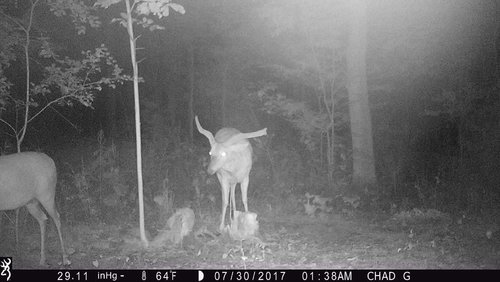
Seem it before. Not 100% convinced that all of those pictures are the same deer, especially from 1.5 to 2.5. He has no eartag, so I would really like to know what identifying characteristics they used to identify him year to year ESPECIALLY from 1.5-2.5.
Spikes, and general heritability of antler characteristics, have been studied extensively in quite a few states, and especially TX. In a TX studs on low fence, free ranging deer in a huge area over a number of years, TPWD netted bucks from helicopters and measured and tagged them. I may miss the exact numbers but this is close. Only about 20% of deer that were spikes at 1.5yrs reached 140” or more in their peak year. About 80% of deer that had 6pts or more at 1.5yrs reached 140” or more in their peak year. Does the occasional spike make a great buck someday? Yep. Does every great looking yearling become a monster? Nope. BUT we have to let him age, and thus breed, to find out for sure. The question is, if you know that 80% of spike yearlings are mediocre at best(I would of course love a 140” whitetail) and 80% of 6pt yearlings will become great deer, how many does do you want that spike to breed before you find out he isn’t going to be a great buck? 1.5yrs of age is the easiest time to make the call IF you’re going to cull. If you’re at carrying capacity and have a good buck to do ratio, then SOME YEARLINGS HAVE TO BE KILLED to maintain age structure. If you have to kill a yearling buck, you’re obviously MUCH better off killing the spike.
Frankly, I’m all for shooting what you want to shoot, but if you’re going to manage deer for trophy quality, first you get to the population level you want, then you get close to 1:1 sex ratio(for whitetails), then you focus on age structure. With a 1:1 sex ratio, good age structure from 1.5-6.5, and a stable population you MUST kill yearling bucks. If you’re going to kill yearling bucks, you’re stupid to spare the spikes and kill the 6pts.






 www.realtree.com