If they are catching hatch-year pheasants, they are catching hatch-year sharptails. Hell, my dog has caught hatch-year sharpies on the opener. I struggle to see how they aren’t negatively impacting those public land birds at a vulnerable time.
I have had a horseback field trial habit, going on for over twenty years now. In all of that time, no dog of mine has caught a young bird. I am sure it has happened, somewhere, at sometime. It is a training setback, whenever a dog does manage to catch a bird. It gives the dog the idea that pointing is optional, and catching the bird is the better end goal.
One of the major advantages of training on wild birds, is that is very difficult for the dog to catch one. The other big advantage is that wild birds teach a dog to point them from some distance away. Another reason that young sharptails attract trainers from far away, is that their flush is usually staggered. That is a bird or two flush, at a time. This gives the trainer the opportunity to correct the dog, if it breaks at the flush, then have a chance for the dog to get it right, when later birds flush.
My speculation is that a flushing dog will catch more birds than will a pointing dog. A half decent pointing dog, is at least half conflicted, about trying to flush the bird.
In my case, where I train, it is on sharptails, with a few huns thrown in. Young sharptails will fly a hundred yards or more, by the third week in July. By the end of August, they can fly a quarter mile or more.
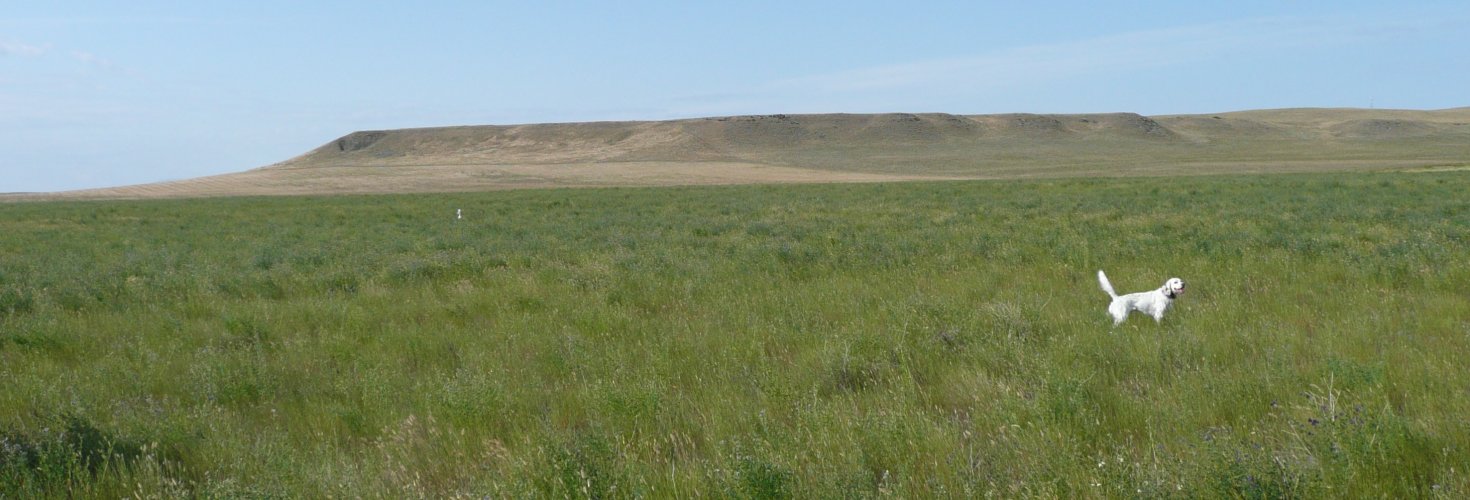
Two of my dogs, each pointing sharptails on an August morning.
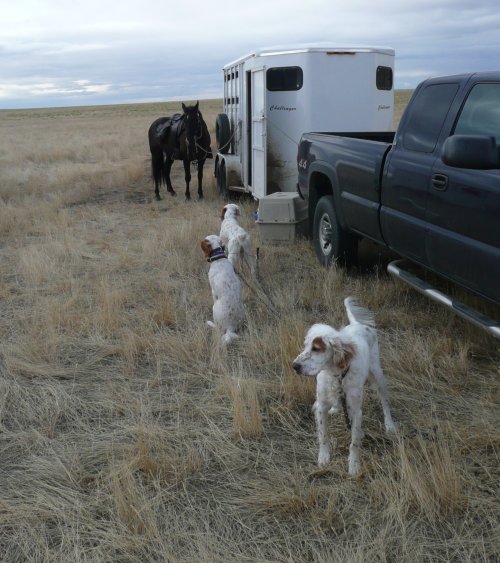
Here, I am getting ready early in the morning, to run the dogs, from horseback. This was in early September, and I did kill a couple of birds, over the dogs. The horse is Smokey. He is now gone, but never forgotten by me. He was a good one.