

Nov 3 - Independents’ Day?

Should we just make you king, since your positions are superior? Are you surprised people have different opinions or am I misinterpreting?
No not surprised. Happy that people can have different options in this country, at least for now. Just find it interesting that two opposing opinions end us up with a bigger, but different problem.

Party doesn’t matter and won’t. People need to vote for high character individuals regardless of party. Those are in short supply in politics and even if they exist the system quickly paints them as the “enemy”. Bodnar seems like a person with integrity. However, even if he was elected, in two years he would take so much flak he wouldn’t want the job anymore. Trump won Montana by 20pts.
 
Trump won Montana by 20pts.
Skewed perspective from a purple Bozeangelos area, but nationally Trump's support has been waning due to a wide variety of noted misjudgments on his part which have been adversely submarining any purported efforts at "making America great". As pointed to above, it is unfortunate that the staunch D voters will split votes away from an otherwise Independent candidate who would have had a shot, according to the mathematics of political pundits.
 
I've talked about this before. People complain about the parties, but fewer and fewer take part in them to advocate for change.

I'm not talking about voting in the general election.

I'm talking about attending a party caucus, voting within the party.

Both parties tend to be run by the extremes because moderates--heck even people that don't give power to fake issues and conspiracies or pie in the sky changes with no concern for their impact--do not take an active role in the party.

You can say indepenedents are the answer but that is no panacea either. I give you:

unspecified-unspecified-jesse-ventura-poses-for-a-studio-shot-while-with-the-wwe-in-1987.jpg


He did have some of the best political ads ever though...


He actually was pretty close to a die hard libertarian, and had some really good moderate staff members with solid ideas--from both parties...just couldn't get out of his own way and keep his foot out of his mouth.

Context at the time was a couple of classic old school politicians being run by the two major parties and a voting public tired of the same old.

Also--polls at the time had him trailing by a fair amount. The vote was split three ways, but they had him in the mid 2o % range. He won with 37%. HUGE younger voter turnout made a big difference for him.

So don't lose hope. .
 
Last edited:
There isn't a perfect answer, but there are plenty of answers. The only politician we would agree with 100% of the time would be us if we ran. Otherwise, we win some and lose some.

If that site was right, we are up over 18 million spent on Montana Senate campaign. Sure, it's possible that people who donated millions to their candidate don't want anything in return, and the candidate will always do the right thing.

But, politics doesn't quite work that way. I'll think it's more like I'll vote for your "bill" if you vote for mine no matter if they are Rs, Ds, or Is. Sometimes, they support bills knowing it's not going to pass, so they can campaign on it to raise money.

You can pretend a candidate has integrity ... but I call it politics which is something else entirely.
 
Skewed perspective from a purple Bozeangelos area, but nationally Trump's support has been waning due to a wide variety of noted misjudgments on his part which have been adversely submarining any purported efforts at "making America great". As pointed to above, it is unfortunate that the staunch D voters will split votes away from an otherwise Independent candidate who would have had a shot, according to the mathematics of political pundits.
Agree. Why is he not splitting off any meaningful % of R voters? (At least in the polls. Maybe Election Day will be different?)

I have said since the start that Dems will get the blame for this. But both sets of voters are slaves to their party loyalty. Objective thought is dead.
 
I've talked about this before. People complain about the parties, but fewer and fewer take part in them to advocate for change.

I'm not talking about voting in the general election.

I'm talking about attending a party caucus, voting within the party.

Both parties tend to be run by the extremes because moderates--heck even people that don't give power to fake issues and conspiracies or pie in the sky changes with no concern for their impact--do not take an active role in the party.

You can say indepenedents are the answer but that is no panacea either. I give you:

unspecified-unspecified-jesse-ventura-poses-for-a-studio-shot-while-with-the-wwe-in-1987.jpg


He did have some of the best political ads ever though...


He actually was pretty close to a die hard libertarian, and had some really good moderate staff members with solid ideas--from both parties...just couldn't get out of his own way and keep his foot out of his mouth.

Context at the time was a couple of classic old school politicians being run by the two major parties and a voting public tired of the same old.

Also--polls at the time had him trailing by a fair amount. The vote was split three ways, but they had him in the mid 2o % range. He won with 37%. HUGE younger voter turnout made a big difference for him.

So don't lose hope. .
He was a vanguard of the current era of celebrity in politics. That kind of makes me wonder if anyone without some celebrity persona will ever win the presidency. Even politicians are trying to craft some type of celebrity profile.

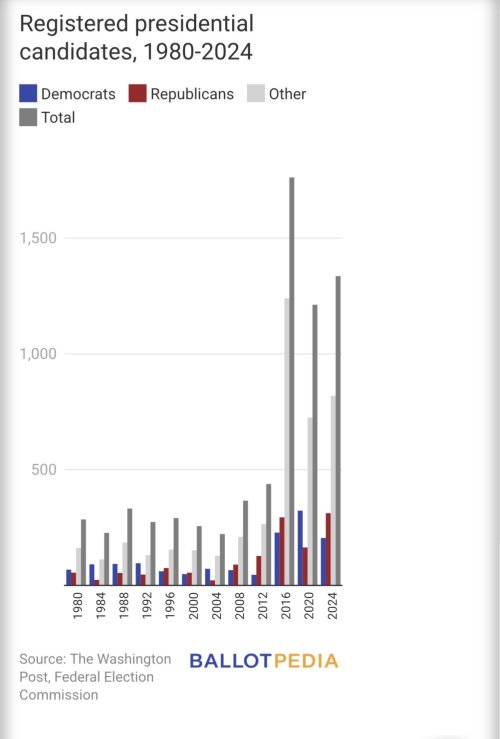
Lots of people registered for 2028. Lots of Ind, lots of No party. The result of the internet and social media?

IMG_2795.jpeg
 
If that site was right, we are up over 18 million spent on Montana Senate campaign. Sure, it's possible that people who donated millions to their candidate don't want anything in return, and the candidate will always do the right thing.

Just a reminder that over $200 million was spent on the 2024 Montana Senate race to get a preferred candidate elected. Agree with jimh that it is a lot of money to spend and not expect something in return. Just seems like there's a lot of better ways to spend $200 mil.

 
Whew, that was long and slow. I think he's Dazed and Confused. Yes, that's a pun. It wasn't that bad.

He suggests all votes are strictly down party lines. Of course, that's not the case. If you look, you'll find the vast majority of the bills are bipartisan. An Independent would have to pick a side since you can either vote for or against a bill.

The reality is that not all Congressman/Senators always vote with their party. Manchin didn't and he didn't need an I next to his name to not vote with party. Of course, McCain did the same thing. Those are just two examples.

I think a more effective solution is to encourage people to pay more attention to primaries so that the best candidate is chosen for each party.

Furthermore, what is the explanation for the majority being independent when people from one party or the other depending on the state consistently win? I think it is because people say they are independent, but when push comes to shove they lean toward one party or the other.

For those who made it this far ... I asked Grok to summarize his video and say what was fact.

Main arguments in the video​

  • He challenges the long-standing claim that an independent vote is a “wasted vote,” asking: “How’s that unwasted vote been working out for you?”
  • Independents are the largest political identity in the U.S. (citing figures around 45%, higher than either Democrats or Republicans).
  • Being independent does not mean being “middle of the road” or a fence-sitter. He calls it “the original road”—“Before there was ever a Republican or Democrat, there was an American.” A true independent, he says, takes the best of both sides rather than rejecting both.
  • The current system is “lopsided.” He notes that in 2024 a large majority of House seats were effectively decided in party primaries by a small share of eligible voters, so many general-election contests are not real competitions.
  • In a closely divided Congress, even a small number of true independents (ones who do not caucus with either party) could act as “majority makers” or a “toll booth.” Extreme measures would struggle to pass, and both parties would have to write legislation more aligned with where most Americans actually are.
  • He highlights former Sen. Joe Manchin’s new Independent Leadership Council (launched with Manchin’s daughter Heather) as an effort to recruit, fund, and support independent candidates for Congress.
  • Practical advice: Look at the full ballot, study the independent options, and treat them as potential winners rather than automatic spoilers or protest votes.
In short, McConaughey argues that independents are not a fringe or wasted choice—they reflect the largest group of Americans and could serve as a practical check that pulls both major parties toward the center.

Factual elements​

  • Party identification: A Gallup survey showed a record 45% of U.S. adults identified as independents in 2025, with Democrats and Republicans at 27% each. (When independents are pressed on leanings, many still tilt toward one of the major parties.)
  • Primary elections: An analysis from the Unite America Institute found that in 2024, roughly 87% of U.S. House seats were effectively decided in party primaries by about 7% of eligible voters. This is a documented point about safe seats and low primary turnout.
  • Joe Manchin’s group: Former Sen. Joe Manchin and his daughter Heather did launch the Independent Leadership Council in the summer of 2026 to recruit and support independent candidates for Congress. That is accurate.

Opinion and advocacy​

  • The core message that an independent vote is not “wasted,” that independents should be treated as potential winners, and that a “fair fight” requires more than the two major parties is McConaughey’s opinion and call to action.
  • Claims about how 3–5 true independents would function as a “toll booth” or force both parties toward the center are logical projections based on narrow congressional margins, but they remain speculative.
  • Rhetorical lines such as “How’s that unwasted vote been working out for you?” and framing the system as uniquely “lopsided” are persuasive argument, not neutral data.
Bottom line: The video rests on a couple of real, verifiable statistics (Gallup’s independent identification numbers and the primary-election concentration data) and a real organizational development (Manchin’s council). The rest is McConaughey’s political opinion and advocacy urging voters to consider independent candidates more seriously.
 
If you look, you'll find the vast majority of the bills are bipartisan.
[/LIST]
What do you mean by this? Wouldnt a "biparitsan" vote mean something like 30 dems + 30 repubs voting for something while 40 others do not? Or even 5 breaking rank?

I cant really call something biparitisan if less than 2% of senators didnt break party ranks. Its been contingent on a few voices (manchin or fetterman, for example) that do.

Save for some covid relief stuff, i dont see where a lot thats been done in the last 10 years could be labeled that.
 
This is what I mean.

Major non-bipartisan bills (party-line or near-party-line) that became law in the past ~6 years (roughly late 2020–October 2026) include these high-profile measures. Most routine laws still pass with bipartisan support, but these significant ones advanced mainly or entirely with votes from one party, typically via budget reconciliation when one party controlled the White House and both chambers of Congress.

Democratic-led (Biden administration, 2021–2022)​

  • American Rescue Plan Act of 2021 (signed March 11, 2021; ~$1.9 trillion COVID-19 relief).
    Included direct payments, extended unemployment benefits, aid to states/localities/schools, vaccine and health funding, and other provisions.
    Senate: 50–49 (all Democrats yes; all Republicans no; one Republican absent). House final passage: 220–211 (nearly all Democrats yes; one Democrat opposed; all Republicans no). It used reconciliation.
  • Inflation Reduction Act of 2022 (signed August 16, 2022).
    Major climate/clean energy investments and tax credits (~$369 billion), Medicare drug-price negotiation, extended ACA subsidies, corporate minimum tax, IRS funding, and related tax changes.
    Senate: 51–50 (Vice President Harris tiebreaker; all Democrats yes; all Republicans no). House: 220–207 (all Democrats yes; all Republicans no). Also advanced via reconciliation.

Republican-led (Trump second term, 2025–2026)​

  • One Big Beautiful Bill Act (reconciliation bill signed July 4, 2025; H.R. 1 / related measures).
    Extended and expanded elements of the 2017 tax cuts, added deductions (e.g., for tips and overtime in some accounts), included Medicaid work requirements and other changes/cuts, SNAP adjustments, border/immigration funding, repeal or changes to some Inflation Reduction Act clean-energy provisions, debt-limit increase, and other priorities.
    House and Senate passages were nearly party-line (Democrats uniformly opposed; nearly all Republicans supported, with a small number of Republican defections on some votes; Vice President Vance broke a Senate tie in one account). It was a top Republican priority and cleared without Democratic support.
  • Secure America Act (signed June 10, 2026; S. 2).
    Reconciliation measure providing roughly $70 billion (through FY 2029) primarily for ICE, CBP, and related immigration/border enforcement.
    Senate: 52–47 (one Republican voted no; Democrats and independents caucusing with them opposed). House: 214–212 (largely party-line). It built on earlier border/immigration funding in the 2025 reconciliation package.

Additional context​

  • In 2025, Congress also used the Congressional Review Act for multiple resolutions overturning Biden-era regulations; these votes were typically highly partisan and contributed to record party-unity voting that year.
  • Many other major laws in this period were bipartisan (e.g., the Infrastructure Investment and Jobs Act, CHIPS and Science Act, PACT Act for veterans, and various funding or must-pass measures). Analyses note that a large majority of enacted laws still draw support from both parties, even amid high polarization; the stark party-line outcomes tend to concentrate on big reconciliation packages in periods of unified government.
  • Earlier in the window (late 2020), major COVID relief packages were largely bipartisan. The 2017 Tax Cuts and Jobs Act falls just outside a strict 6-year lookback.
Vote details can vary slightly by chamber, final version, absences, or procedural steps. Exact roll calls are available on Congress.gov, GovTrack, or Senate/House records. These four stand out as the clearest high-profile examples of non-bipartisan major legislation that became law.
 
To be clear, it's very possible an Independent or group of Independents could have prevented that major legislation from passing which is either a good or bad thing depending if you wanted your "Independent" to support them or not. But the Independent or group of Independents might have just voted with the party with the majority. It's just hypothetical.
 

Latest posts

Forum statistics

Threads
120,256
Messages
2,254,418
Members
39,114
Latest member
jackthed123
Back
Top