


Montana Regional Caps and Limited Entry for Mule Deer.

Why the hate for outfitters? Even if they were cut completely out there isn’t enough scale with the amount of clients they take to alleviate the pressure from an 11 week OTC general season. Outfitters account for @ 7000 hunters annually. There’s nearly 200,000 deer hunters each year.

It makes no sense to me that if easing pressure on the resource is the focus and LE or regional caps is the mechanism to do so that reduction of R licenses aren’t front and center in the conversation.

This intense focus on NR and outfitted NR as the way to solve a problem by cutting a percentage of 25% of the total number of hunters doesn’t make sense to me if reducing pressure on the resource is the real focus.

I get it that NR and outfitted hunters are a convenient target for venting frustration. But venting frustration doesn’t solve a problem.

Not only that, in my opinion we’re at some semblance of equilibrium on the political front with the historic tension between MOGA , resident hunters, and landowners. Asking everyone to sacrifice an equal portion of opportunity is one thing. Asking one set of stakeholders to bear the brunt of the reduction is sure to trigger a renewed political fight that has a high likelihood of seeing even more preferential access towards NR licenses for outfitters. I can almost guarantee that if MOGA feels like it has to go to legislature to protect the status quo they are going to make sure they get more than just the status quo as an outcome.
The small ratio of NR to R and outfitted to DIY is exactly why MT public land deer hunting quality suffers. By simple stats it is R hunter days over a entirely too long hunting season impacting deer hunting quality, but when you try to actually address that problem, it is your wealthy NR overlords and their friends in the legislature who stop you.

Your wildlife is managed for the benefit of landowners, outfitters, clients, and NR’s. That problem is not going away until you cut the cancer out - cut NR tags. NR LO, NR outfitted, NR native, NR college student, NR DIY: all of the above. That should be step #1. Throttle the tags, strangle the lobby. Then you at least have an opportunity to manage wildlife for R quality.
 
Follow the $$$. Can’t cut NR tags because it funds our agency. Our agency is funded by NR’s, so we have to cater to them. Because we cater to them, we can’t cut tag their #’s…and on and on.

Half of the time I am convinced the way out of the rabbit hole is a $50 R tag. At $16 y’all are like the guy who got a free ticket to the $500/plate private political fundraiser and thinks he’s gonna have a say on how the campaign is run…technically you have a spot at the table like everyone else, but no one takes you seriously.
 
The small ratio of NR to R and outfitted to DIY is exactly why MT public land deer hunting quality suffers. By simple stats it is R hunter days over a entirely too long hunting season impacting deer hunting quality, but when you try to actually address that problem, it is your wealthy NR overlords and their friends in the legislature who stop you.

Your wildlife is managed for the benefit of landowners, outfitters, clients, and NR’s. That problem is not going away until you cut the cancer out - cut NR tags. NR LO, NR outfitted, NR native, NR college student, NR DIY: all of the above. That should be step #1. Throttle the tags, strangle the lobby. Then you at least have an opportunity to manage wildlife for R quality.

That’s not happening until an alternate funding mechanism other than hunter dollars to fund FWP is created.

Resident hunters are more willing to complain about NR’s and not do anything about it than they are willing to self fund FWP.

The folks who fund 73-75% of FWP aren’t going anywhere in the near future.

People want to blame that on MOGA. MOGA deserves plenty of criticism on a variety of fronts. But the funding model and the dependency on NR’s for license dollars is a Montana resident issue. It’s our legislators who pass the bills to allow for additional half price licenses beyond the historic cap of B-10 and B-11 licenses. It’s our residents who scream bloody murder when higher resident license fees are proposed.


This is one of the reasons that I think funding for our FWP should be shouldered by every resident of MT whether they hunt or not. There should definitely be license fees but FWP manages all wildlife in MT for the benefit of all residents, not just hunters and fishermen.
 
Follow the $$$. Can’t cut NR tags because it funds our agency. Our agency is funded by NR’s, so we have to cater to them. Because we cater to them, we can’t cut tag their #’s…and on and on.

Half of the time I am convinced the way out of the rabbit hole is a $50 R tag. At $16 y’all are like the guy who got a free ticket to the $500/plate private political fundraiser and thinks he’s gonna have a say on how the campaign is run…technically you have a spot at the table like everyone else, but no one takes you seriously.

I was typing when you posted this. You’re correct.
Find an alternative funding source for FWP and folks wanting to seriously limit NR’s might be taken seriously. Until then, solutions that hurt FWP’s budget are going to just be heard as noise.
 
Follow the $$$.
Absolutely
That would be a huge increase in pressure on mule deer, There are roughly 200K deer licenses and 40% are being filled on whitetails.
150k LE MD tags is too many - i agree. Itd still take several thousand md hunters out of the landscape.

Several years the NR MD harvest approaches 15k and the number of MD hunters is double that.
 
Absolutely

150k LE MD tags is too many - i agree. Itd still take several thousand md hunters out of the landscape.

Several years the NR MD harvest approaches 15k and the number of MD hunters is double that.
Sales for general deer were 160K the last several years give or take. The 200K number must include doe tags.
If you had a LE quota of 150K mule deer tags, That is 15K for NR and 135K for R. Since R choose whitetails at roughly 40% plus rate, we can assume that roughly 100K residents would apply. That leaves 35K tags unsold after the draw. Who gets those tags, because FWP is going to sell them. Do residents get to pick up a second buck tag? Do NR that didn't draw get a shot at those tags. Any way you look at it you are adding a lot of extra pressure on mule deer.
 
It’s our residents who scream bloody murder when higher resident license fees are proposed.
Any insight on this one? Why pay more when you can just jack NR prices even higher? (as you all recently did).

Apples to pistachios, I an aware, but a few years ago R IA deer tags went from $24 to $28.50. So your average R hunter buying a buck + extra doe tag shells out $57 + habitat fee + base license to hunt a long weekend. With few exceptions, each of our deer seasons requires a separate set of tags purchased. So hunt archery too, and the price of admission is $134.

Agency said fee has been flat while costs had gone up 50%. Response from the public? Then why didn’t you raise the price higher? I did not hear a peep from hunters about having to pay more. We know we are already getting world class deer hunting for peanuts. NR paying exorbitant fees are our friends and family members. We don’t want them paying any more than they already are.

Exceptions abound and I don’t mean to paint an overly rosy picture. Even so, it is hard to watch $16/$20 deer/elk being referred to as overpriced due to decreased hunt quality. Hunt quality is not going to improve until MT R hunters put up. It is almost as if we have to wait another 10 years for conditions to degrade so much more until enough R get fed up enough and demand a fee increase.
 
Any insight on this one? Why pay more when you can just jack NR prices even higher? (as you all recently did).
Many residents - as stated previously - hunt very little or not at all. The low cost of the tag gets them in the field if they get the time off, if their uncle calls, or whatever else. Id rather charge more and pay for it more myself - and get off the NR tit.
 
Last edited:
Sales for general deer were 160K the last several years give or take. The 200K number must include doe tags.
If you had a LE quota of 150K mule deer tags, That is 15K for NR and 135K for R. Since R choose whitetails at roughly 40% plus rate, we can assume that roughly 100K residents would apply. That leaves 35K tags unsold after the draw. Who gets those tags, because FWP is going to sell them. Do residents get to pick up a second buck tag? Do NR that didn't draw get a shot at those tags. Any way you look at it you are adding a lot of extra pressure on mule deer.
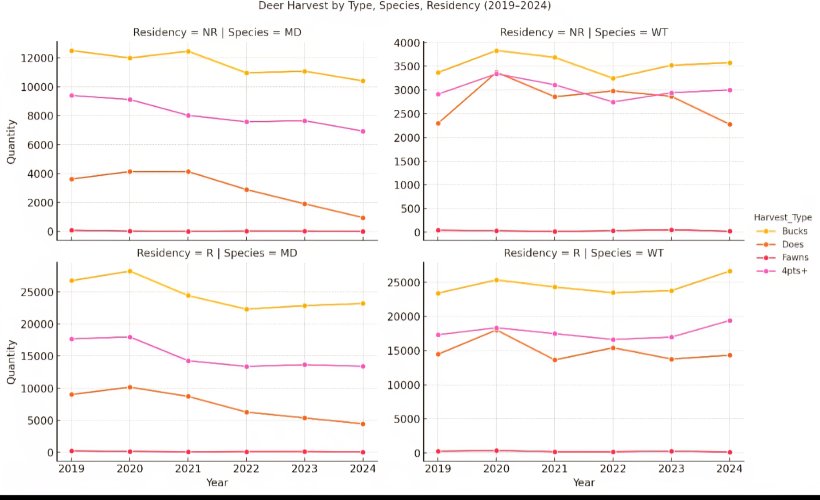
My caveman math was ignoring the second tag sales and assumptions regarding how many R would or wouldnt buy it.In 2019 NR killed over 1/3rd of the buck mule deer in the state and slightly more of the total population that includes does.

Given theyve only got 20 percent of the tags in "generous" wyoming.... thatd be mathematically impossible there. There is plenty of room to cut NR opportunity in Montana.

Going to LE is a big win for MD, R, and NR diy guys in terms of hunt quality.Screenshot_20250708_064128_ChatGPT.jpg
 
Last edited:
My caveman math was ignoring the second tag sales and assumptions regarding how many R would or wouldnt buy it.In 2019 NR killed over 1/3rd of the buck mule deer in the state and slightly more of the total population that includes does.

Given theyve only got 20 percent of the tags in "generous" wyoming.... thatd be mathematically possible there. There is plenty of room to cut NR opportunity in Montana.

Going to LE is a big win for MD, R, and NR diy guys in terms of hunt quality.View attachment 377451
I could easily be convinced to try LE, if someone put up some actually limiting numbers. So far the LE I see is more of a pick your district and all that does is limit residents.
I am all for limiting NR, but I just don't see any plan where residents step up and make up the funding difference.
I would love regional caps on NR if region 7 got a cut in NR. I just do not see that happening, more likely that region 7 will see and increase.
 
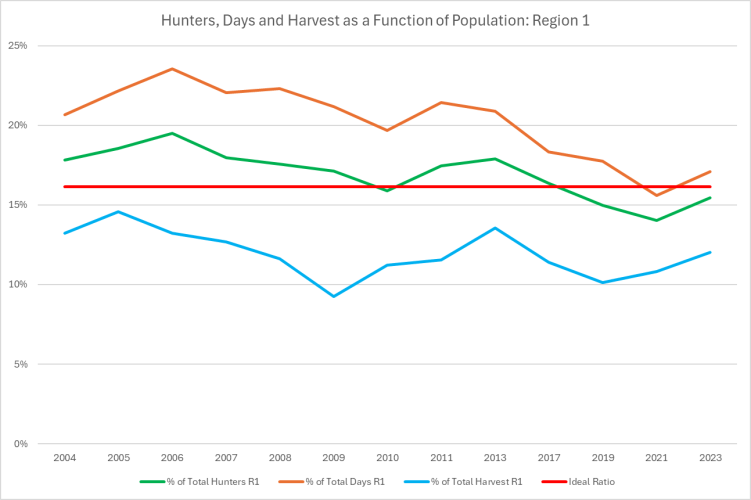
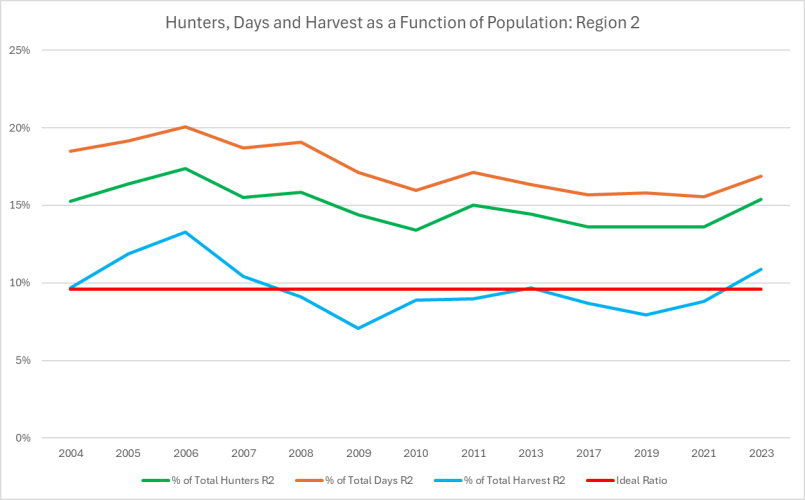
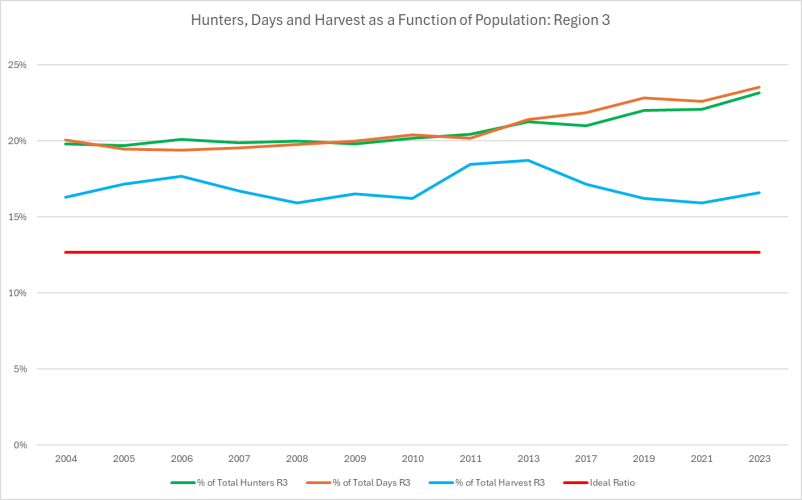
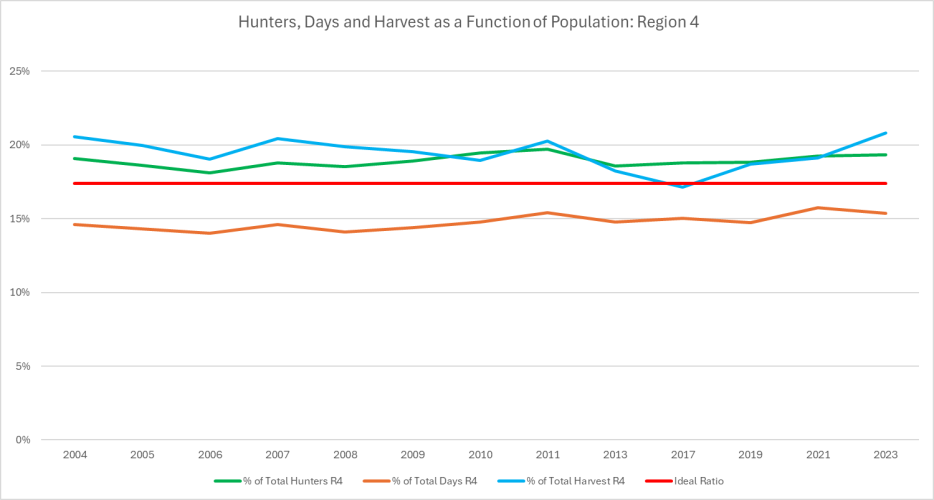
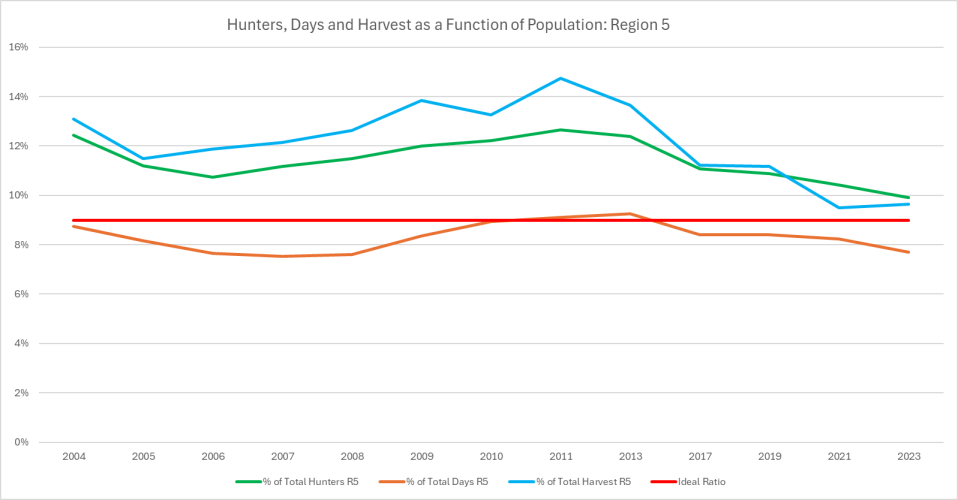
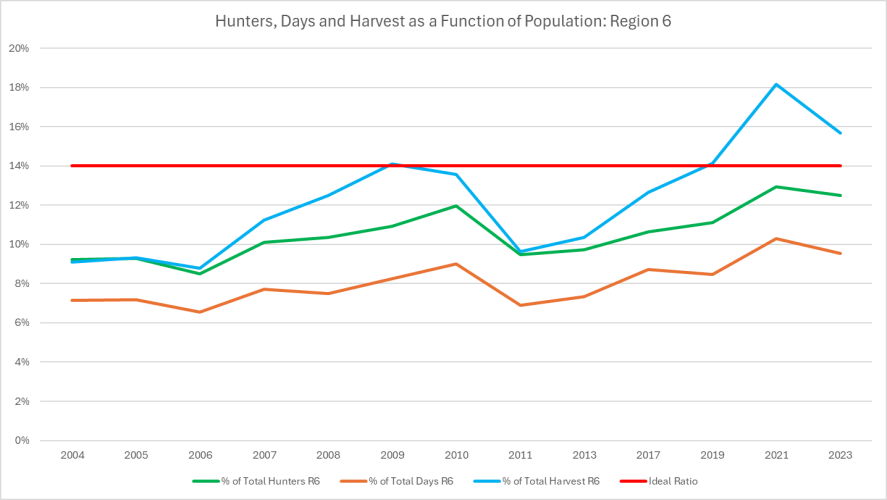
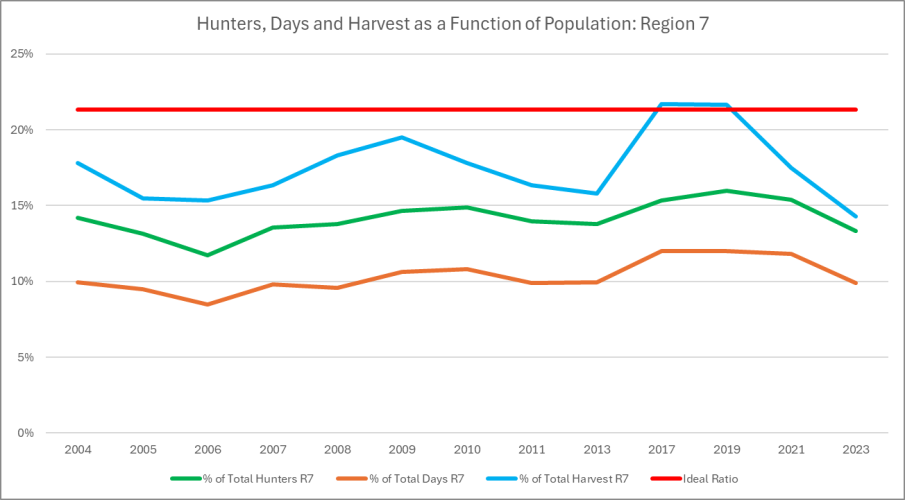
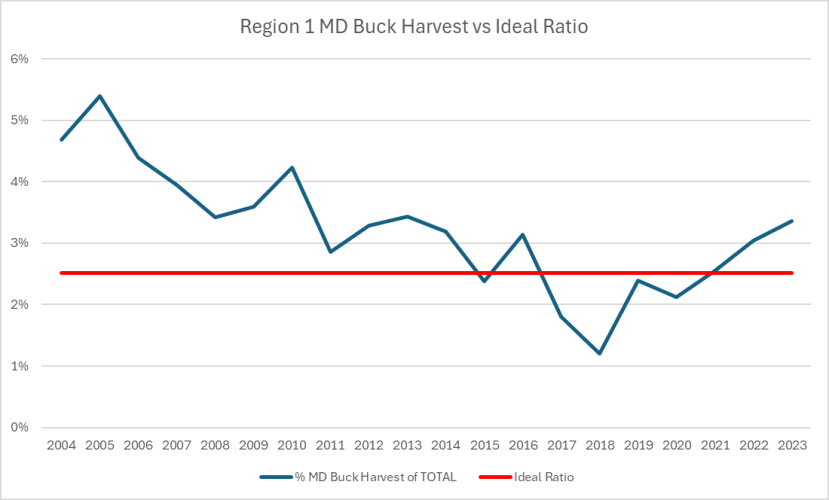
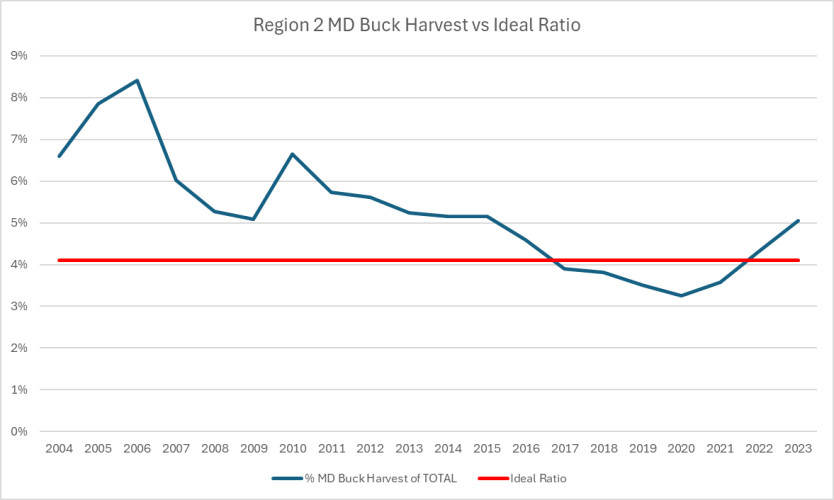
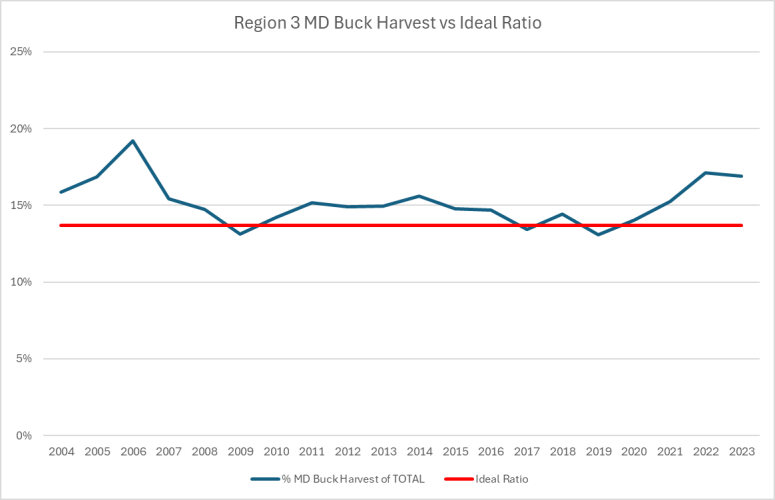
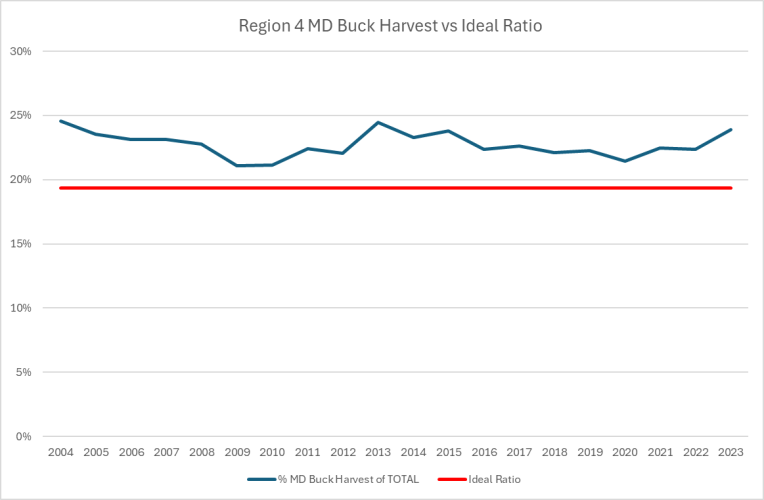
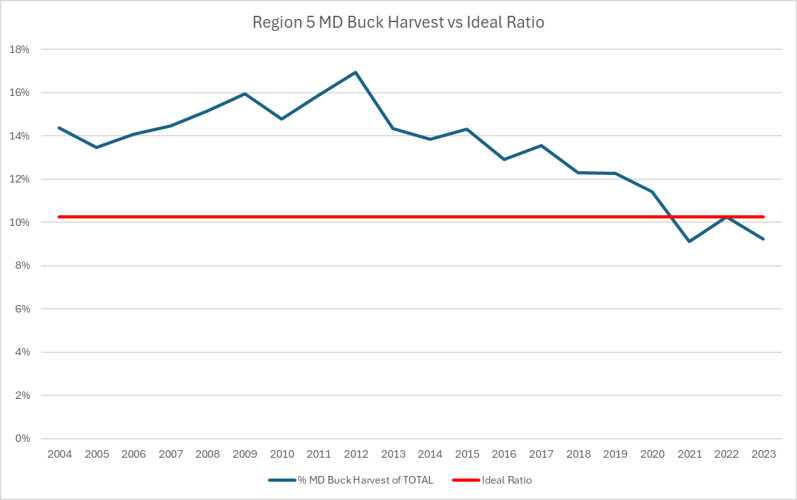
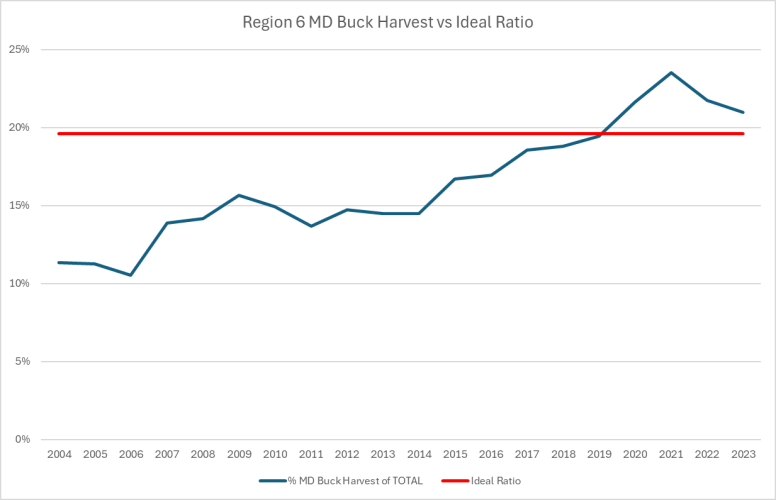
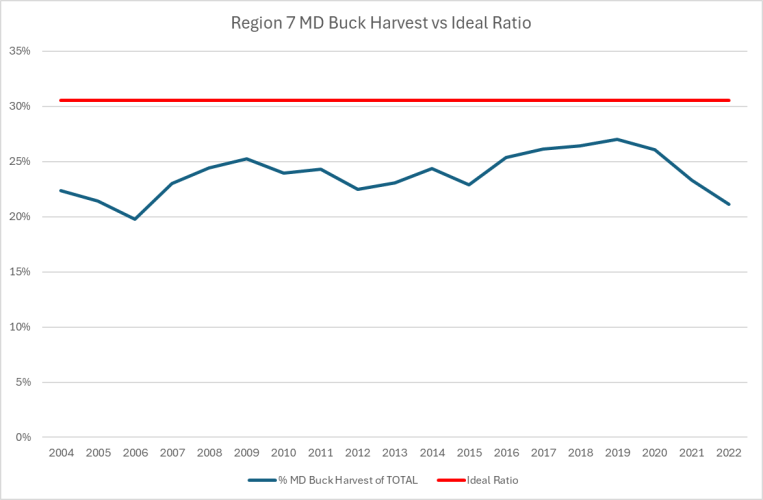
Attaching some figures that display % total hunters, % total hunter days, % total harvest vs the "ideal ratio" (the ratio of a regions deer population as a proportion of the whole). Also see the proportion of mule deer buck harvest as a function of regional population:

1751983173764.png
1751983200264.png
1751983211167.png
1751983226464.png
1751983240070.png
1751983257133.png

1751983269321.png

1751983281128.png
1751983291020.png
1751983303082.png
1751983315298.png
1751983326049.png
1751983339928.png
1751983351723.png
 
Here-in lies the problem with NR Regional caps only. Yes, NR are oversubscribed in R6 and R7, but residents are far undersubscribed. With NR caps you would push more pressure into regions like 3, 4, 5 that are already more crowded than 6 or 7. Unintended consequences or people just looking out for their region and not the whole state....

If capped, it should be NR & Residents.

As for the assumptions I made for the above graphs, I took the most recent LTA's (10 yrs isn't an LTA, but don't get me started on that) and broke them down regionally as a proportion for the "ideal ratio". Also, the first graphs are a function of all deer (whitetail and MD combined), whereas the final 7 are function of only MD.
 
Last edited:
With NR caps you would push more pressure into regions like 3, 4, 5 that are already more crowded than 6 or 7. Unintended consequences or people just looking out for their region and not the whole state....
I didn’t look closely at your graphs so maybe you have graphed this out as a basis for this statement but this doesn’t match my anecdotal experiences simply because of terrain, topography, canopy, and access. I’m not sure there is anywhere I can’t get to in a couple hours of walking in eastern Montana. You can’t say the same thing in region 3,4,5. I can still get away from people and find Hidey holes in 3,4,5 with some effort. You can’t do that in 6 and 7 unless you lease private land. Just food for thought on the statistics of regional caps. I don’t think any of this has a snow balls chance in hell of actually being implemented but if I did I think you could chop nr tag allocations up in a way to alleviate pressure. Again no one likes this comment but it is fact, the low pressure lands in 6 and 7 are private lands. So how do we get hunters distributed onto these lands? That’s where the answer lies. There are solutions. They come with trade offs that many don’t like.
 
So how do we get hunters distributed onto these lands? That’s where the answer lies. There are solutions. They come with trade offs that many don’t like.

Agreed. There is an obvious solution to this problem, and many on HT are not going to like it.
 
I didn’t look closely at your graphs so maybe you have graphed this out as a basis for this statement but this doesn’t match my anecdotal experiences simply because of terrain, topography, canopy, and access. I’m not sure there is anywhere I can’t get to in a couple hours of walking in eastern Montana. You can’t say the same thing in region 3,4,5. I can still get away from people and find Hidey holes in 3,4,5 with some effort. You can’t do that in 6 and 7 unless you lease private land. Just food for thought on the statistics of regional caps. I don’t think any of this has a snow balls chance in hell of actually being implemented but if I did I think you could chop nr tag allocations up in a way to alleviate pressure. Again no one likes this comment but it is fact, the low pressure lands in 6 and 7 are private lands. So how do we get hunters distributed onto these lands? That’s where the answer lies. There are solutions. They come with trade offs that many don’t like.
The low pressure lands in 3, 4, and 5 are private too....

If you can figure out a way to properly incentivize private land game harvest to "acceptable" levels you'll be Governor in the next election cycle
 
Agreed. There is an obvious solution to this problem, and many on HT are not going to like it.

As another point to consider here:

MT has lost about 2 million acres in Block Management over the last 20 years. Some of the most common reasons cited are:

1.) Hunter behavior
2.) Selling the property/property passes down and gets split
3.) Not getting the outcomes they had hoped for
4.) Leasing to hunt clubs

Since 2019, this has been the agency and state's response to that loss:
1.) Increase Block Management payments from $12.5K to $25K in 2021 and to $50K in $2023 to help make Block more competitive with leasing financially.
2.) Increasing the daily payment rate for BMA's
3.) Passage of SBs 83 & 441 in 2025 to increase enforcement tools for BMA cooperators and the agency. Rule making on these two new laws will commence shortly.
4.) Added shed hunting to criminal trespass laws
5.) Created another (hopefully) stable source for Block Mgt of funding through HB 145
6.) Passed the Puiblic Access to Lands Act in 2019

Since 2019, Block Mgt and PAL have opened up over 1 million acres of landlocked public land through incentive-based programs that let landowners work with the agency to help create new opportunities.

MT has also added the Big Snowies WMA, Great American Outdoors Conservation Easement (phase 1) and is working on adding another 500,000 acres of access through the habitat leasing program.
 
Last edited:

Latest posts

Forum statistics

Threads
117,783
Messages
2,168,660
Members
38,350
Latest member
hygt6q
Back
Top