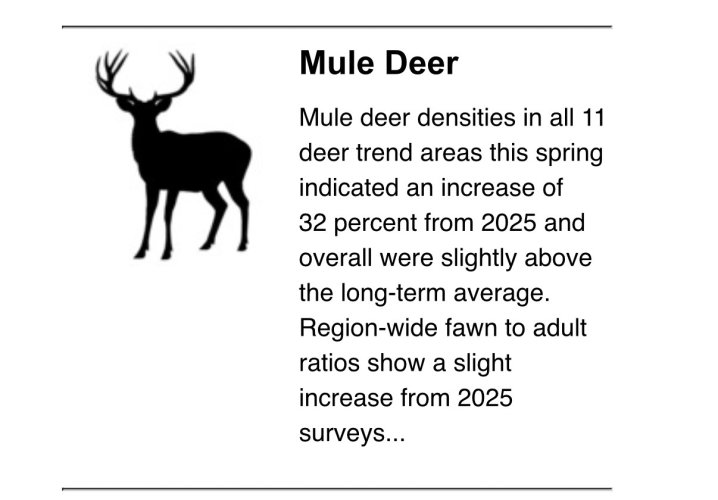
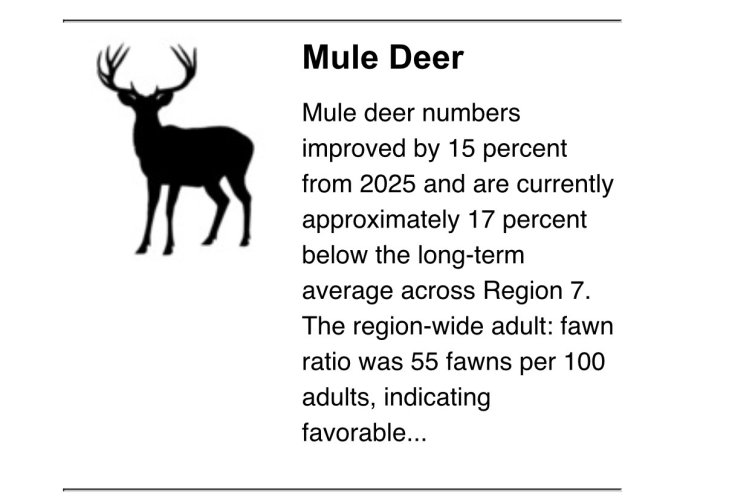
Montana Mule Deer Mismanagement

You’re spot on most of the time but completely out of touch on these 2 comments respectively,They are a huge seller and lots of times sell out quickly . It’s gotten to be a big thing .
Maybe so, I guess that there are more people out there with more money then sense than I thought. Would be interesting to know just how many people are booking a high priced cow hunt. # mandatory reporting or at least ask the question on the phone survey.
 
I think it would have to start very basic region 6 and 7 have the nonresident harvest data that shows harvest needs to be cut in half to get more in line with the other regions, when that doesn’t work residents need to be forced to pick a region. When that doesn’t work it goes limited entry like antelope where way to many tags are issued. When that doesn’t work we maybe shift the season a bit back into October. If I live to be 200 years old I can see it happening in my lifetime.
I can agree with all of this, I just worry that the solution to getting 6 and 7 in line with the rest of the state is going to be increase the number of resident hunters.
 
I can agree with all of this, I just worry that the solution to getting 6 and 7 in line with the rest of the state is going to be increase the number of resident hunters.
That’s where the next steps come in. Montana fwp isn’t going to move the only data we can use is there’s because ours is anecdotal and dismissed. Harvest stats in those two regions can’t be ignored or I should say it shouldn’t, it has been ignored for a long time. Fwp should have been on top of it.
 
I’m curious why you don’t think our season structure ie rut hunting drives age structure and what is left on the landscape? Are you seeing large older age class bucks make it to winter range? For 15 years, I have collected and sent in hunter harvested deer to Masons lab for age analysis. It backs up what @antlerradar has been saying about harvesting the young up and comers while passing for later years the bucks that don’t express nice antlers ie the old bucks aren’t the ones with nice antlers. I think a lot of the frustration you see in this thread with the season structure can be explained by that fact right there for better or for worse or right or wrong since I know when we start talking antlers everyone gets all hackled up but I think it’s worth understanding frustration points even if they are misplaced biologically speaking
I have a little bigger and longer running data set, my shed antler collection. I dug into the records last night and this morning. Here is what I found. The collection has shed antlers from 63 different top end MT. bucks from the 70's through the 90's. I or someone I know found at least two years worth of quality antlers from 39 of the 63; or 61%. When you bump it up to three years worth of quality antlers the number of bucks falls to 27 of the 63; or roughly 43%. In this century I have found antlers from 19 top end bucks, with 2/3's of those being in the first five years of the century. Two years worth of quality antlers were found from 7 of the 19; or 31% and I couldn't find three years worth of antlers from any of the 19 bucks. As you have stated, there are still some bucks living longer. I have seen them and found multiple years worth of their antlers even in recent years. Most have been on private, but some have been public land bucks. Old bucks are out there, just not old bucks with even nice antlers. The number of top end bucks that are living long enough to grow and shed two good sets of antlers has crashed in the last 20 years. Top end bucks older than that are unicorns. We are absolutely selecting the top end bucks out of the herd at a relatively young age. The antler collection also indicates potential is reached at around age 6. Today in SE MT virtually none of the top end bucks are reaching that age, unless they are spending the season on private land that is not hunted.

 
Last edited:
I have a little bigger and longer running data set, my shed antler collection. I dug into the records last night and this morning. Here is what I found. The collection has shed antlers from 63 different top end MT. bucks from the 70's through the 90's. I or someone I know found at least two years worth of quality antlers from 39 of the 63; or 61%. When you bump it up to three years worth of quality antlers the number of bucks falls to 27 of the 63; or roughly 43%. In this century I have found antlers from 19 top end bucks, with 2/3's of those being in the first five years of the century. Two years worth of quality antlers were found from 7 of the 19; or 31% and I couldn't find three years worth of antlers from any of the 19 bucks. As you have stated, there are still some bucks living longer. I have seen them and found multiple years worth of their antlers even in recent years. Most have been on private, but some have been public land bucks. Old bucks are out there, just not old bucks with even nice antlers. The number of top end bucks that are living long enough to grow and shed two good sets of antlers has crashed in the last 20 years. Top end bucks older than that are unicorns. We are absolutely selecting the top end bucks out of the herd at a relatively young age. The antler collection also indicates potential is reached at around age 6. Today in SE MT virtually none of the top end bucks are reaching that age, unless they are spending the season on private land that is not hunted.

A 4 point dies no matter what. Thanks for the info. Sure shows the decline. mtmuley
 

Latest posts

Forum statistics

Threads
119,890
Messages
2,242,159
Members
39,047
Latest member
honzo
Back
Top