

Montana Mule Deer Mismanagement

Seems Mule deer are in good shape in Eastern MT

 
I rewrote this a couple of times to be less sarcastic and more... constructive.

"Overall, recruitment ratios are strong, and this year’s surveys showed 55 fawns per 100 adults, which is only 5 percent below the long-term average."

- That is worded far more optimistically than I would have.

"With survey data going back over four decades, FWP has observed lows in 1988, 1997, 2012, and recently in 2023"

- This fails to mention how every low has been lower, and every high in between has also been lower.

"...although mule deer numbers south of the interstate remain well below average, deer densities there are still higher than those observed north of the interstate at a broad landscape scale."

- I fail to see how this is a positive. It may just be an attempt at providing hunters with some direction in where to look, but I'm not seeing the cause for excitement.


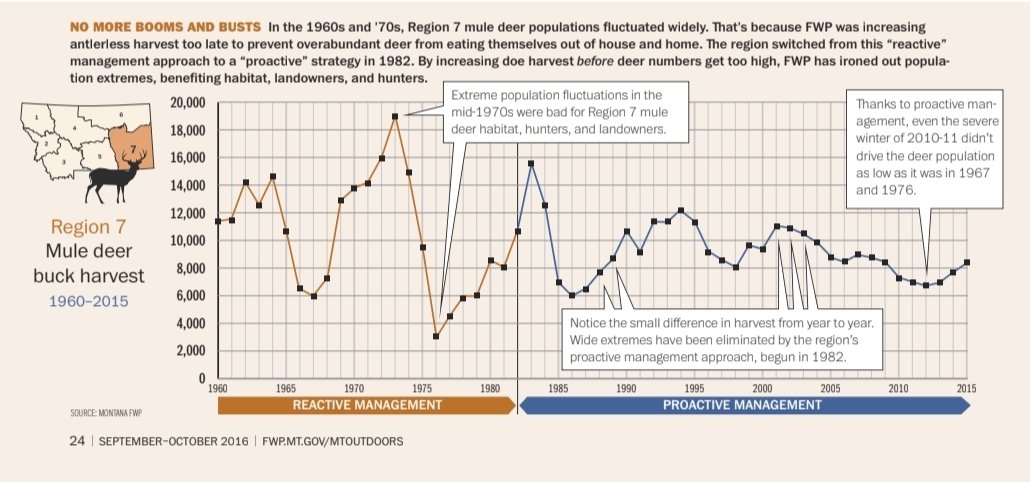
I feel like we're all looking at the same data, and the majority of those on this forum are saying "finally, some hope the population might recover", while FWP may be eyeing this as a "Let's knock them down before they get out of control" situation. I would like to see a single chart, from 1970 to today, of both fawn recruitment and total deer population graphed together. Just to satisfy my own curiosity. I would also like FWP to keep antlerless harvest restricted to private-land only, and highly restrict antlerless tags, if they happen to read this.

My parting thoughts: what is the breakeven fawn recruitment for a stable population, with Zero doe harvest? What recruitment would we need to see (both in fawn:doe and total fawns) to grow the population? And last, but certainly not least- what is the actual population goal, and what does that look like for hunting quality?
 
I rewrote this a couple of times to be less sarcastic and more... constructive.

"Overall, recruitment ratios are strong, and this year’s surveys showed 55 fawns per 100 adults, which is only 5 percent below the long-term average."

- That is worded far more optimistically than I would have.

"With survey data going back over four decades, FWP has observed lows in 1988, 1997, 2012, and recently in 2023"

- This fails to mention how every low has been lower, and every high in between has also been lower.

"...although mule deer numbers south of the interstate remain well below average, deer densities there are still higher than those observed north of the interstate at a broad landscape scale."

- I fail to see how this is a positive. It may just be an attempt at providing hunters with some direction in where to look, but I'm not seeing the cause for excitement.


I feel like we're all looking at the same data, and the majority of those on this forum are saying "finally, some hope the population might recover", while FWP may be eyeing this as a "Let's knock them down before they get out of control" situation. I would like to see a single chart, from 1970 to today, of both fawn recruitment and total deer population graphed together. Just to satisfy my own curiosity. I would also like FWP to keep antlerless harvest restricted to private-land only, and highly restrict antlerless tags, if they happen to read this.

My parting thoughts: what is the breakeven fawn recruitment for a stable population, with Zero doe harvest? What recruitment would we need to see (both in fawn:doe and total fawns) to grow the population? And last, but certainly not least- what is the actual population goal, and what does that look like for hunting quality?
I think around 50-60 fawns : 100 does is the replacement rate, approximately.
 
With the drought in eastern MT worse than it’s been since before the 80’s according some of our local farmers anyways, and the fact that the number of hunters out here won’t be less….Yikes!
 

Forum statistics

Threads
119,174
Messages
2,219,089
Members
38,798
Latest member
benbhunter11
Back
Top