Moisture In Primers? Failure to Ignite

Hams42

Active member
Joined
Jun 3, 2020
Messages
102
Location
Billings Montana
So I've had about a dozen Primers fail to ignite out of the last 100 rounds I've loaded. I have tried three different boxes and two different guns and still have the issue. I think moisture may have gotten into my Primers. Anyone had any luck drying them or do I have a pile of Primers with random duds?
 
So I've had about a dozen Primers fail to ignite out of the last 100 rounds I've loaded. I have tried three different boxes and two different guns and still have the issue. I think moisture may have gotten into my Primers. Anyone had any luck drying them or do I have a pile of Primers with random duds?
Chuck em. mtmuley
 
I concur with mtmuley.

Assuming you’ve made sure they were seated properly, flash holes clear, proper primer strikes, etc.

I’ve had primers stored poorly I thought for sure wouldn’t fire still function. However, I know it can happen. Sucks that you had it happen.
 
I concur with mtmuley.

Assuming you’ve made sure they were seated properly, flash holes clear, proper primer strikes, etc.

I’ve had primers stored poorly I thought for sure wouldn’t fire still function. However, I know it can happen. Sucks that you had it happen.
I thought it was the gun I was using. I have only had one with my other rifle not go off. Im not positive that there is moisture in them all i know is I've had some duds. I am going to do some more checking on other possibilities before I toss them since I have like 8000. I have had them in my attached garage so the moisture would just be from the air.

I have changed my storage system since suspecting them to have moisture in them.
 
I wouldn’t get rid of 8k primers unless I was confident that something was wrong with them and not the gun I was trying to use.

Do you know you had them seated well, good firing pin strike?
 
do the primers have a good strike mark on them or are they light strikes?

Also are the primer pockets clean and the primers seated fully?
 
do the primers have a good strike mark on them or are they light strikes?

Also are the primer pockets clean and the primers seated fully?
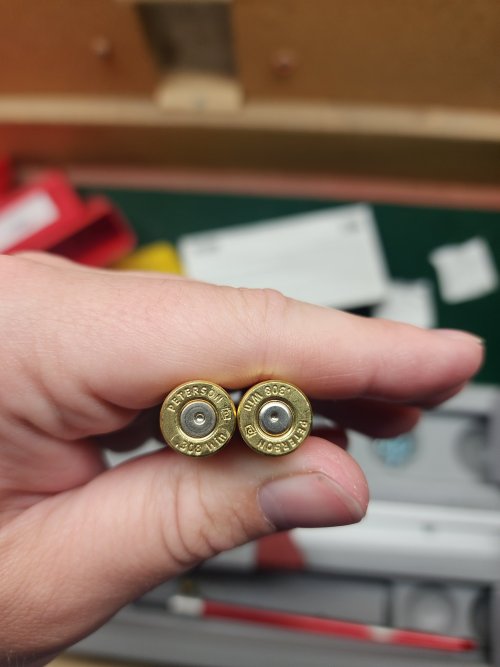
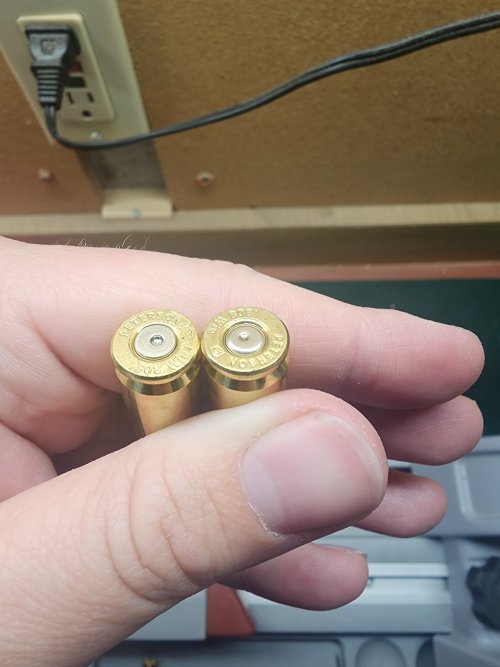
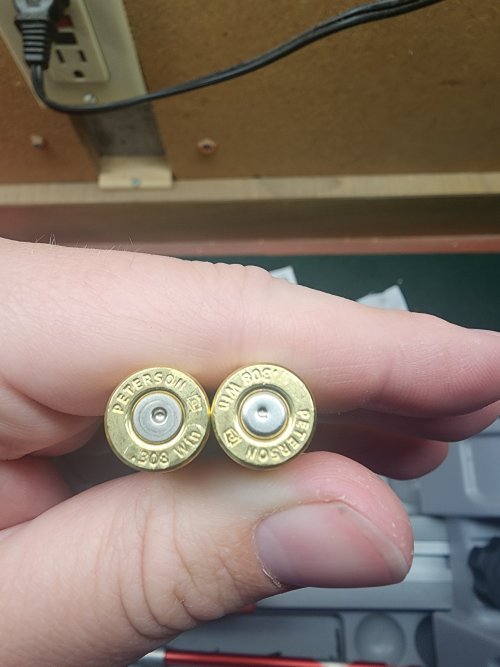
So when I originally looked at the range I thought it looked like a good strick but I just compared it to one that went off and it looks a little light. Left one went off right one didn't.
 

Attachments

  • 20250717_203250.jpg
    20250717_203250.jpg
    1.1 MB · Views: 48
  • 20250717_203310.jpg
    20250717_203310.jpg
    936.5 KB · Views: 47
  • 20250717_203316.jpg
    20250717_203316.jpg
    939.5 KB · Views: 47
I wouldn’t get rid of 8k primers unless I was confident that something was wrong with them and not the gun I was trying to use.

Do you know you had them seated well, good firing pin strike?
I will say that the two guns used were Bergara MG Micro Lite's. I had lots of issues with the first one I had in 6.5 PRC (more than rounds not going off). And I got a replacement gun in .308 and have had about dozen not go off. I have loaded about 300 in my wife's 6.5 Creedmoor and have had no issues. I wonder if Bergara has a flaw in their Premier action firing pins?
 
I can’t say whether it’s Begera or not. Any maker can have some issue though.

Maybe try disassembling the bolt and cleaning it. See if that helps.

It looks and sounds like it is more likely the firearm than the primer.
 
I can’t say whether it’s Begera or not. Any maker can have some issue though.

Maybe try disassembling the bolt and cleaning it. See if that helps.

It looks and sounds like it is more likely the firearm than the primer.
I have done that once about 2 months ago when my suspicion was the bolt. I may see if I can't find a replacement spring that's a tad stronger and see if it fixes the problem.
 
Do not throw away "wet" primers. Dry them out. All primers are kept wet during manufacturing. The last step is drying and packaging.
Unless the water has been mixed with motor oil. Motor oil soaking is the prescribed method of killing primers before disposal. This is right in the Speer manual.

I have used primers which have been wet and then dried. I repackage them in old primer slip boxes and mark them with blue painter's tape. Each one I put in a cartridge gets a circle with a blue sharpie pen so they don't get back in my other ammo or primer stock. I will use them for workups and range fodder loads, but not "make-or-break" loads for self defense or hunting.

Every spring I find tons of .22 LR ammo at the range that has been in the snow and rain all winter. More than half of those will fire after I dry them out. I usually put a bunch of them upright in a jar lid and put them under a lamp overnight. I like them for defense pistol practice because I don't know when I will get a misfire. It gives me real time TRB (Tap,Rack,Bang) training.

So when I originally looked at the range I thought it looked like a good strick but I just compared it to one that went off and it looks a little light. Left one went off right one didn't.
These really look like light strikes. My first guess is seating inconsistencies. I had plenty of these when I first started hand loading. Forget "precision" primer seaters. All cases can have different primer pockets. Especially if you get too aggressive cleaning primer pockets. Old carbon in a primer pocket means nothing as long as the vent hole is clear and the primer seats. We should all learn to seat primers by feel. Speer #10 says a primer should be about .006" below the base of the case. With experience you can feel when it bottoms out.

Speer #10 also describes that you can actually get light strikes from high primers also. If you look at a primer new out of the case, the anvil is not flush with the cup. We drive it flush when we seat it. If we underseat the primer, the anvil is still a little up from the rim of the cup. The first pin strike drives the primer down onto the anvil, but does not fire it. If you strike it a second time and it fires this is often the cause.

This is why I don't use case blocks when I load. I stand my cases up on my epoxied bench top. Any cases with underseated primers are immediately evident. They will tip or wobble.

 
Last edited:
So I've had about a dozen Primers fail to ignite out of the last 100 rounds I've loaded. I have tried three different boxes and two different guns and still have the issue. I think moisture may have gotten into my Primers. Anyone had any luck drying them or do I have a pile of Primers with random duds?
Brass FL over sized with too much headspace can do EXACTLY this. The shoulder moves forward reducing firing pin energy strike on the primer. Do you measure fired brass headspace to insure ONLY 0.002-0.003 setback of shoulder? I would evaluate this load step first. This is a very normal oops. I have shot primers soaked in WD40 for a week as my own personal test, they ALL went bang no problem.
 
As others have said, check seating depth of primers and headspace before throwing out the primers.

I've had a few issues with cartridges not firing and it was never an issue with the primer. Headspace and primers not fully seated are usually the culprit.
 
Brass FL over sized with too much headspace can do EXACTLY this. The shoulder moves forward reducing firing pin energy strike on the primer. Do you measure fired brass headspace to insure ONLY 0.002-0.003 setback of shoulder? I would evaluate this load step first. This is a very normal oops. I have shot primers soaked in WD40 for a week as my own personal test, they ALL went bang no problem.
Great answer.

If you need a tool for this, the L.E. Wilson go/no-go ammo gage is awesome for checking re-sized cases or finished ammo.
Here is the factory website, but I get mine from Brownell's or Midway.

 
Last edited:
If after all the tinkering with the rifle, sizing brass etc. and you still get failure to fire, these would become range primers only. Some of them go off, so at least you're not tossing out a couple hundred bucks worth of primers, just use them for range practice where it wont matter. But, IME, this is a brass sizing issue causing excess headspace. Disassemble, clean your die, re assemble and start it way long, adjusting down until a fired case gets sized just enough for the bolt to drop on its own weight (with firing pin removed). Lock it down and load away. If you keep sizing it down to meet some arbitrary .002" or.003" bump you read about online, you very well can be over sizing your brass. The goal is for the brass to fit YOUR chamber, not some magic bump number. I had the exact same problem way back when I started gunsmithing and chambering barrels and it took a bit to narrow down the issue. Not saying this is the exact cause, but more than likely, this will end up being the problem.
 
I will start with the sizing step. I measure the OAL of the case but haven't been measuring to the shoulder.

I appreciate everyone's help on this matter. Its always as soon as I think I know what I'm doing I run into a problem like this. All of the experience from you guys is a God send for a guy like me. Still a novice reloader after 7 years!
 
I will start with the sizing step. I measure the OAL of the case but haven't been measuring to the shoulder.

I appreciate everyone's help on this matter. Its always as soon as I think I know what I'm doing I run into a problem like this. All of the experience from you guys is a God send for a guy like me. Still a novice reloader after 7 years!
Measuring the brass, while helpful, does not do anything to show you how it fits the chamber in your rifle other than how much your dies change from fired, to sized. Its strictly a comparative number. What you are after, especially in a hunting rifle, is reloaded ammo that fits the chamber without any resistance, every time, but is sized just enough to not create an excess headspace that will allow your ammo to move under the impact force created by the firing pin momentum. Factory chambers are usually on the high side of headspace already, just to ensure all standard spec factory ammo will fit. So, even just a couple of thousandths will have an impact on how your reloads will chamber. That's why I say, adjust using the bolt and trial fitting and not just relying on measurements of fired vs sized brass.
 
Agree with others, check the amount of shoulder bump vs fire formed brass. 1x fired brass very well might not be fully formed to chamber yet as well if headspace is a bit generous.

Second thing I would question is the ignition system. Is firing pin protruding enough and is it hitting with enough energy? Is there anything causing resistance or binding in the system?
 
I had a similar issue in that the round that didn’t fire had a lighter strike that the ones that did fire. This was in an older Ruger M77. I had the bold disassembled, cleaned and a new spring installed. That fixed my issue. Hope you can get it resolved
 

Latest posts

Forum statistics

Threads
117,770
Messages
2,168,081
Members
38,346
Latest member
nrspence
Back
Top